Ethiopia, Kenya and Rwanda all measure their 2035 mitigation pledges against projected emissions. The countries rely on different measures and expect international support to deliver a substantial share of the cuts.
Their plans also put irrigation, early warning and safer settlements alongside the work of reducing emissions.
Three Pledges With Distinct Delivery Priorities
Ethiopia’s 2035 climate plan hinges on how much carbon its land can absorb. Its submission attributes just over three-quarters of the modelled reduction under its full-support pathway to land use and forestry. Livestock remains its largest source of greenhouse gas emissions in that scenario.
Kenya’s second nationally determined contribution (NDC) sets out how many tonnes it aims to avoid through domestic measures and how many depend on outside support. Rwanda’s NDC 3.0 also quantifies the gap between the two pathways. Each plan starts from a national projection of business-as-usual emissions in 2035.
The three plans were filed in 2025. Kenya submitted on 30 April, Ethiopia on 26 September and Rwanda on 8 December. Their pledges provide a basis for following investments in land, power and public services. For smallholder farmers and city residents, the clearest evidence of delivery may come from more reliable water supplies and better protection from floods and landslides.
How Much Each Country Would Avoid
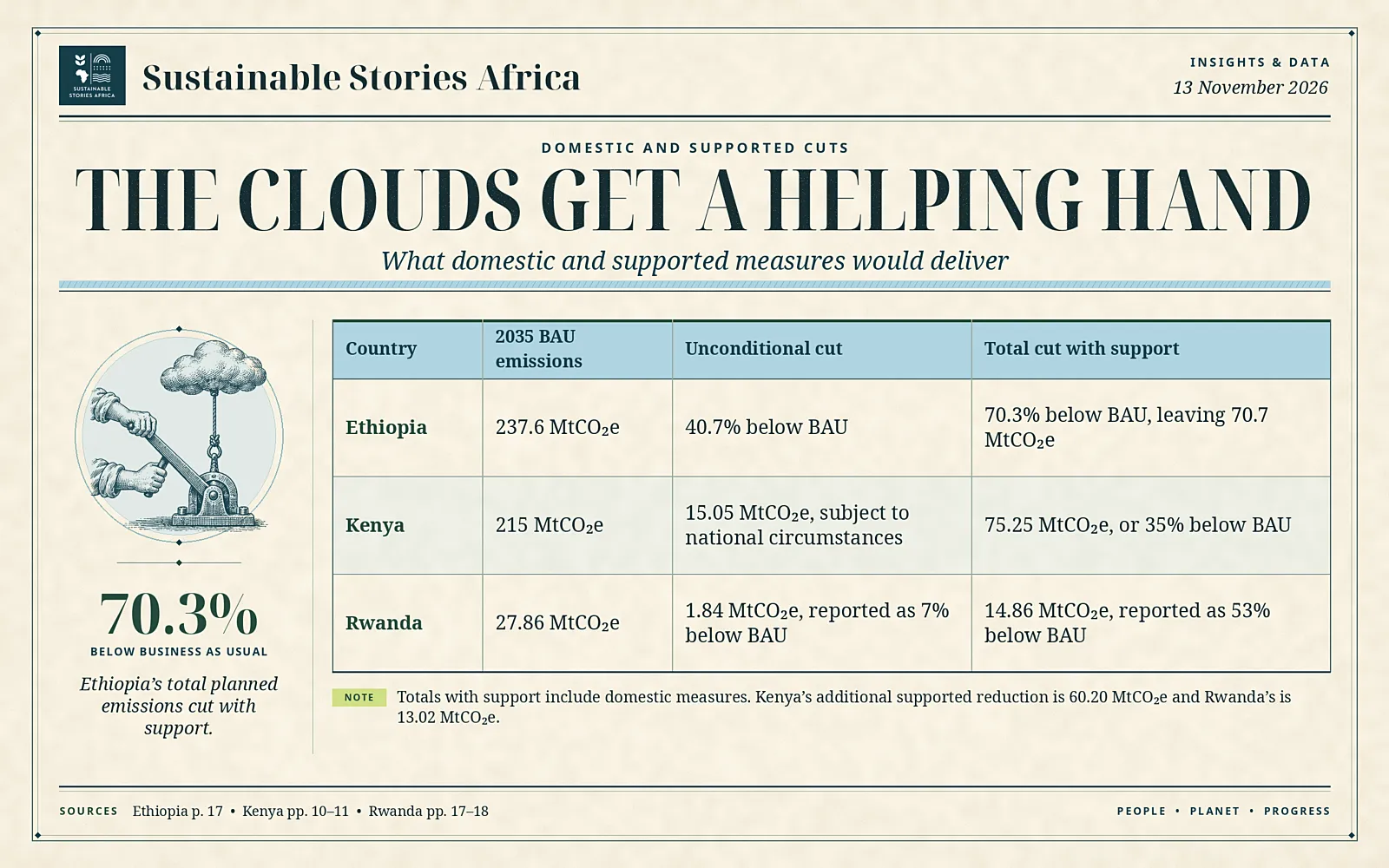
Ethiopia projects net emissions of 237.6 million tonnes of carbon dioxide equivalent (MtCO₂e) in 2035 under its reference case. The unconditional pathway puts that figure at 140.8 MtCO₂e. With the full set of measures, the submission projects 70.7 MtCO₂e, or 70.3% below the reference case. The lower pathway depends on international support and assumes much greater carbon removals from land and forestry.
Kenya aims to avoid 75.25 MtCO₂e in 2035 against projected emissions of 215 MtCO₂e. It expects domestic resources to support 15.05 MtCO₂e of reductions, subject to national circumstances. The remaining 60.20 MtCO₂e depends on a mix of international support, investment, technology, capacity building and participation in carbon markets. The domestic and additional supported portions account for 20% and 80% of the planned reduction respectively.
Rwanda’s reference case projects 27.86 MtCO₂e in 2035. The domestic package would avoid 1.84 MtCO₂e. The additional conditional measures could avoid another 13.02 MtCO₂e, leaving national net emissions at 13.00 MtCO₂e if all measures are implemented. Rwanda reports the combined reduction as 53% below business as usual.
A modelled reference case represents a possible future. Rwanda’s submission estimates net emissions at about 4.2 MtCO₂e in its 2015 base year. Its fully implemented 2035 plan still projects 13.00 MtCO₂e. The target therefore represents slower growth in net emissions than under business as usual. Showing the historical year alongside the modelled pathways makes the scale of that growth visible.
Why Land And Energy Both Matter
Ethiopia’s model already incorporates earlier restoration and afforestation initiatives in the reference scenario. Under the full-support pathway, it expects the land-use and forestry sector to remove a net 155.3 MtCO₂e in 2035, compared with a net removal of 26.6 MtCO₂e under the reference case. The value of that contribution depends on the survival and continued growth of restored forests and on how the country estimates removals. Livestock emissions require separate measures, including improvements in production practices.
Kenya’s plan aims for renewable generation on the national grid to move towards 100% by 2035. It also includes measures for cleaner cooking, transport and industry. A cleaner grid can lower emissions when vehicles and equipment switch to electricity. The gains depend on how much clean power the grid supplies and how affordable the switch is for businesses and households.
Rwanda’s plans for restoration, agriculture and urban development show how land use affects adaptation as well as emissions. Its submission envisages restoring nearly 70,000 hectares of forest by 2035. Forest recovery can help protect watersheds and moderate runoff. Tracking the condition of restored sites and the quality of land management over time would help establish whether those benefits endure.
Kenya’s previous contribution targeted a 32% reduction against its 2030 projection. The second submission moves the headline to 35% against a 2035 projection and uses 2022 as the base year for its modelling. Comparing what the new plan adds requires following the policies that underpin each reference case as well as the number of tonnes that each package could avoid.
Where Adaptation Reaches Farms And Cities
Ethiopia aims to expand climate-smart irrigation from 0.49 million hectares in 2020 to about 1.8 million hectares by 2035. It pairs that expansion with solar pumping, catchment rehabilitation and measures to recharge aquifers. For farmers managing more erratic rains, the value of new irrigation will depend on water availability during dry spells and whether the infrastructure stays in service.
Kenya makes locally led adaptation part of its national and county response. Its priorities include drought and flood warnings, water storage and agricultural extension. County authorities can use local knowledge to decide where a warning service or new water infrastructure would make the greatest difference. Progress measures can then show how many people receive and can act on that service.
Rwanda aims to reduce the share of Kigali residents living in unplanned settlements from a reported baseline of 60% to 44% by 2035. It also plans multi-hazard early warning that reaches all 30 districts. Those measures respond to distinct problems. Warnings give residents time to act, while decisions on housing and land use shape their exposure for years. Tracking both can reveal whether urban growth is reducing risk.
The three submissions also show why adaptation projects need their own investment plans. Irrigation and water storage require maintenance. Warning services need equipment, trained staff and regular updates. A district can track the service it delivers each year, while national ministries can use those reports to decide which investments can be expanded and where a project needs to be redesigned.
How Financing Can Support Credible Delivery
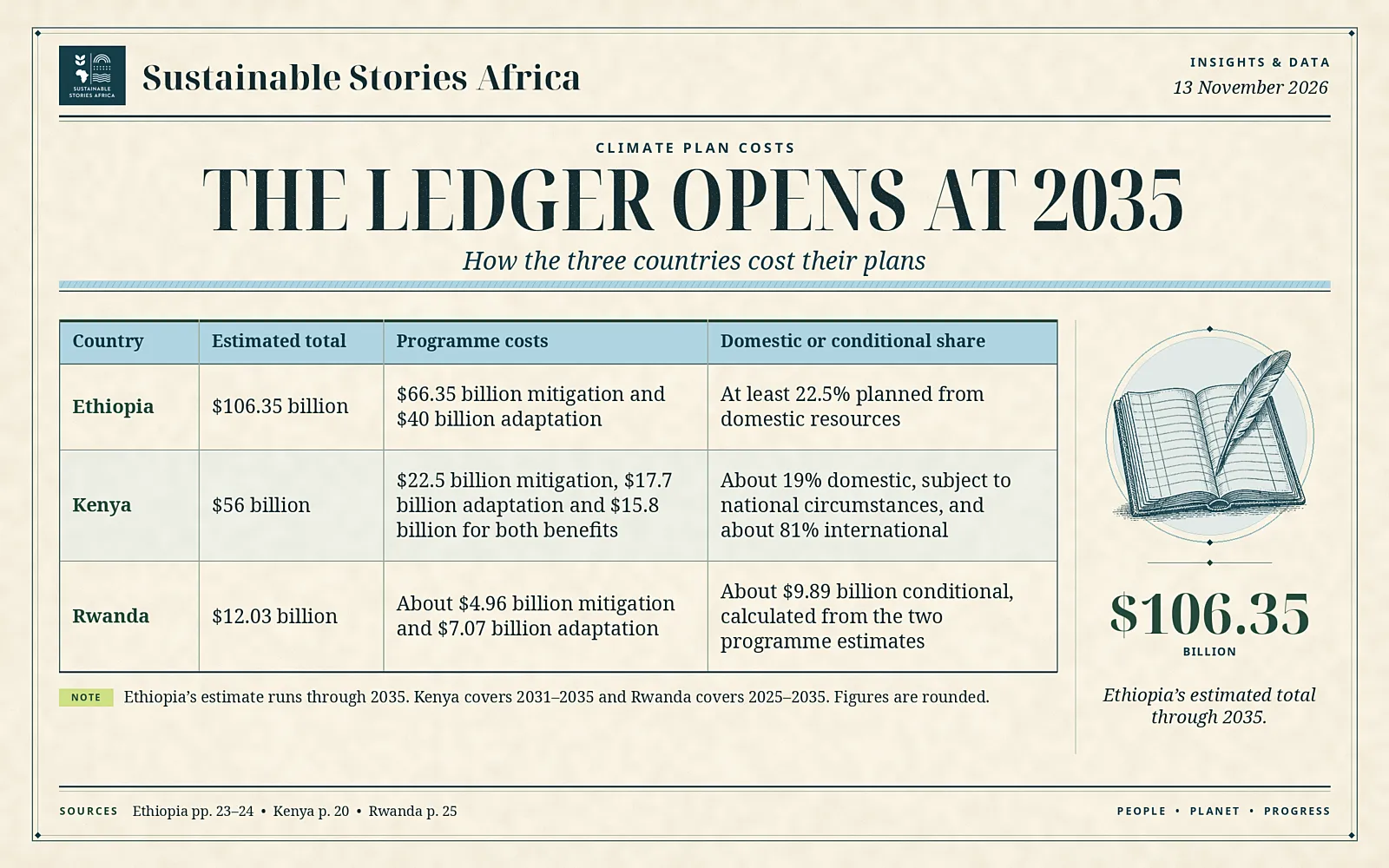
Ethiopia estimates US$106.35 billion in financing needs and commits to mobilising at least 22.5% domestically. Kenya estimates US$56 billion for 2031–2035 and aims to cover about 19% through its domestic contribution, subject to national circumstances. Kenya counts loans towards that contribution because taxpayers bear the repayment obligation. Rwanda’s costing tables distinguish domestic and conditional measures for both mitigation and adaptation.
Investment plans can turn those totals into a sequence of decisions. Finance ministries can name the agencies responsible for procurement, publish funding terms and report what reaches districts or utilities. For projects designed to cut emissions and reduce climate risk, Kenya’s separate budget line for measures with both benefits helps show the scope of the estimate. A project can report both benefits without counting the same expenditure twice.
International cooperation through carbon markets introduces a further accounting decision. Kenya envisages setting aside a share of mitigation outcomes for its own target. Publishing how credits are authorised and accounted for would allow buyers and citizens to see which reductions remain available to count towards Kenya’s pledge.
Rwanda estimates that about US$9.89 billion of the cost of its mitigation and adaptation measures is conditional. The estimate follows from adding the two conditional entries in its financing table. Different parts of the programme will draw on different sources. A utility may be able to attract investment in an energy project, while protecting an exposed settlement may call for more public or concessional funding.
What Governments Can Report By 2035
Track Ethiopia’s land removals and livestock emissions separately, Kenya’s domestic and internationally supported reductions in tonnes, and Rwanda’s progress on the measures behind its combined target.
For adaptation, publish results where people use the services. Irrigation that operates through a dry season, timely county warnings and safer settlement patterns can show how the plans are reducing risk.
Headline Options
Sustainable Stories Africa How Ethiopia, Kenya and Rwanda Plan to Meet Their 2035 Climate Pledges
Bloomberg Ethiopia, Kenya and Rwanda Seek Climate Finance to Meet Their Emissions Targets
Time Magazine How Three African Climate Plans Could Change Farms and Cities by 2035
WSJ Three East African Climate Plans Link Emissions Goals to Outside Financial Support
Financial Times East African Climate Pledges Tie Emissions Goals to Land Restoration and Finance
Sources and Data Notes
Ethiopia NDC 3.0 • PDF pp. 17–18, 21 and 23–26, especially Tables 2–4
Kenya’s Second NDC • PDF pp. 10–11, 13–14 and 20, especially sections 3.1, 3.2 and 5
Kenya’s updated first NDC • Updated first NDC, 2030 target
Rwanda NDC 3.0 • PDF pp. 16–18 and 21–25, especially Tables ES-1 and ES-2
UNFCCC NDC Registry • Submission dates and titles