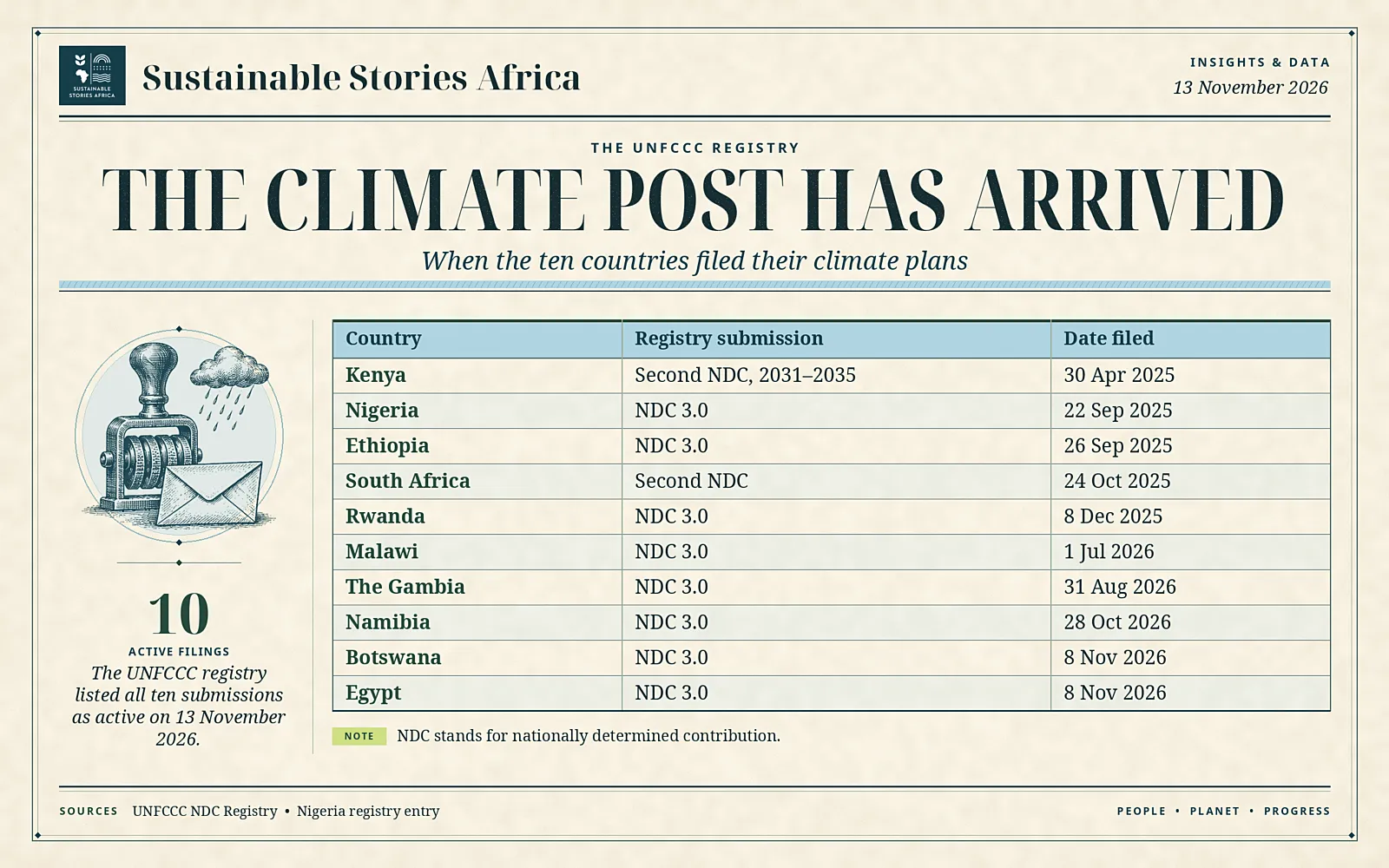
Ten African countries in this review have registered climate plans with the UN. Botswana and Egypt filed theirs on 8 November, a day before COP31 opened in Antalya.
All ten plans set targets for 2035. The figures tell different stories depending on how governments count emissions, which measures they can deliver domestically and where they need international support.
Ten Climate Plans With Different Baselines
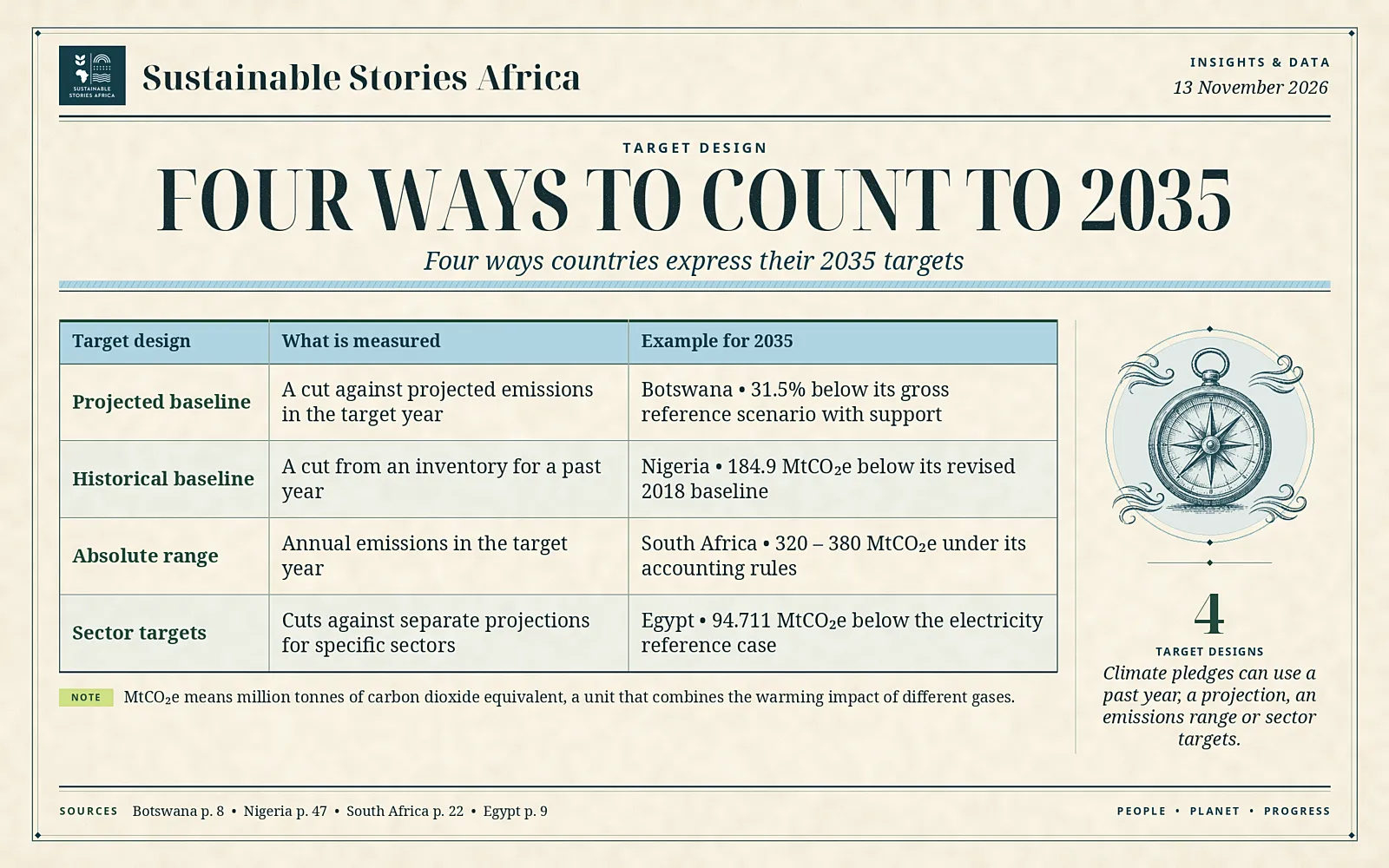
Botswana says it can hold its 2035 greenhouse gas emissions 31.5% below its projected path with international support. Nigeria plans to cut emissions by 32.2% from an actual historical reference year. Read together, the percentages look almost identical. The national outcomes they describe are markedly different.
That distinction matters as governments gather for COP31 in Antalya, Türkiye, from 9 to 20 November 2026. The UN climate registry lists all ten submissions covered in this pack as active. Five were filed in 2025 and five in 2026. Kenya and South Africa call theirs second nationally determined contributions. The other eight use the title NDC 3.0.
A nationally determined contribution, or NDC, sets out the climate action a country intends to take under the Paris Agreement. For a household exposed to flooding, what matters is whether drainage improves and warnings arrive in time. For a government or lender, the NDC sets the direction for the investment and public services that can make those improvements possible.
What Paris Requires Governments To Do
Article 4 requires each party to prepare, communicate and maintain successive NDCs and to pursue domestic measures aimed at achieving their mitigation objectives. Parties communicate an NDC every five years. The agreement calls for each successive contribution to go beyond the one before it and reflect the country’s highest possible ambition in light of its circumstances.
Countries determine their own contributions. The parties encouraged a 2035 end date for plans communicated in 2025 under Decision 6/CMA.3. Kenya and South Africa specify implementation periods from 2031 to 2035. Namibia’s plan covers 2026 to 2035, with 2030 as an interim milestone. A shared end year makes it easier to line up deadlines across plans even when the delivery periods differ.
The five-year cycle sits alongside the agreement’s longer-term objective of holding warming well below 2°C and pursuing efforts to limit it to 1.5°C above pre-industrial levels. That temperature goal applies globally. Governments explain what they consider a fair national contribution in light of their circumstances. Domestic implementation then determines what the country contributes in practice.
How To Read The Emissions Numbers
Business as usual, often shortened to BAU, is an estimate of future emissions under a set of assumptions. It can change when a government updates its forecasts for electricity demand, its inventory or the policies already assumed in the reference case. A cut below BAU shows how much emissions could be avoided against that projection. It can coincide with higher emissions than in an earlier year. Botswana’s full-support pathway leaves 2035 emissions about 6% above its 2022 inventory on the same gross basis.
A historical baseline asks how far emissions change from a fixed reference year. Nigeria’s target uses a revised 2018 inventory. South Africa specifies a range for annual emissions in 2035. Egypt gives quantified reductions for selected sectors against their own projected baselines. Each design answers a different question. A credible comparison starts with the same year, scope and unit, then examines the inventory and accounting rules behind the figure.
Net emissions also reflect removals from activities such as forest growth. Ethiopia’s target counts those removals, and The Gambia publishes its headline net pathway with land use, land-use change and forestry included. Botswana’s headline target excludes that land-use category. An inventory can show improvements in land management and rising emissions from energy at the same time. Reading the land and energy lines separately makes those changes visible.
A single-year emissions target also leaves room for different paths to the deadline. Two power systems can reach the same annual level in 2035, even if one switches from fossil fuels sooner. The earlier switch can avoid more emissions over the full period. Interim milestones and annual inventories help readers understand what happens between the starting point and the target year.
What Climate Plans Can Change Locally
Mitigation reduces emissions or increases removals. Adaptation lowers the harm people face from climate hazards. The two can reinforce each other. A solar-powered borehole can reduce reliance on diesel and improve water access in a drought-prone area. Its resilience benefits depend on whether the water source remains viable and whether someone maintains the equipment.
Some plans also address loss and damage, including the destruction of homes and livelihoods after floods or the gradual loss of usable farmland as salt water moves inland. Early warning and coastal protection can reduce exposure. Recovery finance and social protection matter when communities still suffer losses. The Gambia’s submission illustrates the distinction by setting out separate indicative investment requirements for adaptation and a planning estimate for loss and damage.
Where countries identify an unconditional contribution, it generally reflects measures they intend to deliver with domestic or already identified resources, as defined in each plan. Conditional measures depend on international support such as concessional finance, technology transfer or technical assistance. A plan may express the conditional scenario as a total that includes domestic action, as Rwanda does, or show the additional contribution separately. The table labels determine which arithmetic is valid.
The legal architecture allows governments to describe adaptation in several ways. Article 7 provides for adaptation communications, which may be submitted as part of an NDC or alongside another document. A reader assessing a country’s response to drought can therefore start with the NDC and look for greater detail in its adaptation plan and local water budgets.
Where To Check Progress After Filing
The public UN climate registry establishes what was communicated and when. Biennial Transparency Reports under Article 13 give readers a route to examine inventories and track implementation and achievement. Reporting rules allow flexibility for developing countries that need it in light of their capacities, and least developed countries and small island developing states may submit this information at their discretion. Technical expert review can identify where reporting and methods need strengthening.
The global stocktake under Article 14 assesses collective progress and informs subsequent national plans. At country level, readers can follow a different trail. An electricity target can be checked against procurement, grid connections and measured generation. A flood resilience programme can be checked against local budgets, completed works and changes in the number of people exposed. Reporting the same indicators over time makes progress easier to see.
Finance needs deserve the same scrutiny. An indicative cost is a planning figure. Signed financing, funds disbursed and works completed are distinct stages. A national investment plan can link these stages by naming the institution responsible for each project and the indicator it will report. That gives citizens and investors a way to follow the decisions taken between one Paris Agreement submission and the next.
Plans that envisage carbon-market cooperation also need to show who can count the resulting reductions. Article 6 provides for voluntary cooperation and requires robust accounting to avoid double counting when internationally transferred mitigation outcomes are used towards NDCs. A credit transaction may help finance a project. The accounting records show how that transaction affects the host country’s progress towards its own pledge.
What To Watch After COP31 Ends
Follow the annual budgets and project timetables that put the pledges into effect. For emissions targets, keep the reference case, the accounting scope and the promised level of support beside every figure.
For adaptation, follow the services and places named in each plan. District-level evidence can show whether people are receiving warnings sooner, keeping access to water in a drought or spending less time recovering from floods.
Headline Options
Sustainable Stories Africa How Ten African Countries Set Their Climate Targets Under the Paris Agreement
Bloomberg Ten African Climate Plans Show How Financing Shapes the New 2035 Pledges
Time Magazine What Ten African Climate Pledges Mean for Communities Facing Growing Climate Risks
WSJ Ten African Climate Plans Put Power Investment and Public Budgets Under Scrutiny
Financial Times Africa’s Paris Agreement Pledges Expose the Challenge of Comparing Different National Targets
Sources and Data Notes
Paris Agreement and adopting decision • Articles 2, 4, 6–8, 13 and 14 and Decision 1/CP.21, paragraph 90
UNFCCC decision on common NDC time frames • Decision 6/CMA.3, paragraph 2
UNFCCC NDC Registry • Submission titles, dates and active status as at 13 November 2026
UNFCCC registry entry for Nigeria • Active submission dated 22 September 2025
UN Climate Change Conference in Antalya • Conference dates and location