Malawi, Nigeria and The Gambia all expect international support to help deliver their 2035 climate plans. Their submissions show how financing affects projects ranging from cleaner cooking to flood warnings and coastal protection.
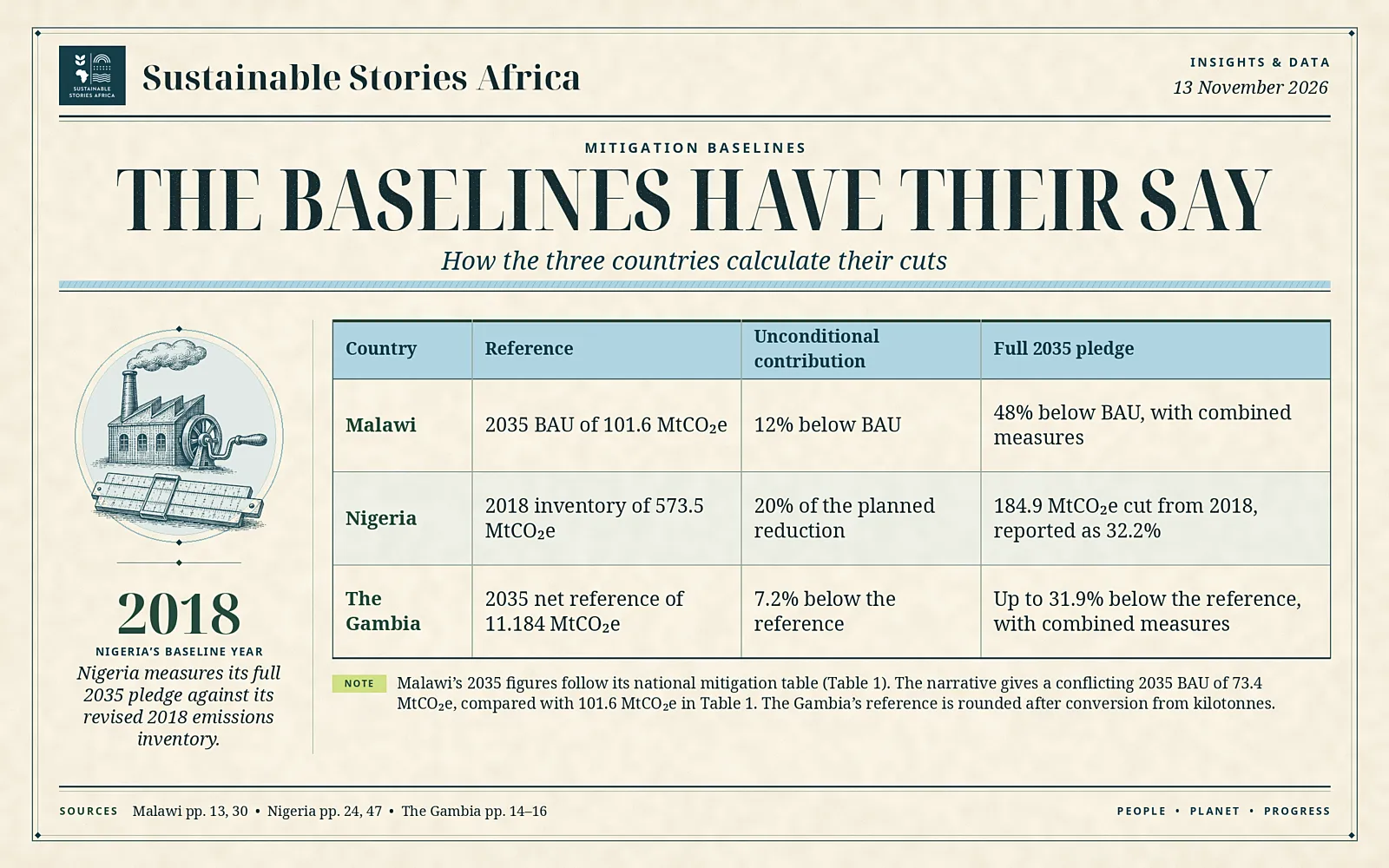
The countries also calculate their mitigation targets differently. Nigeria uses a historical baseline, while Malawi and The Gambia use projected emissions.
Three Plans Put Financing Into Focus
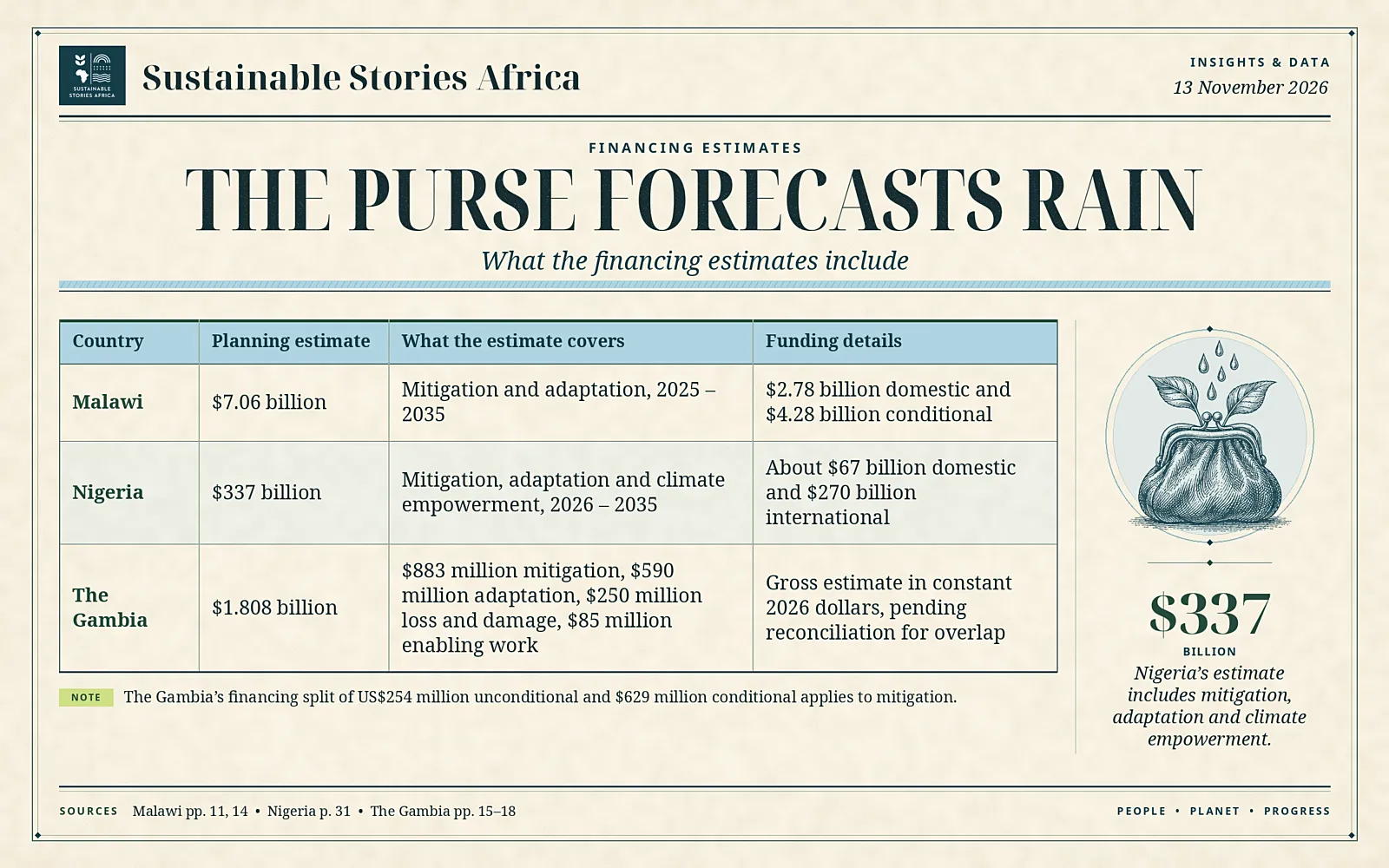
Nigeria estimates it will need US$337 billion for its climate plan from 2026 to 2035, including mitigation, adaptation and climate education and engagement. It aims to mobilise roughly a fifth domestically. Malawi estimates about US$7.06 billion for its 2025–2035 plan and expects domestic resources to cover about 39%.
The Gambia puts its gross planning estimate at US$1.808 billion, pending a check for overlapping costs. Its figure includes separate provisions for adaptation and loss and damage. All three plans are active in the UN climate registry. Nigeria filed in September 2025, Malawi in July 2026 and The Gambia in August 2026.
The cost figures tell readers what the governments expect to spend across their stated programmes. For families facing flooding or relying on firewood to cook, delivery depends on which parts receive funding and which public institutions can put the money to work.
What The Three Emissions Targets Cover
Nigeria’s NDC 3.0 sets an economy-wide absolute reduction of 184.9 MtCO₂e in 2035 from its revised 2018 reference level of 573.5 MtCO₂e. The country reports a 32.2% cut. Subtracting the stated reduction gives an implied 2035 emissions level of 388.6 MtCO₂e. The submission also sets a 2030 reduction of 168.2 MtCO₂e from the same historical reference. Nigeria describes a 20% unconditional share and an 80% conditional share of the planned reduction.
Malawi models 2035 emissions at 101.6 MtCO₂e under business as usual. The unconditional pathway lowers that to 89.0 MtCO₂e. With the domestic and conditional measures combined, emissions would fall to 53.3 MtCO₂e, or about 48% below the projected level. Malawi also reports a conditional-only scenario of 65.9 MtCO₂e in its national mitigation table. The scenario labels help explain why the same document contains several different percentages.
The Gambia includes land use, land-use change and forestry in its headline net target. The domestic package would cut projected 2035 emissions by about 7.2%. With an additional 2.77 MtCO₂e a year from conditional measures, the combined reduction would reach up to 31.9%. The conditional measures depend on predictable international finance and other support, including technology and technical assistance.
The Gambia’s earlier submission set a 49.7% reduction against a 2030 reference case. Its latest filing explains that the target year, data and modelling assumptions have changed. The newer pledge specifies a domestic contribution and quantifies individual measures. Those details give readers more to track across sectors, while the different reference cases limit what the two percentages reveal about the change in ambition.
How The Plans Put Costs Together
Nigeria allocates around US$195 billion to mitigation and US$141.5 billion to adaptation. It assigns US$500 million to Action for Climate Empowerment, which includes activities that help people understand and participate in climate action. Nigeria expects about US$270 billion in international funding. It also says proceeds from international transfers of mitigation outcomes could contribute to the domestic portion once the mechanism is operational.
Malawi’s financing table puts mitigation at roughly US$4.21 billion and adaptation at US$2.84 billion. Its conditional cost estimate is US$4.28 billion across the two programmes. Measures such as efficient cooking and waste recovery link national emissions projections to day-to-day spending. Reporting the funding source and status for individual projects would help readers tell which measures are ready to proceed.
The Gambia breaks its mitigation portfolio into 10 quantified unconditional measures and 29 quantified conditional measures. Of the US$883 million estimated for mitigation, US$254 million relates to the domestic package and US$629 million to the additional conditional package. The financing estimate covers the systems required to deliver the measures as well as the physical investment. The submission treats the total across programmes as a gross planning figure subject to reconciliation.
Nigeria’s financing assumptions also matter for the sectors expected to make the cuts. The plan targets zero routine gas flaring by 2030. For regulators and operators, evidence of delivery would include flare volumes, operating data and progress on projects to capture or use the gas. That makes routine flaring a measure that can be followed well before the main 2035 target year.
How Climate Measures Reach Vulnerable Households
Malawi envisages expanding access to cleaner cooking for more than 1.7 million households by 2030 through improved charcoal and firewood stoves. Field reporting can establish how many stoves are still in use after distribution and whether households burn less fuel. The plan also sets out conservation agriculture and a network of composting enterprises. Their benefits depend on whether farmers can use the practices and obtain the inputs season after season.
Nigeria plans to roll out agricultural early warning and meteorological forecasts in 18 states and strengthen extension services. A timely warning can help farmers adjust when they plant, harvest or move livestock. The service depends on useful local forecasts and channels that farmers can access. Funding the equipment, staff and communications together would help the service continue through successive growing seasons.
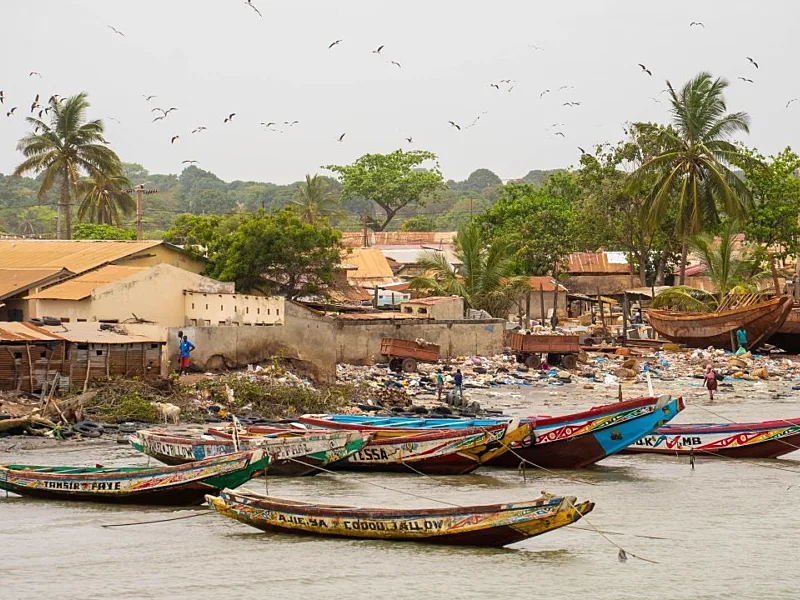
The Gambia identifies coastal erosion, saltwater intrusion and flooding among the threats to livelihoods and essential services. Its adaptation priorities include coastal protection and more resilient water supplies. The loss and damage programme also addresses preparedness, recovery and reconstruction, alongside impacts such as displacement. Those priorities help explain why the national plan gives recovery its own indicative planning figure.
Financing rules can determine which services are available after a climate shock. The Gambia’s provision for loss and damage is an initial programme estimate. Experience with emergency response, reconstruction and slow-onset coastal impacts can inform the next costing. Records of losses at community level would help clarify what the proposed programme needs to cover and where existing public services are stretched.
What To Verify As Funding Arrives
Governments can publish project lists that show the responsible agency, the cost estimate and the date each project is expected to start. They can update those lists as financing is approved and money is disbursed. This would make it possible to see whether new funding accelerates delivery and which regions are still waiting for essential services.
Financiers can also show whether support comes as a grant, a loan or another instrument. A commercial project that generates revenue can have different funding options from a flood warning service or emergency recovery programme. The financing terms help explain who bears the cost and whether an implementing agency can afford to operate the service after construction.
The emissions figures require similar care. Nigeria can report progress against its 2018 inventory and explain any revisions to that baseline. Malawi and The Gambia can publish their projected reference cases and actual emissions with consistent units and sector coverage. These steps give readers a way to follow both funding and emissions through successive reporting rounds.
The budget horizon matters when households are expected to change how they cook or farm. Some costs occur up front, while others recur as equipment wears out or public agencies update forecasts. A financial report that gives annual spending alongside results can show whether a programme is expanding and whether its existing users continue to benefit.
What The Next Reports Should Show
Track Nigeria’s domestic mobilisation against the US$67 billion it aims to raise and Malawi’s funding against its domestic and conditional estimates. The Gambia’s next costing can clarify where programme budgets overlap and how the figures change after reconciliation.
Follow service outcomes alongside expenditure. Useful measures include continued stove use in Malawi, the reach of warnings in Nigeria’s farming communities and the protection of water supplies in The Gambia.
Headline Options
Sustainable Stories Africa How Malawi, Nigeria and The Gambia Plan to Fund Their Climate Pledges
Bloomberg Nigeria, Malawi and The Gambia Outline Funding Needs for National Climate Plans
Time Magazine What Climate Finance Could Change for Vulnerable Households in Three African Countries
WSJ Three African Climate Plans Show How Governments Expect to Finance Local Delivery
Financial Times Three African Pledges Put Domestic Funding and International Financial Support Under Scrutiny
Sources and Data Notes
Malawi NDC 3.0 • PDF pp. 11, 13–14 and 29–30, especially Table 1 for the 2035 pathways
Nigeria NDC 3.0 and attachments • PDF pp. 12, 23–24, 27, 31, 38 and 47–48, especially the target and finance sections
The Gambia NDC 3.0 • PDF pp. 14–19, 39–40, 53–54 and 139–140, especially the net pathways and cost estimates
UNFCCC registry entry for Nigeria • Active submission dated 22 September 2025
UNFCCC NDC Registry • Submission dates and titles