Vaccination can prevent drug-resistant infections and may reduce antibiotic use, but the relationship is more complex than a simple fall in disease automatically producing less prescribing.
A Wellcome evidence synthesis explains why.
For African health systems, the priority is to connect immunisation with diagnostics, prescribing stewardship and research that measures benefits in local settings.
Vaccination Strengthens Infection Prevention And Treatment
Vaccination belongs within strategies to address antimicrobial resistance, but its effects on antibiotic use and resistance need careful measurement.
Wellcome’s report Vaccination to Prevent Antimicrobial Resistance reviews findings from 13 funded projects and discussions at a November 2024 workshop, identifying potential benefits and many uncertainties.
The direct case is strong:
- Preventing infections caused by resistant pathogens can reduce the burden of difficult-to-treat disease.
The indirect pathway, through changes in prescribing and microbial populations, is less straightforward and varies across settings.
For African policymakers, this distinction matters when deciding which programmes to fund and how to evaluate them.
Vaccines, appropriate prescribing and reliable diagnostics should work together, with local evidence informing the additional resistance-related value of immunisation.
Prevention Offers Benefits Beyond Avoided Infections
Antimicrobial resistance, or AMR, occurs when microorganisms no longer respond adequately to medicines used against them.
- Antibiotic resistance is the bacterial part of this wider problem.
- Preventing illness can reduce the need for treatment and the circulation of resistant infections, while also protecting households from care costs and lost work.
The Wellcome report cites WHO modelling published in 2024 to illustrate the scale of potential vaccine benefits.
- WHO’s corrected announcement describes a possible annual reduction of 2.5 billion defined daily doses of antibiotics, or 22%, from vaccines against 23 pathogens for that calculation.
- Some vaccines are available but underused; others would require development.
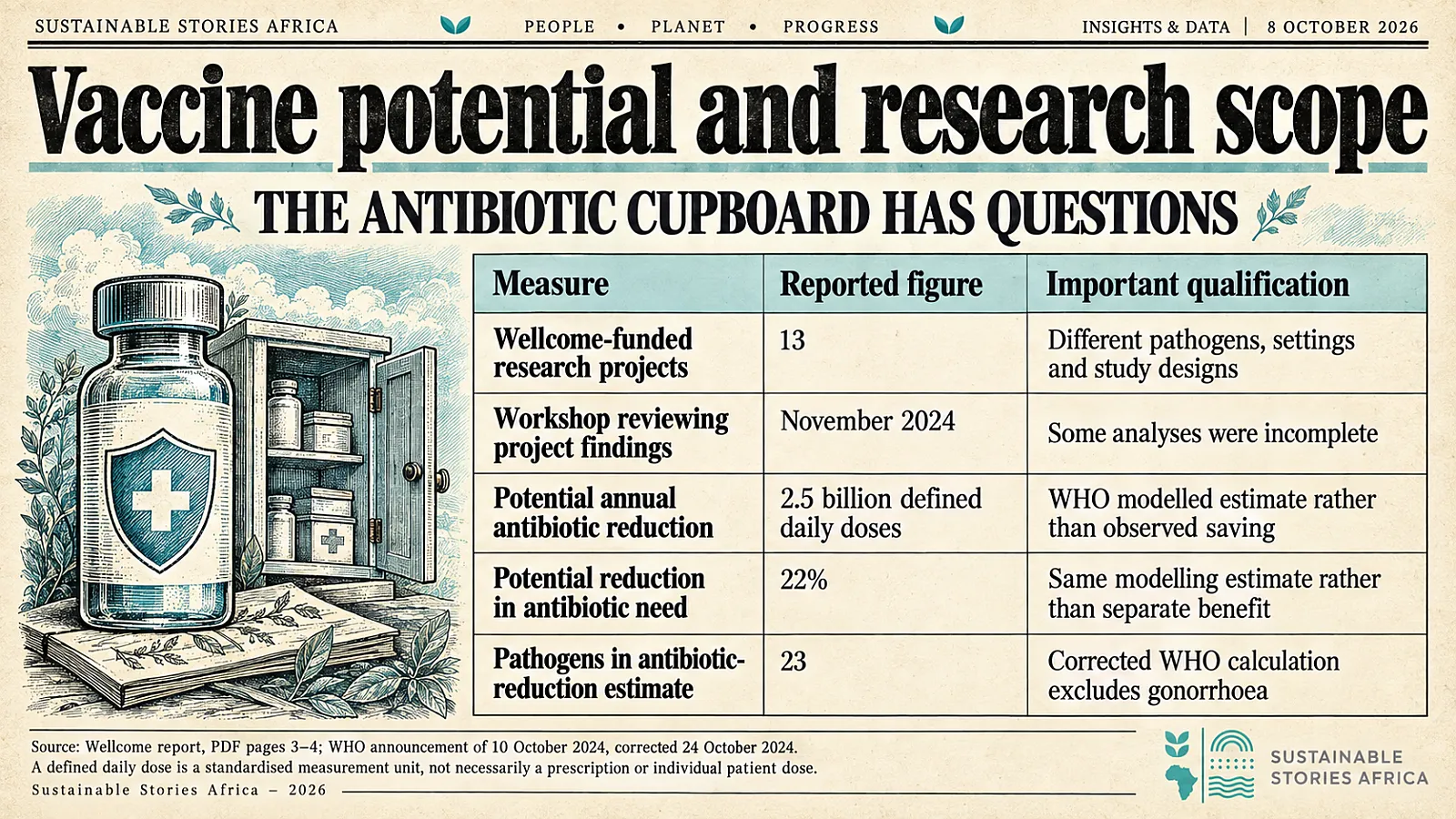
These estimates should inform research and appraisal without becoming promises of immediate savings.
- Delivery capacity, vaccine coverage, effectiveness and health systems behaviour affect what can be achieved in practice.
Field Evidence Shows Why Prescribing Persists
The projects reviewed show why reducing infection does not always lead to an equivalent reduction in antibiotics.
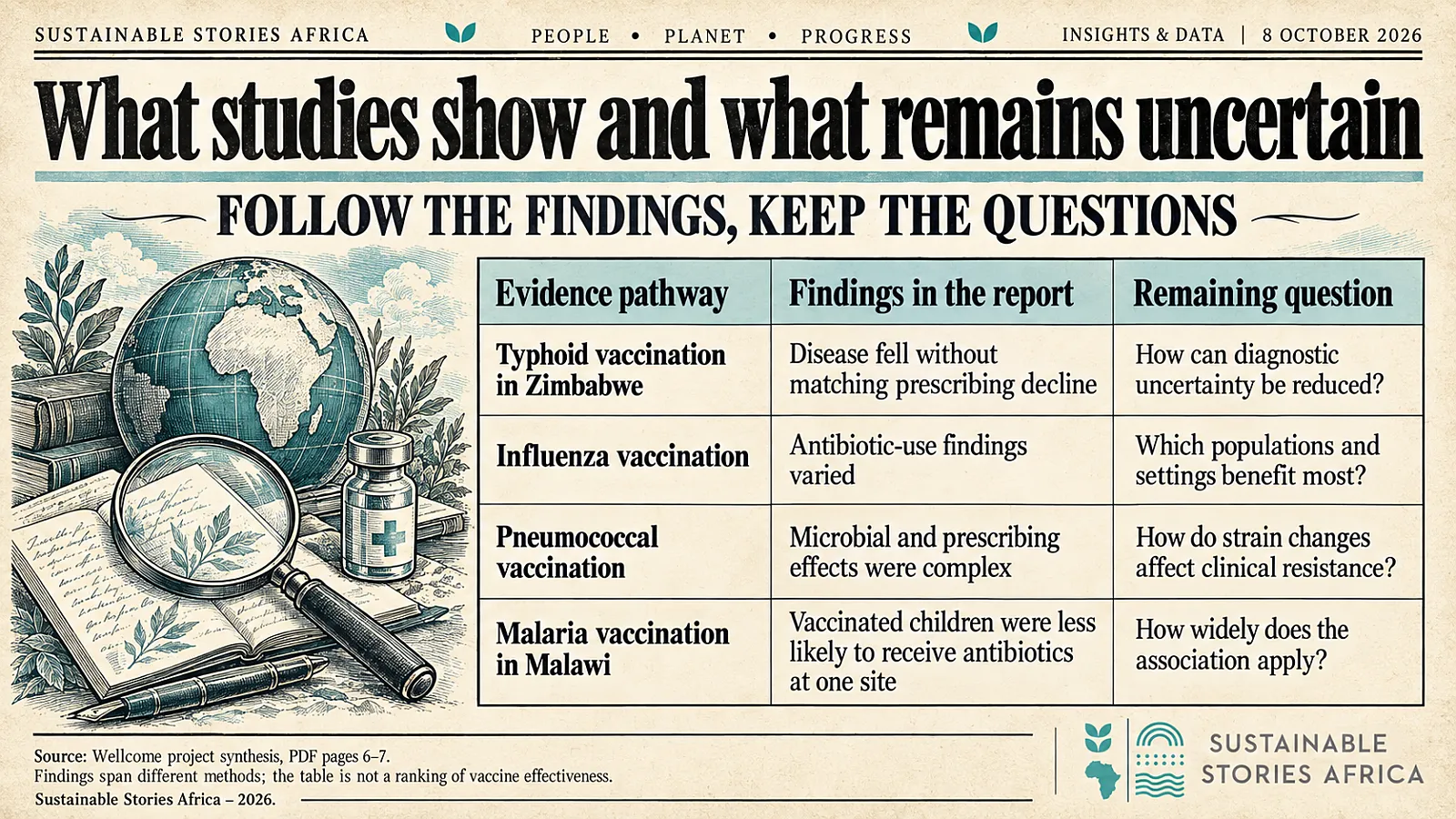
- In Zimbabwe, a typhoid conjugate vaccine rollout reduced typhoid incidence in the communities receiving it, but the project did not find a corresponding decrease in antibiotic prescribing or use.
- Some beneficial changes in circulating strains’ resistance profiles were observed.
Health workers described continued uncertainty about the cause of illness and concern about missing a serious diagnosis.
- In that setting, just-in-case prescribing persisted.
- The finding does not show that the vaccine failed.
- It shows that disease prevention and prescribing behaviour are distinct outcomes.
Evidence from influenza studies was also mixed.
- Analyses differed across populations and settings, with some finding little association between vaccination and antibiotic use.
- Vaccine effectiveness, illness management and methodological limitations all influenced interpretation.
Pneumococcal disease introduces an additional challenge.
- Vaccines cover a subset of the many pneumococcal serotypes.
- Changes in the circulation of vaccine and non-vaccine strains, together with gene exchange, can affect resistance in ways that are difficult to predict.
A useful study must therefore examine relevant microbial changes as well as clinical outcomes.
The report also reviews studies concerning malaria and diarrhoeal disease.
- Preventing a non-bacterial illness may reduce inappropriate antibiotic treatment or treatment of secondary infections, but that effect depends on how clinicians diagnose and manage symptoms.
Findings from one country or pathogen cannot simply be transferred to another.
Integrated Programmes Could Increase Public Value
The practical opportunity is to combine prevention with the conditions that enable appropriate treatment.
- Where health workers have reliable information and usable diagnostic support, fewer infections may translate more effectively into fewer unnecessary antibiotic courses.
- That is a policy proposition to evaluate, not a guaranteed effect.
For an illustrative primary care team, vaccination coverage alone would not reveal whether prescribing had changed.
- Staff would also need to examine illness presentations, diagnostic results, treatment decisions and access to referral.
- Otherwise, a programme could improve one outcome while leaving another unchanged.
The broader value of infection prevention includes protecting patients from difficult-to-treat disease, even where downstream antibiotic reductions are hard to demonstrate.
Economic evaluation should recognise that value while making assumptions visible.
African research institutions can generate evidence that national decision makers can use.
- Studies should involve local health services and address the questions that determine policy choices, including feasibility and affordability.
Communication should explain different outcomes without suggesting that uncertainty means there is no benefit.
- A vaccine can prevent its target disease even when a study cannot demonstrate a wider resistance effect.
- Conversely, a modelled reduction in antibiotic need does not establish the effect of a particular local rollout.
Policymakers can present the direct evidence, additional potential benefits and the remaining questions separately.
- That makes the case more transparent for finance officials and communities, and gives researchers a clearer indication of which evidence would change a funding or programme decision.
Health Authorities Need Shared Evidence Priorities
The report recommends more empirical evidence, better standardisation and closer alignment with policymaker needs.
- It identifies immunisation advisory groups, programme managers and AMR officials as important users of that evidence
- Finance ministries also influence which interventions can be supported.
National programmes can begin by mapping where immunisation and AMR plans already intersect.
- Joint evaluation could examine disease burden, antibiotic prescribing and resistance outcomes with consistent definitions.
- A vaccination programme cannot be judged solely by an antibiotic-use measure that omits its direct disease benefits.
Research design needs adequate follow-up and transparent methods.
- Observing differences between vaccinated and unvaccinated groups may reflect other factors, such as healthcare access.
- Modelling can explore possible impacts, but conclusions remain dependent on the assumptions and evidence used.
Investing in laboratory and surveillance capacity is necessary for measuring local resistance.
- Prescribing data should also distinguish antibiotics, quantities and indications where feasible. A simple prescriptions count may miss differences in duration or treatment type.
Finally, financing decisions must consider practical delivery.
- A favourable benefit-to-cost estimate does not ensure that a programme is affordable or that staff, cold-chain capacity and other resources are available.
- Implementation plans should explain how to address constraints while maintaining essential services.
Path Forward – For Vaccines And Stewardship
African health systems should connect vaccination with appropriate prescribing, diagnostics and surveillance.
Research should measure direct protection from resistant infections alongside the more uncertain effects on antibiotic use and resistance patterns.
This approach can strengthen the investment case without overstating benefits.
Local evidence and workable delivery plans will help immunisation and AMR programmes support each other and protect the usefulness of essential medicines.