Ghana’s climate-smart agriculture startups are developing weather services, irrigation systems and products made from agricultural waste.
Financing constraints; expanding employment, certification and weak links to public policy.
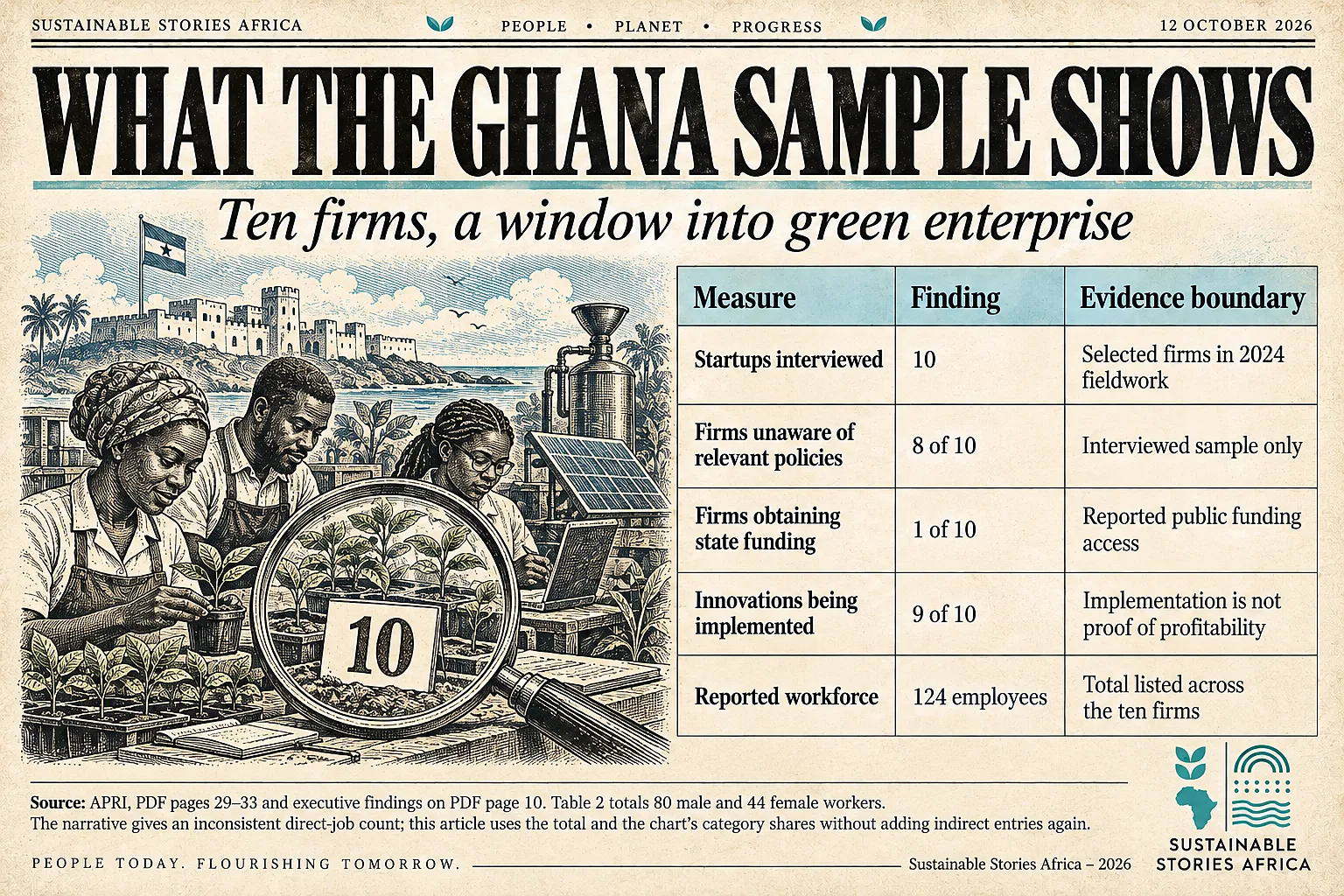
APRI’s country study finds that eight of ten interviewed startups were unaware of relevant public policies.
The evidence points towards a practical challenge: making support usable for the businesses expected to deliver climate resilience and jobs.
Ghana’s Agricultural Innovation Needs Accessible Support
Ghana’s climate-smart agriculture entrepreneurs are creating opportunities for young workers, but public support often fails to reach them in forms they can use.
A September 2025 report by Bismark Owusu Nortey and Serwah Prempeh for Africa Policy Research Institute links this implementation gap to finance, skills and regulatory obstacles. [1]
The study examines ten startups and draws on 2024 fieldwork, alongside interviews with public institutions and other stakeholders.
- Eight companies were unaware of relevant public policies, while only one had obtained funding from state institutions.
These findings describe the interviewed businesses, rather than the entire Ghanaian startup economy.
For farmers dealing with unpredictable rainfall and changing production conditions, enterprise survival affects whether useful technologies remain available.
For young people, it determines whether innovation produces sustained employment or opportunities that disappear when short-term support ends.
Employment Promises Depend On Reaching Actual Firms
Climate-smart agriculture aims to improve productivity and resilience while reducing emissions where possible.
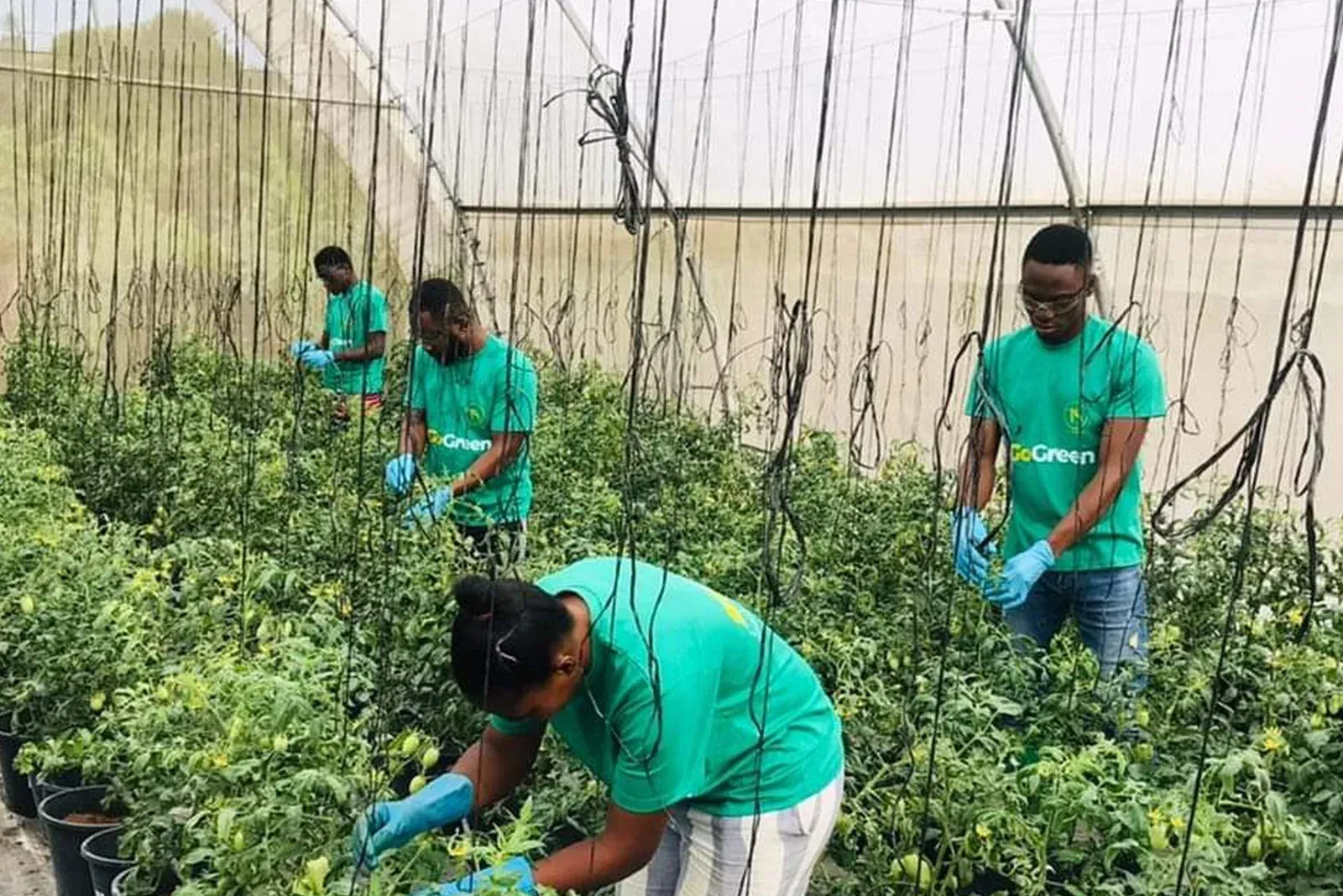
- The technological applications range from soil and grain monitoring to irrigation, weather advice and the conversion of agricultural waste into useful products.
- Their benefits depend on affordability, adoption and service quality, rather than on a climate label alone.
The ten businesses are beyond concept stage: nine were implementing their innovations, and one remained at ideation.
- Together, they reported serving more than 1,000 clients.
- This is evidence of market engagement, although the study does not establish a uniform measure of revenue, profitability or independently verified emissions savings.
Employment also needs precise description.
- The report’s respondent table lists 124 employees across the ten businesses, comprising 80 male and 44 female workers.
- Its employment chart classifies 61% as direct and 39% as indirect.
- The indirect entries in parentheses are included within the reported total and should not be added again.
These figures describe the sample’s reported activity, not national employment.
Policy Commitments Encounter Everyday Business Frictions
The study identifies several supportive policy frameworks, including the National Climate Change Policy, the climate-smart agriculture action plan and the National Green Jobs Strategy.
- However, the authors find weak links between these frameworks and startups’ practical requirements.
- Public officials describe broad consultation, while entrepreneurs report limited awareness and participation.
These perspectives reveal a governance problem that a policy inventory alone cannot resolve.
- A consultation process may exist without consistently reaching emerging businesses.
- Older policies may also predate a company’s formation.
Officials therefore need continuing channels for founders to obtain information and influence implementation after a policy is approved.
Regulatory costs add another barrier.
- The report describes difficult registration and certification procedures and limited understanding of intellectual property protection.
- Only two of the ten startups had registered intellectual property for their products or services.
- Some businesses reported abandoning procedures because of cost or complexity.
These are reported experiences, not an official schedule of statutory fees.
The timing matters.
- The study discussed the National Green Jobs Strategy covering 2021 – 2025 and calls for implementation before its expiry.
- For an October 2026 policy discussion, the relevant question is what has been delivered, reviewed or continued after that period.
The earlier recommendation should not be presented as an unexpired deadline.
Finance is equally uneven.
- Startups rely heavily on accelerators, donor partners and foreign entities, while public funding access was limited in the sample.
- Training in proposal writing can improve applications, but repeated grant competitions consume time that founders also need for product development and customer service.
Local Knowledge Can Improve Technology And Livelihoods
The Ghana study provides examples of innovations grounded in local production problems.
- Sesi Technologies develops grain moisture and soil monitoring tools; Ignitia provides weather information; ECOVON uses coconut husks in panel production.
- These applications connect climate adaptation and resource efficiency with identifiable customers and production needs. [1]
Such businesses can create work in equipment servicing, field operations, customer support and product development.
- The employment opportunity includes people outside advanced software or engineering roles, provided training and commercial demand are sufficient.
- Counting jobs should be accompanied by attention to pay, continuity and progression.
Indigenous knowledge can help technologies suit local farming decisions and resource practices. APRI finds recognition of this knowledge in policy but weak documentation and limited integration with formal innovation systems.
- Collaboration between knowledge holders and technologists can improve relevance, while recognition and fair arrangements are necessary to avoid treating community expertise as a free input.
Gender inclusion requires equally specific attention.
- All ten sampled companies were male-led, despite researchers’ efforts to identify female-led firms.
- This does not establish that Ghana has no women leading climate-smart agriculture businesses.
It does show why outreach methods and support programmes should actively identify women whose enterprises may be absent from established networks. [1]
Agencies And Financiers Should Simplify Enterprise Support
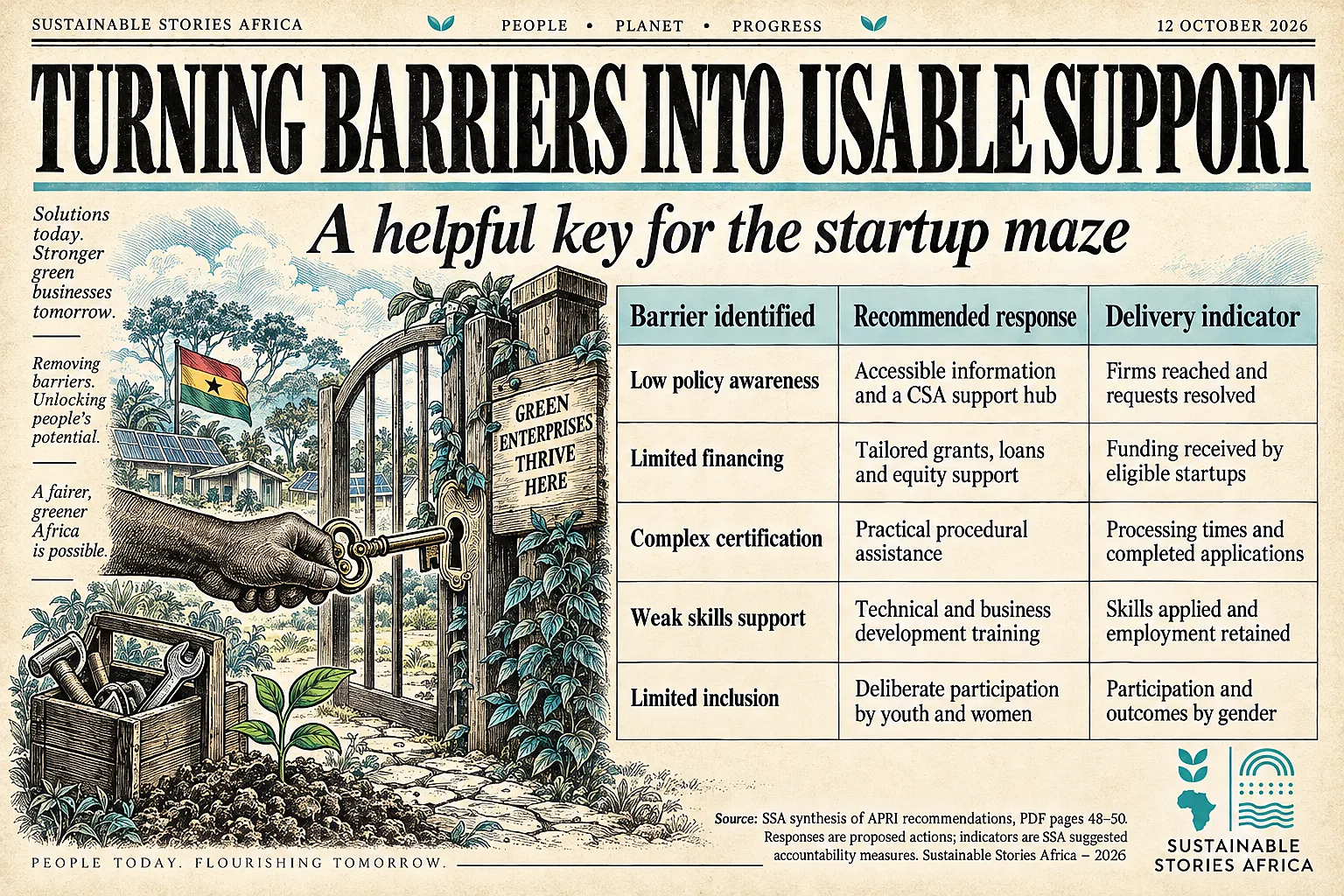
Public institutions should connect agriculture, employment and innovation programmes through a practical service that explains eligibility, procedures and responsible contacts.
- APRI’s proposed climate-smart agriculture hub would be most useful if it helps founders complete tasks, rather than simply adding another directory of policies.
Financiers and accelerators should distinguish support for testing a product and capital needed to expand a functioning business.
- Market access, financial management and certification assistance can be as important as a grant.
- Training programmes should connect participants with actual operational needs and continue long enough to assess whether companies retain workers.
Government and enterprise-support organisations should also publish evidence of delivery.
- Relevant measures include funding reaching firms, customer adoption, job continuity and women participation.
- Where a programme falls short, a clear account of the obstacle would support revision and help rebuild trust among entrepreneurs.
Path Forward Making Agricultural Innovation More Inclusive
Ghana should translate climate and employment commitments into support that entrepreneurs can access, with clearer procedures, responsive finance and sustained skills development.
Reviewing delivery after the Green Jobs Strategy’s 2021 – 2025 period would provide a useful starting point.
Judge progress through viable services for farmers and durable opportunities for young workers, including women.