Nigeria’s climate financing challenge includes weak coordination, inconsistent policy signals and limited capacity to prepare investments.
APRI’s country-platform report proposes an institutional response that connects climate action with national development priorities.
Historical financing estimates illustrate the scale of the mismatch, while experiences from energy-transition partnerships reveal the limits of large pledges.
A useful platform would need authority, participation and evidence of delivery across mitigation, adaptation and livelihoods.
Nigeria’s Climate Finance Needs Coordinated Delivery
Nigeria could improve the effectiveness of climate investment by coordinating national priorities, project preparation and international partnerships through a country platform.
A February 2025 Africa Policy Research Institute report by Lai Yakubu Yahaya and Olumide Onitekun argues that fragmented policies and misaligned interests have constrained the mobilisation and deployment of finance.
The report proposes a Country Platform for Climate Action that extends beyond a conventional energy-transition partnership.
- It would combine decarbonisation with adaptation, resilience, industrial development and employment.
- The proposal describes an institutional design; the report itself does not establish that the proposed platform has been implemented. [1]
For African governments navigating climate and development needs, the issue is practical.
- Money needs investable projects, public institutions to coordinate them and a clear account of whose needs those investments address.
Historical Financing Data Illustrate The Coordination Challenge
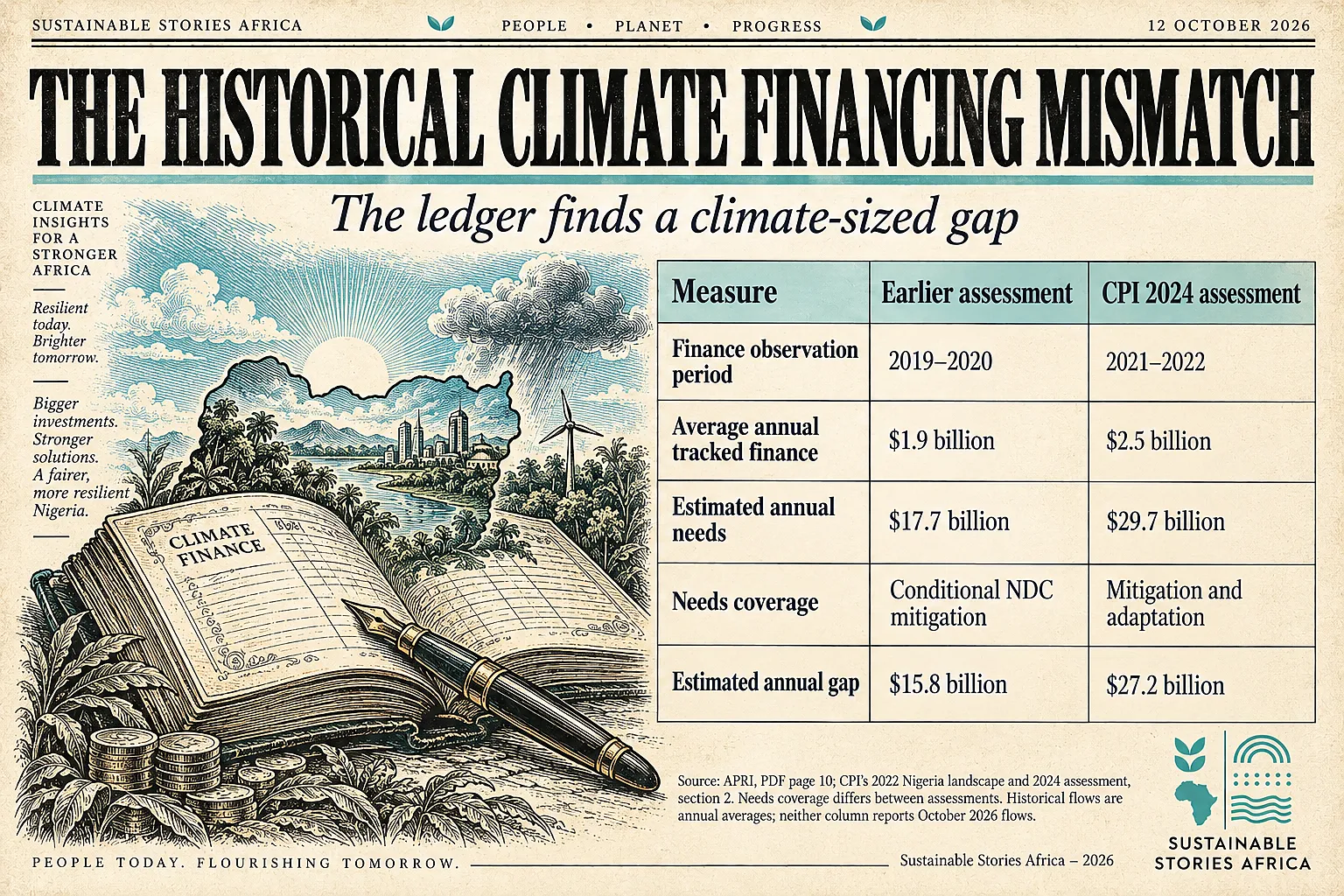
Drawing on an earlier Climate Policy Initiative landscape analysis, APRI cites tracked annual climate finance of $1.9 billion against estimated annual needs of $17.7 billion for Nigeria’s conditional Nationally Determined Contribution.
- The resulting gap is $15.8 billion.
- These are historical assessment figures, not measurements of financing flows in October 2026.
The comparison establishes an order of magnitude within that assessment.
- Tracked finance was about 10.7% of estimated annual needs.
- It does not show how much was available for any particular project, and financing needs can change as policies, costs and implementation assumptions change.
For additional context, CPI’s 2024 assessment records average annual finance of $2.5 billion in 2021 – 2022 against US$29.7 billion in annual mitigation and adaptation needs, leaving a $27.2 billion gap.
- The larger needs benchmark includes $12 billion for adaptation, so the two gap estimates are not a like-for-like measure of deterioration.
Projects require credible demand, appropriate preparation and regulatory clarity.
- Agencies need agreement on responsibilities, while public guarantees must be assessed against fiscal capacity.
- A platform could make these requirements visible before negotiations advance.
Partnership Experience Reveals Risks Beyond Funding Volumes
The report examines Just Energy Transition Partnerships, or JETPs, developed for South Africa, Indonesia, Vietnam and Senegal.
- These arrangements try to align international support with national transition plans and mobilise investment while addressing the interests of affected workers and communities.
- Their design varies with each country’s energy system.
APRI identifies several concerns, such as early partnership experience: commitments may not translate into delivery, vulnerable groups may receive limited benefits, and external financiers could heavily shape priorities.
- A narrow focus on energy infrastructure can also leave adaptation, nature and wider development needs insufficiently addressed.
These issues are particularly relevant to Nigeria.
- An electricity transition that improves supply while neglecting flood resilience, agricultural vulnerability or consequences for oil-dependent communities would leave important climate and development risks unresolved.
- Coordination should make those competing needs explicit rather than assume that one sector’s investment programme covers them all.
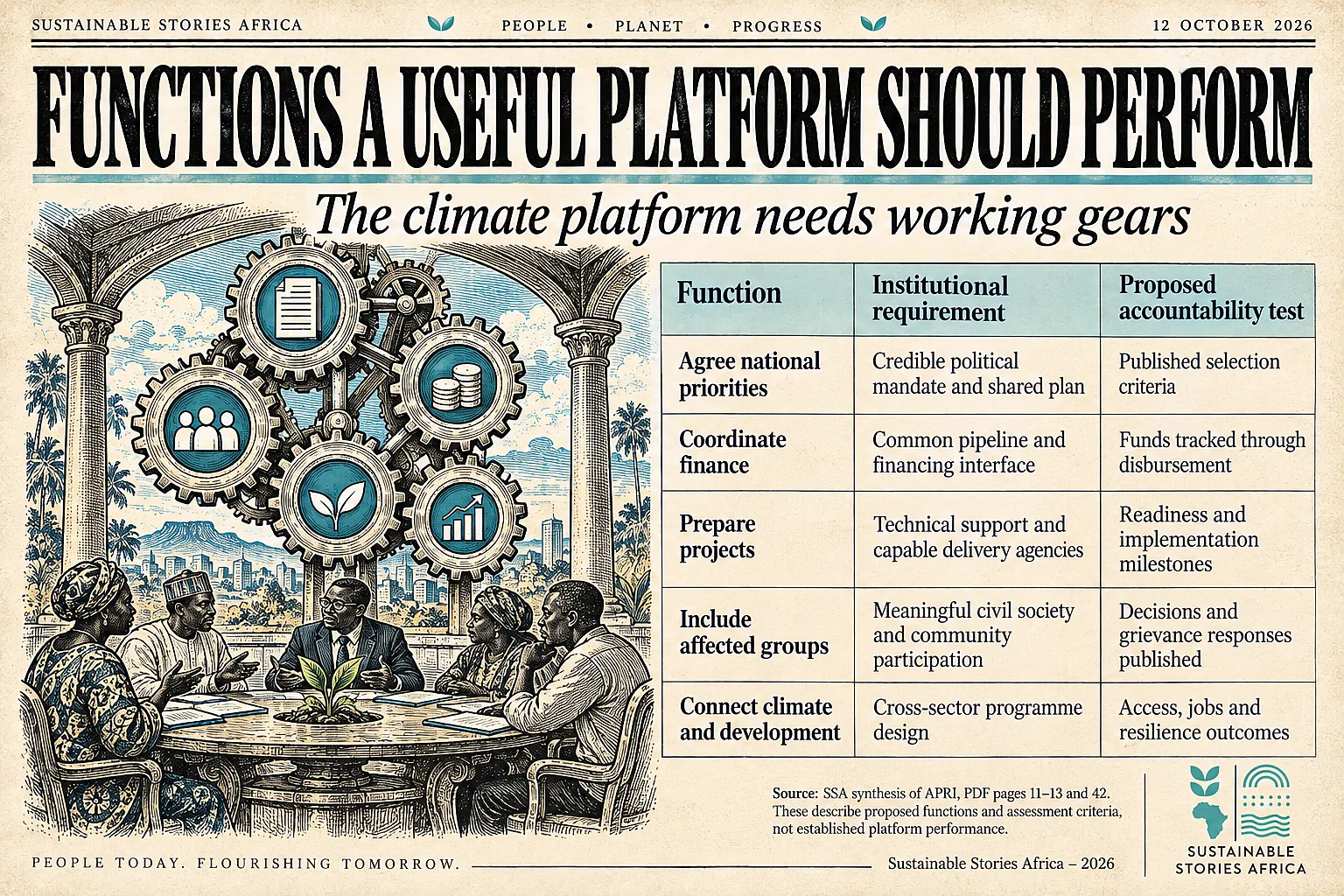
The country-platform concept responds by bringing government, business, civil society and development partners behind an agreed programme.
- National ownership is central, but it needs more than a government label.
- Shared decisions, clear responsibilities and accessible information are necessary for domestic participants to shape investment choices.
Political commitment matters because agencies have different mandates and incentives.
- A platform without authority to reconcile conflicts could become an additional administrative layer.
- Conversely, concentrating power without participation could weaken legitimacy.
The institutional task is to establish accountable coordination that can act and can be scrutinised.
Development Priorities Can Improve Investment Relevance
A broader platform could link reliable electricity with productive activity, resilient infrastructure and employment.
- For example, project preparation can examine both energy needs and the vulnerability of the facilities being served.
- This would help avoid investing in equipment without understanding the conditions required for lasting operation.
APRI recommends a programme-based approach rather than a succession of disconnected transactions.
- This could give financiers a clearer pipeline while helping government compare investments against agreed development objectives.
- The benefit depends on credible selection criteria and the capacity to reject projects that do not meet them.
Adaptation and mitigation also require different financial approaches.
- Some investments can generate commercial revenues; others provide public benefits without a reliable income stream.
- A platform should recognise this distinction when allocating grants, concessional finance or risk-sharing instruments.
- Seeking private capital for every activity can leave essential public services unsupported.
Local project-development capacity would strengthen ownership.
- Nigerian institutions and firms need technical, legal and financial expertise to negotiate terms, prepare investments and monitor results.
- APRI places technical assistance alongside finance because coordination cannot substitute for the skills required to move projects into operation.
Government And Partners Must Establish Clear Responsibilities
Government should define the platform’s mandate, participating institutions and relationship with existing planning and climate bodies.
- Federal and state roles need explicit treatment so national coordination supports subnational implementation.
- The initial programme should identify a manageable set of priorities and the capacity required to deliver them.
International partners should align support with that programme and disclose the terms and stage of financing.
- Separate pledges, signed commitments, disbursements and operating assets categories in public reporting.
- This would prevent an announcement from being treated as evidence that citizens have already received a benefit.
Businesses and civil society should have structured opportunities to question and shape assumptions and implementation.
- Monitoring should assess development results and financial mobilisation.
- A platform that improves decision quality and identifies delivery failures would provide value even before it attracts a large new funding package.
Path Forward – Building A Credible Climate Programme
Nigeria should pursue climate coordination through an accountable national programme with clear institutional roles, prepared projects and meaningful participation.
Finance should follow credible priorities across energy, adaptation and livelihoods.
Reporting on the movement from commitments to implementation would make a country platform assessable and link climate cooperation with development results people can recognise.