
A US study of 187,341 adults links ADHD with a higher hazard of later cognitive impairment and greater support needs after diagnosis.
The findings strengthen the case for care that follows people across their lives.
For African health planners, the relevance lies in integrated services and better research.
The study does not establish that ADHD causes dementia or provide an African risk estimate.
Ageing With ADHD Demands Broader Attention
Attention-deficit/hyperactivity disorder is often discussed through school performance or working life.
New research places it in another consequential conversation: how health systems support people as they grow older.
A study published in JAMA Psychiatry on October 7 found an association between ADHD and subsequent mild cognitive impairment or dementia in a large US cohort.
Researchers led by Guilherme Bauer-Negrini and Douglas Teixeira Leffa analysed electronic health records and genetic information from 187,341 participants aged at least 50 in the All of Us Research Program.
Their approach examined both recorded ADHD diagnoses and inherited susceptibility, providing two different ways to investigate the relationship.
The central message is one of preparedness.
- A statistical association cannot change an individual's future, but it can expose gaps in how services connect mental health, cognitive assessment and everyday support.
- For African policymakers, the study raises questions about service design while leaving local prevalence and risk unanswered.
The Headline Association Requires Careful Interpretation
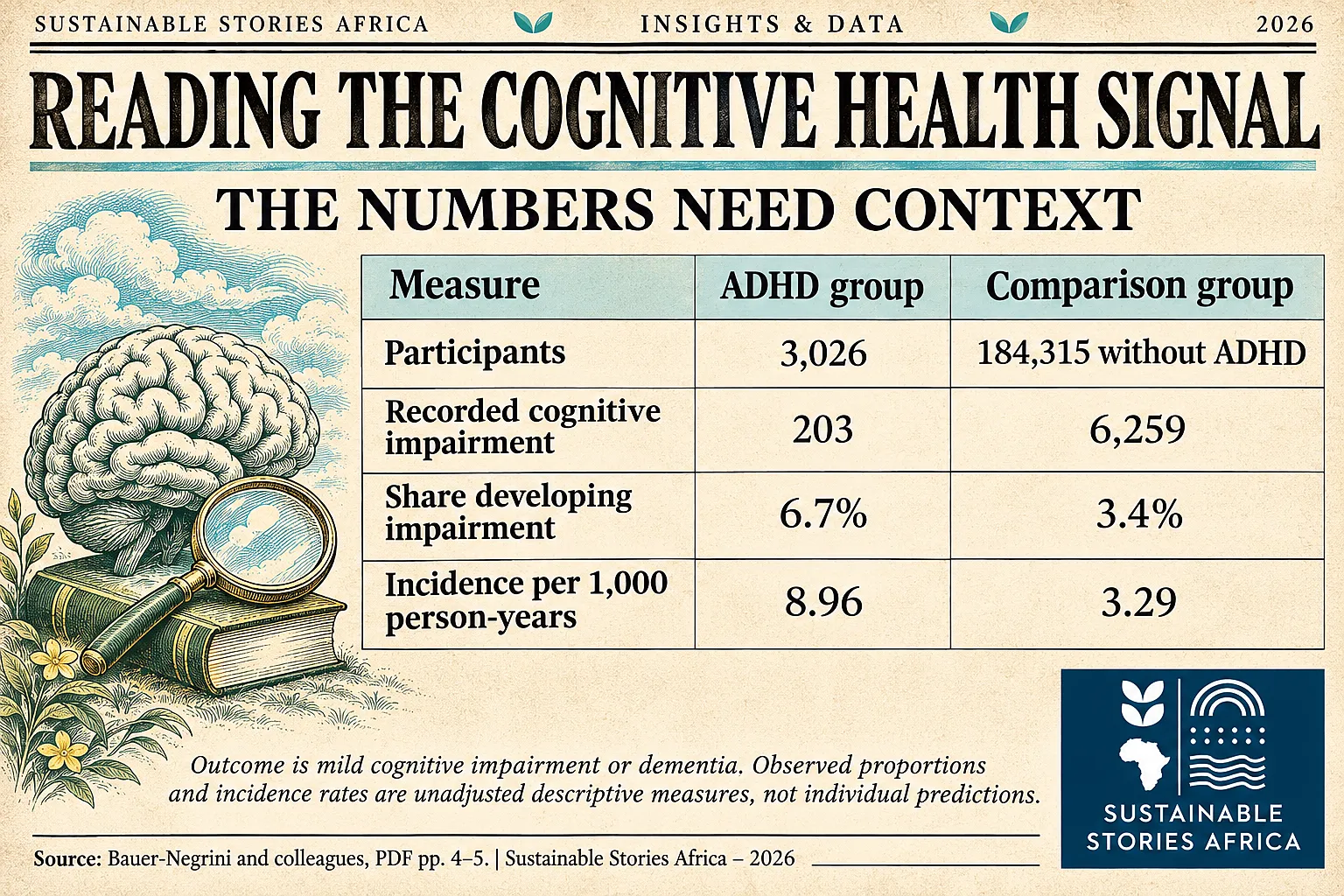
Among 3,026 participants with ADHD, 203 developed cognitive impairment during follow-up: 6.7%, compared with 3.4% among those without ADHD.
- These proportions help readers see the scale of outcomes recorded.
- They should accompany, rather than disappear behind, the larger relative estimates generated by statistical modelling.
The main adjusted model produced a hazard ratio of 4.60, with a 95% confidence interval of 3.99 to 5.29.
- A hazard ratio compares the rate at which outcomes occur over follow-up; it does not mean that 46% of participants developed dementia or that everyone's lifetime probability increased by the same amount.
The outcome also combined mild cognitive impairment and dementia.
- Reporting it simply as Alzheimer's disease would change what the research measured.
In addition, the researchers followed for an average of 10.26 years using historical records, a new decade-long trial that began when the paper appeared.
Clinical Records And Genetics Offer Clues
The association became smaller when researchers accounted for additional differences between participants.
- A fully adjusted model incorporating health conditions, healthcare use, education and smoking history yielded a hazard ratio of 3.08.
- A separate matched analysis, balancing participants on measured characteristics, produced a more conservative estimate of 2.26.
That movement is informative.
- People with ADHD in this cohort had more recorded psychiatric and physical conditions and substantially more healthcare contact.
- These differences can affect both underlying health and the likelihood that cognitive problems are detected.
- Adjusting for them strengthened the analysis, but cannot remove every source of bias.
Genetic analysis added another perspective. Participants in the highest fifth of the ADHD polygenic risk score had a 35% higher hazard of cognitive impairment than those in the lowest fifth.
- This score combines many genetic associations; it is neither a diagnosis nor a clinical destiny.
- The underlying genetic research was predominantly European, limiting transferability across populations.
Timing remained a concern.
- The association weakened when longer intervals were required between ADHD documentation and cognitive impairment, becoming statistically non-significant at nine years.
- Reduced statistical power complicates that result, while the possibility that early cognitive symptoms were initially attributed to ADHD cannot be excluded.
Better Care Means Supporting Everyday Function
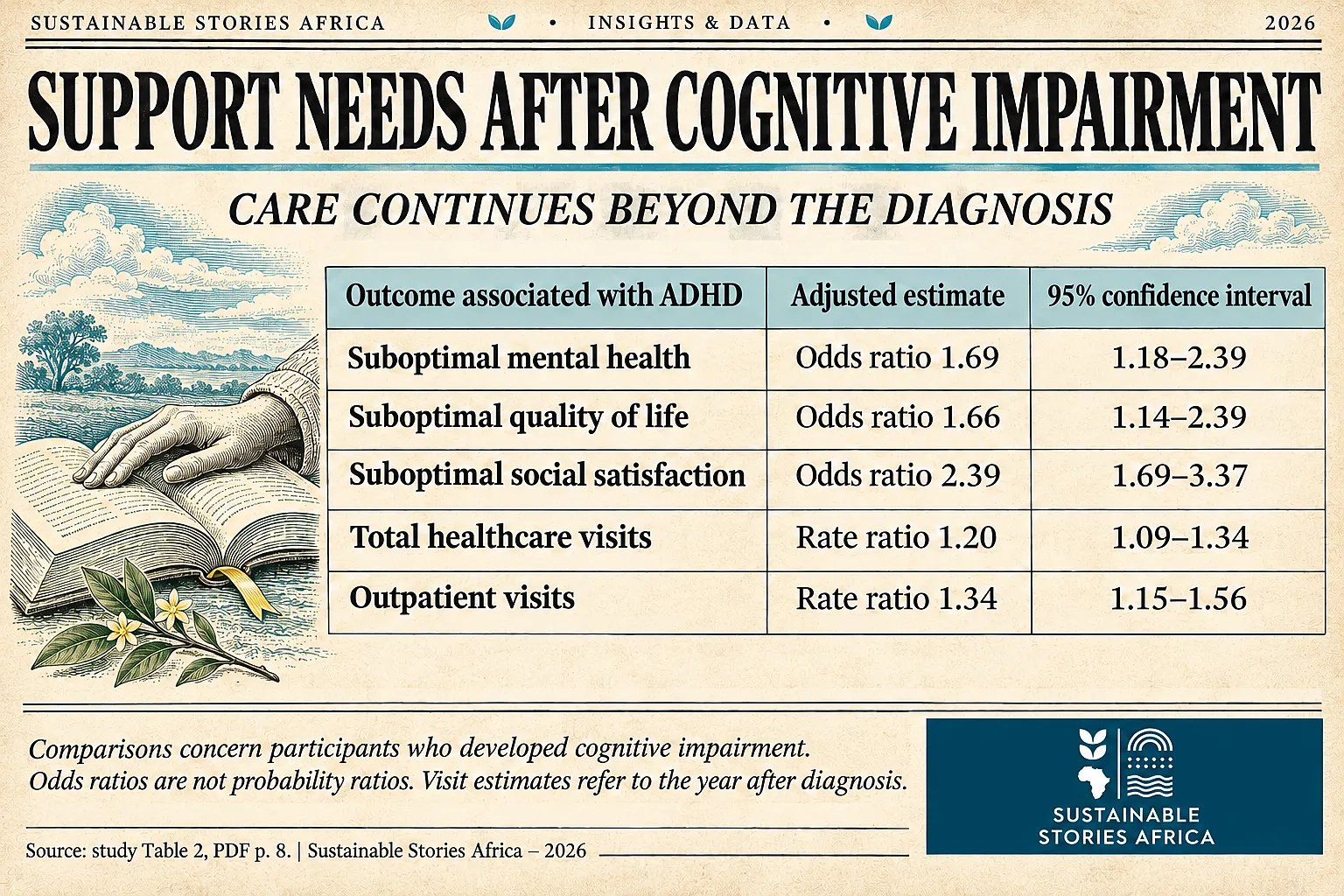
The research also examined what happened after cognitive impairment developed.
- Participants with ADHD reported poorer mental health, quality of life and social satisfaction, and used more healthcare overall.
- The policy issue therefore extends beyond detecting cognitive change to making care usable for people managing overlapping difficulties.
For service providers, these findings suggest that appointment systems, communication and follow-up deserve attention alongside diagnosis.
- A person can receive an accurate assessment yet struggle to navigate separate services, understand instructions or organise repeat visits.
- Reducing that burden is a practical, measurable objective.
Evaluate the benefits of integrated care rather than assume them.
- The study measured associations and service use; it did not test a coordinated care programme or calculate savings.
- Its value is in identifying questions that services should now investigate.
Build Services Around Evidence And Inclusion
Health authorities can start by reviewing whether adult mental health pathways connect effectively with cognitive assessment and older-person services.
- The authors call for cognitive monitoring in adults with ADHD.
- Translating this proposal into practice requires clinical guidance on who benefits, appropriate assessments and how findings lead to support.
For African research institutions, a priority is locally grounded longitudinal evidence.
- The US findings cannot establish the burden among African populations, where patterns of diagnosis, documentation and access may differ.
- Studies should measure functional change repeatedly and distinguish longstanding attention difficulties from newly emerging cognitive problems.
Researchers should also include people who are poorly represented in existing records.
- A study requiring both genomic information and electronic health histories selects a particular population.
- Better representation would make future conclusions more useful for public planning and reduce the risk that sophisticated tools deepen existing evidence gaps.
Employers and insurers should approach the results through inclusion, not deterministic assumptions about capability.
- Nothing in the study justifies treating an ADHD diagnosis as proof of future dementia.
- Assess workplace design and accessible health benefits to support their immediate value without overstating distant outcomes.
Another unresolved question concerns treatment.
- The researchers lacked sufficient lifetime treatment information to establish whether medication or other ADHD interventions modify cognitive risk.
- The paper therefore cannot support claims that a particular treatment prevents dementia, or recommendations to change treatment on that basis.
The most useful accountability measures would link assessment to outcomes: whether people obtain appropriate referrals, remain engaged with services and report better daily functioning.
- Counting assessments alone would leave the main social challenge untouched.
Health sustainability includes preserving autonomy and access throughout life, especially when support needs overlap.
Path Forward – For Inclusive Lifelong Care
Health systems should connect adult ADHD services with appropriate cognitive assessment and practical support, guided by clinical expertise.
Communication must distinguish population associations from personal prognosis.
African institutions should build representative long-term evidence and evaluate integrated services.
Better functioning, continuity of care and equitable access should determine whether those efforts succeed.