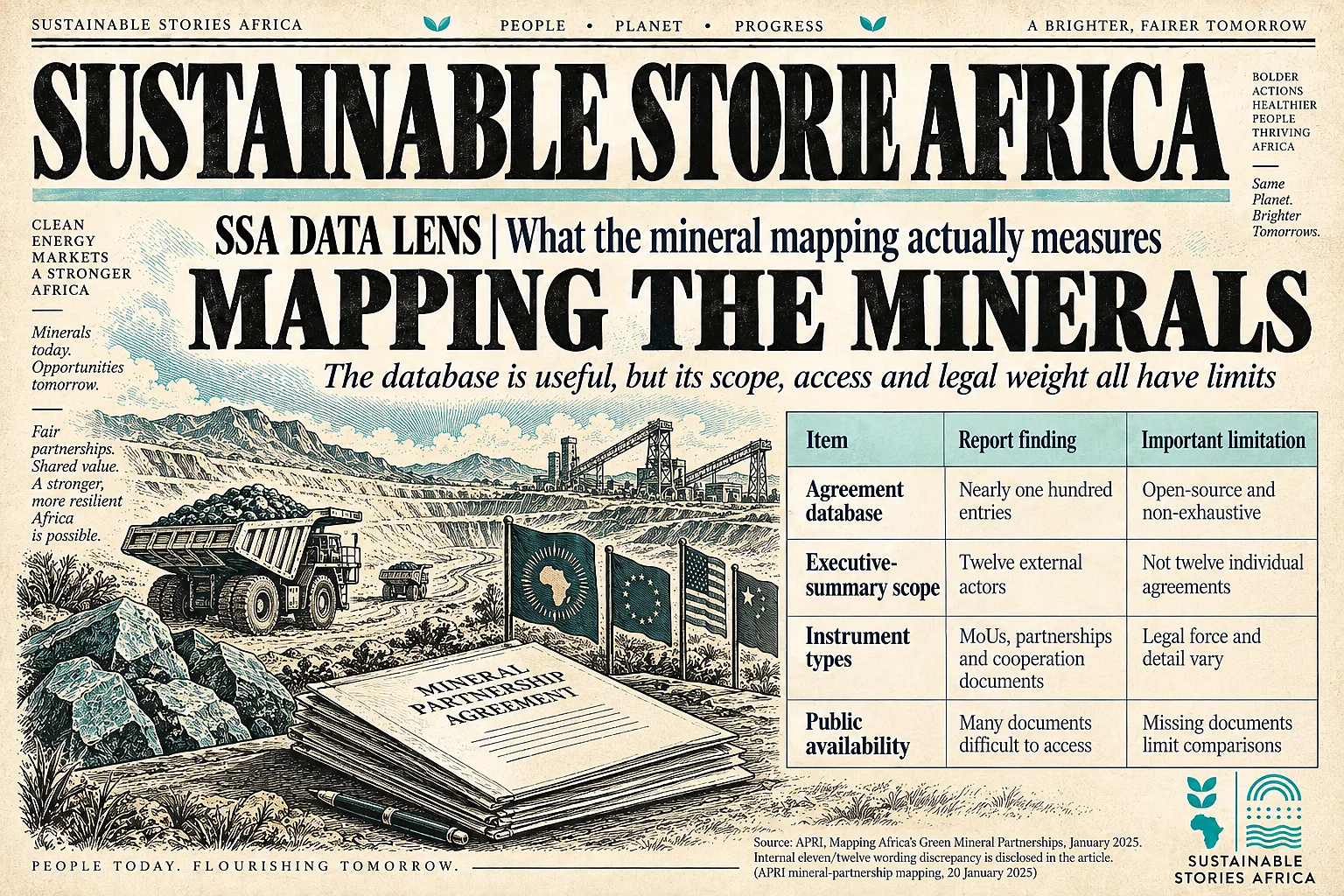
Nearly one hundred mineral-related agreements feature in APRI’s mapping of Africa’s partnerships with external actors.
Their number reveals diplomatic activity, but not necessarily financed projects, industrial upgrading or community benefits.
For African governments, the stronger negotiating question is what each partnership delivers: transparent commitments, competitive processing opportunities, infrastructure, skills and enforceable environmental and social safeguards.
Mineral Diplomacy Needs A Development Test
Africa’s growing network of green-mineral partnerships should be judged by delivered development outcomes rather than the frequency of signing ceremonies.
- Agreements can open doors, but financing, infrastructure and enforceable obligations determine whether they become productive investment.
APRI’s Mapping Africa’s Green Mineral Partnerships, published on 20 January 2025, documents nearly one hundred agreements in a non-exhaustive open-source database.
- Its executive summary examines twelve external actors, including the European Union as an institution.
For this October 2026 article, the mapping is a historical evidence base, not a live count of every current partnership.
The central question remains relevant:
- Can African governments convert global competition for mineral supply into local industrial capacity while retaining public oversight?
Agreement Counts Do Not Measure Investment
The report describes a wide spectrum of arrangements: memoranda of understanding, strategic partnerships, cooperation agreements and joint statements.
- Some establish committees or roadmaps; others encourage investment, knowledge exchange or mineral value-chain integration.
- Many are vague or non-binding.
These instruments should not be treated as equivalent to mining licences, financing commitments or operating assets.
- An agreement can improve diplomatic relations without obliging a company to build a refinery.
- A commercial acquisition may proceed through channels that are not captured by a count of state-to-state documents.
That is why a leaderboard of partnerships can mislead.
- More agreements may indicate stronger diplomatic outreach, better public disclosure or simply a broader definition of what is counted.
- Fewer publicly available agreements do not necessarily mean less investment.
For citizens in a mining region, the development test is more tangible: access to employment, responsible land use, reliable infrastructure and a fair share of economic value.
These outcomes require evidence beyond the signing announcement.
External Partners Follow Different Strategic Models
APRI finds that mineral diplomacy reflects national security, industrial policy and geopolitical relationships as well as decarbonisation.
- Buyers seek resilient supplies and reduced dependence on concentrated processing chains.
- Supplier countries seek investment and greater value retention.
- These interests can overlap without being identical.
The report contrasts direct state involvement and public financing with approaches that primarily encourage private investment.
- It cautions that enabling frameworks often need additional instruments, such as preferential finance, before projects become commercially attractive.
Its discussion of the United Arab Emirates illustrates the difference between diplomatic mapping and corporate activity.
- APRI identifies a $1.1 billion transaction for a 51% interest in Zambia’s Mopani Copper Mines through International Resources Holding.
- The transaction is a specific equity investment, not proof that every bilateral understanding leads to comparable capital deployment.
The report also notes that environmental and social provisions vary across agreements.
- Their presence is useful, but wording alone does not demonstrate implementation.
- Public access, monitoring arrangements and the ability to enforce obligations matter.
For African negotiators, understanding a partner’s strategic objective can clarify bargaining room.
- A buyer concerned with long-term supply may value stability, infrastructure and processing capacity.
- The challenge is to translate that interest into obligations that support the host country’s own development plan.
Criticality itself is context-specific.
- APRI explains that countries’ mineral strategies reflect their particular industrial, technological and security priorities.
- A material that is strategically important to an importing country does not automatically occupy the same place in the producer’s development agenda.
African governments should therefore define their own priorities before responding to external lists.
- These may include geological knowledge, competitive processing, domestic infrastructure or improved supplier capability.
- An agreement that secures a buyer’s future supply can support those aims, but only if they are incorporated into the negotiation.
The distinction also improves public debate.
- Calling a resource critical can create a sense of urgency that narrows scrutiny.
- However, urgency does not remove the need to evaluate project economics, environmental obligations or the public cost of concessions.
A clear national position gives negotiators a basis for comparing offers.
- Instead of asking only which partner will move fastest, officials can ask which proposal best meets disclosed objectives, with credible financing and enforceable responsibilities.
This makes competition among partners useful without assuming that competition alone produces fair terms.
Shared Infrastructure Can Expand Mineral Value
Local value addition is an important ambition, but it needs economic discipline.
- Processing mineral output domestically can create industrial capability when reliable energy, logistics, skills and suitable scale are available.
- Mandating a facility without those conditions can leave an expensive promise unfulfilled.
A stronger partnership would identify the practical investments needed to make processing competitive.
- Shared power, transport and water infrastructure can support activity beyond a single concession if access arrangements and pricing are designed for wider use.
- The benefit should be assessed against public costs and alternative investments.
APRI emphasises that African countries are not passive recipients of external offers.
- Governments can select partners and reject arrangements that do not align with national or regional objectives.
- That agency is stronger when negotiation is informed by comparable terms and credible project analysis.
Regional coordination can also help.
- Not every country needs the same facility, and some value chains may work better across borders.
- Mineral diplomacy should therefore connect with electricity planning, logistics and regional industrial strategies rather than operate as a self-contained foreign-policy exercise.
Community participation is equally central. Industrial value cannot compensate for avoidable environmental damage, uncompensated displacement or unsafe work.
The meaning of a green mineral must extend beyond its eventual use in a low-carbon technology.
Publish Commitments And Track Their Delivery
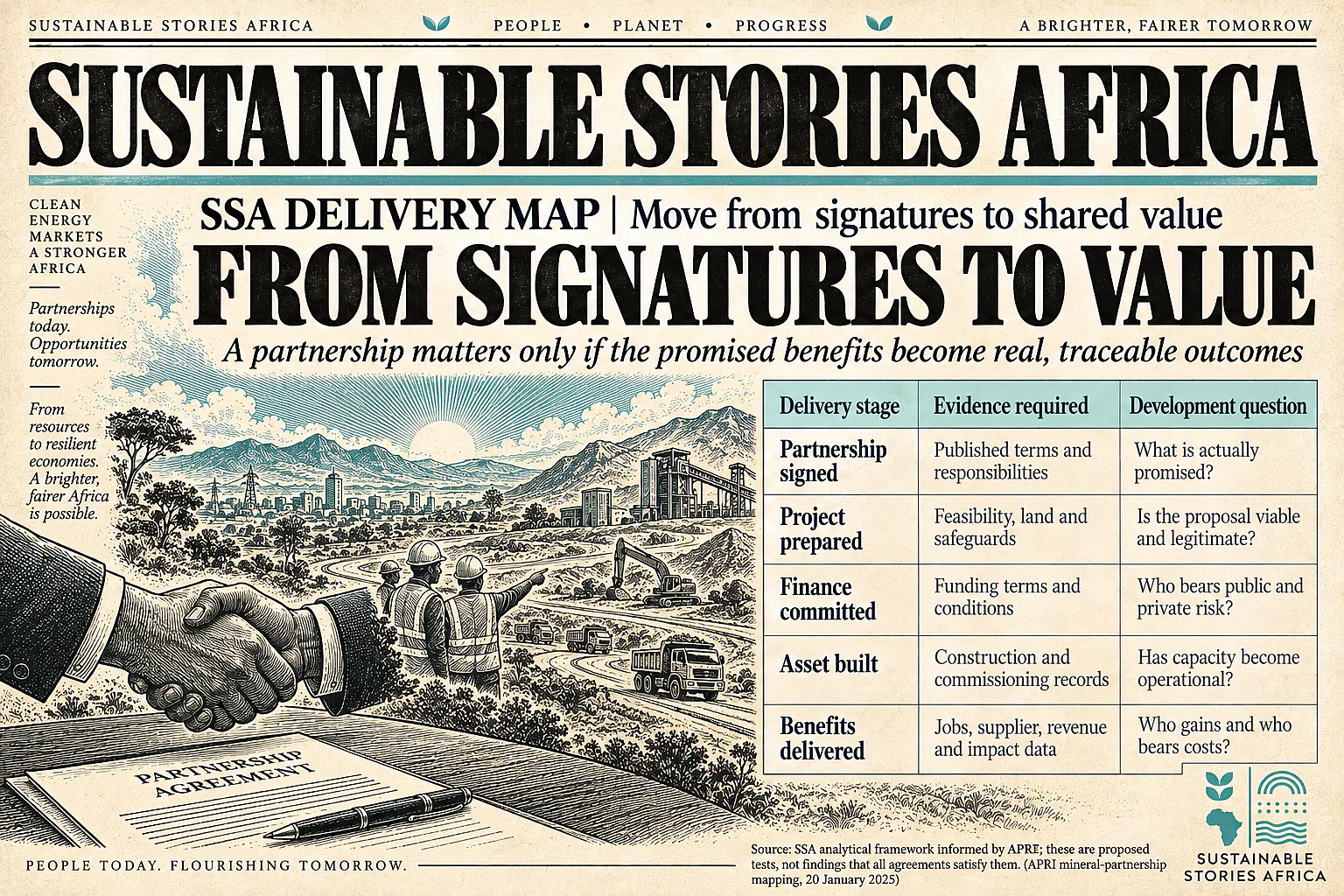
Governments should publish agreements where legally possible and disclose the material commitments attached to them.
- Where confidentiality is justified, a public summary should still identify objectives, responsible institutions, duration and implementation milestones.
- Transparency makes comparison and scrutiny possible.
Each partnership should have a delivery record distinguishing diplomatic intention, project preparation, committed finance, disbursement, construction and operation.
- These categories prevent an announced investment from being repeatedly reported as if it were new capital.
Negotiators should specify who funds geological work, infrastructure and skills development; how local suppliers can compete; and what happens if milestones are missed.
- Environmental responsibilities need to cover the project life cycle, including rehabilitation and closure.
Investors should provide evidence of the financing and operating assumptions behind proposed facilities.
Governments should test public guarantees and tax concessions against realistic outcomes, rather than assume that resource competition makes every project commercially sound.
APRI’s own methodology requires caution.
- The executive summary names twelve actors, while a methodology passage refers to eleven partners.
- This article uses the explicit twelve-actor list and does not convert that internal inconsistency into a precise comparative ranking.
The same discipline applies to the database’s nearly one hundred agreements.
- Its authors describe it as non-exhaustive and dependent on publicly discoverable information.
- It is a tool for understanding diplomacy, not an audited register of active mines or invested capital.
A credible African minerals strategy should make those distinctions routine.
- The aim is to replace announcement-driven success with verifiable progress in production, skills, public revenues and community outcomes.
Path Forward – Make Mineral Diplomacy Accountable To Development
African governments should connect mineral partnerships to costed industrial plans, publish material commitments and track progress from intention to operation.
Financing, shared infrastructure and community safeguards need named owners and measurable milestones.
The green transition creates negotiating opportunities, not automatic development gains.
Africa retains more value when agreements are transparent, commercially credible and accountable to the people living with extraction.