Africa’s bandwidth and data infrastructure are expanding, but connectivity is not translating evenly into productivity or export growth.
AFC’s 2026 report identifies a missing middle: the platforms, skills and institutions that help businesses use digital infrastructure effectively.
Its benchmark scenario suggests substantial digital-services export potential.
Realising that opportunity requires enterprise adoption and functioning ecosystems, not cables and data centres alone.
Africa Needs Digital Systems That Produce
Africa’s next digital investment challenge is to turn connectivity into productive economic activity.
The Digital Infrastructure chapter of AFC’s State of Africa’s Infrastructure Report 2026 argues that physical networks must connect with platforms, skills and enterprise use.
The report examines 46 African countries over 2014 – 2024 and finds no clear relationship between faster connectivity expansion and corresponding growth in digitally delivered services exports.
- The result challenges the assumption that infrastructure deployment alone guarantees internationally tradable digital output.
It does not establish that connectivity lacks value.
- Digital infrastructure also supports domestic payments, public services and business activity that export measures do not capture.
The useful question is what additional conditions enable those investments to create wider economic returns.
More Digital Capacity Does Not Ensure Use
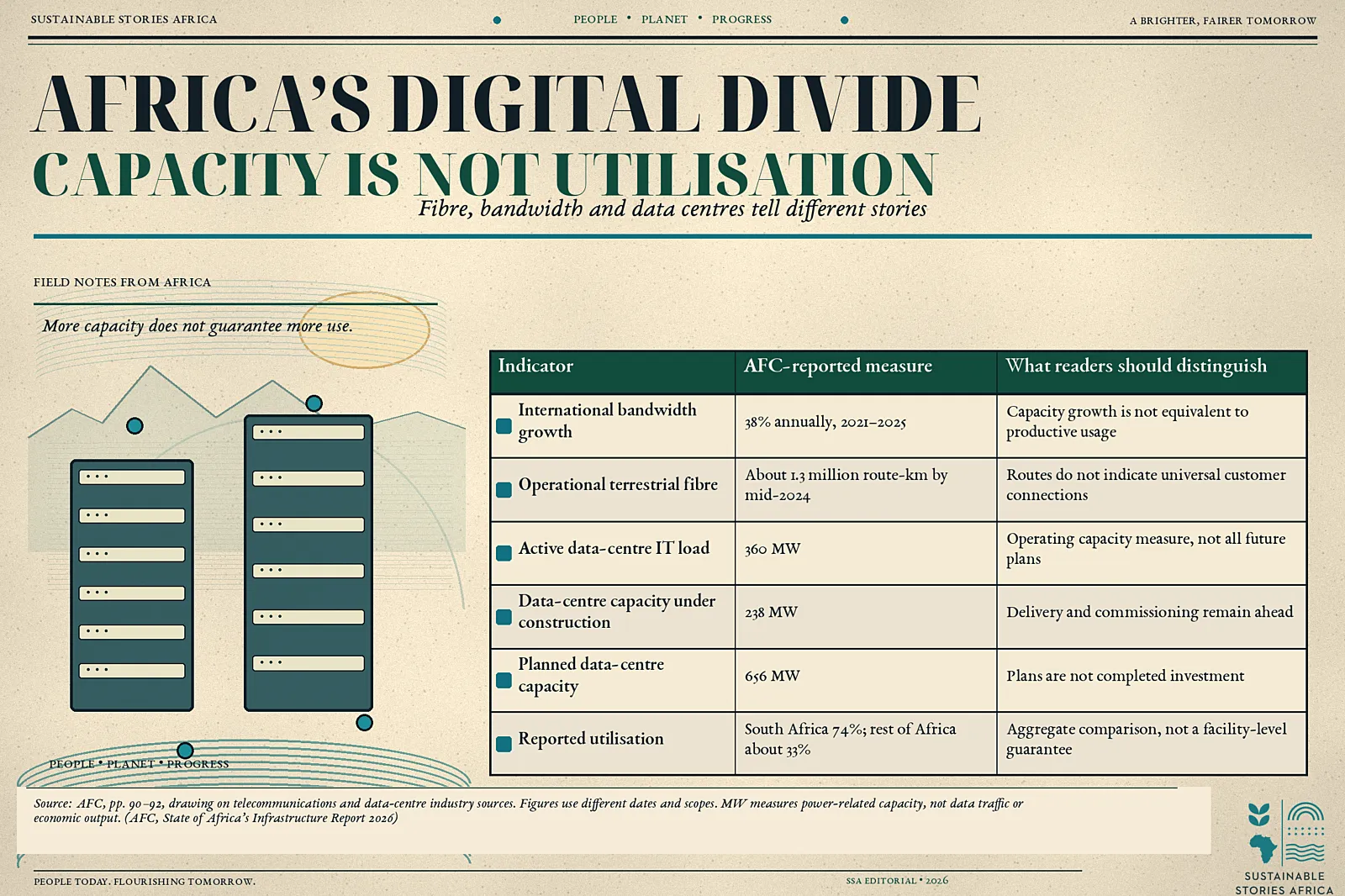
The data-centre market illustrates the gap between capacity and utilisation.
- AFC cites approximately 360 MW of active IT load, with 238 MW under construction and 656 MW planned.
- The combined total of 1,254 MW includes operating capacity as well as future projects.
This distinction matters for investment narratives.
- Planned megawatts are not available computing capacity, and available capacity is not necessarily occupied.
- The report cites utilisation of roughly 74% in South Africa against around 33% across the rest of Africa.
These market-level figures do not describe every facility.
- They nevertheless highlight why investors must examine the demand behind construction plans.
- More buildings and power capacity will not automatically create enterprise customers capable of paying for advanced services.
The Missing Middle Connects Infrastructure With Firms
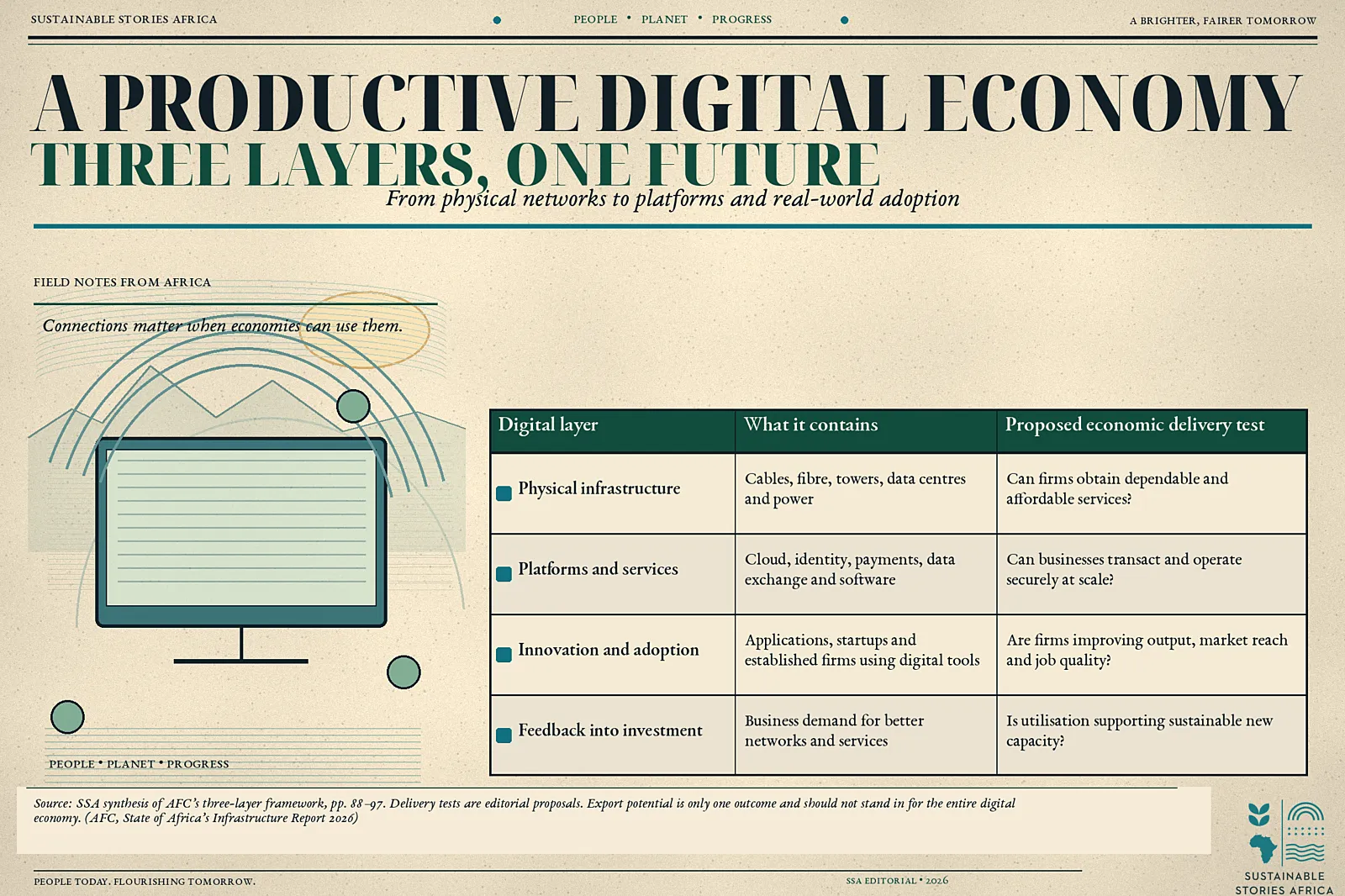
AFC presents three interdependent layers.
- Physical infrastructure includes cables, fibre, towers, data centres and energy systems.
- The platform layer includes payments, cloud services, digital identity, data exchange and enterprise software.
- The innovation layer consists of applications and firms using those capabilities.
The missing middle therefore has both physical and institutional dimensions.
- Inland backbones and local interconnection help distribute connectivity, while platforms and rules make it usable for business.
Focusing on only one interpretation risks overlooking the other.
- A retailer, for example, may gain little from faster connectivity if payment systems, inventory tools and relevant skills remain inaccessible.
- A service exporter may need dependable hosting, secure data handling and customers’ confidence as well as bandwidth.
These are illustrative business needs, not cases measured individually by AFC.
The report’s MainOne example shows how layers can reinforce one another.
- It traces investment from an international cable into metro fibre and data-centre services, followed by a wider technology ecosystem.
- The account illustrates a pathway; it should not be treated as proof that one infrastructure provider caused every subsequent business success.
This distinction is important for policy.
- Infrastructure remains necessary, especially in underserved areas, but complementary investment can determine how much economic activity it supports.
- Rebalancing towards utilisation does not mean abandoning connectivity gaps.
The export analysis is observational rather than a controlled test of causation.
- Differences in economic structure, measurement and time lags can influence the relationship between connectivity and exports.
- AFC’s findings support a cautious conclusion: connectivity alone is not sufficient evidence of export success.
They do not identify a single missing variable that explains every country’s performance or prove that new network investment cannot help.
There is a similar distinction between coverage and meaningful use.
- A network may reach a location without providing every resident or business with affordable devices, appropriate services or the skills to benefit.
Measuring geographic availability is therefore necessary but incomplete.
- A productivity strategy needs to follow what people and firms are able to do with access, not simply whether a signal is present.
Digital Exports Offer A Useful Benchmark
AFC uses Ghana’s digitally delivered services exports, equivalent to 6.3% of GDP in its analysis, as a benchmark.
- Applying that ratio to the ten economies in its comparison would raise their combined exports from approximately $29 billion to $127 billion annually.
The implied difference is about $98 billion.
- It is a benchmark scenario, not a forecast, financed pipeline or guaranteed revenue opportunity.
- Countries differ in economic structure, skills, market access and capacity to develop internationally competitive services.
The measure also has boundaries.
- Digitally delivered services capture cross-border services supplied remotely through digital networks.
- They do not capture every domestic digital transaction, digital goods sale or service supplied through a commercial presence abroad.
For decision-makers, the scenario is most useful as a prompt for investigation.
- It asks why some economies convert digital capabilities into tradable services more effectively, and which barriers can be addressed without assuming identical outcomes across countries.
A practical adoption programme can begin with existing business problems rather than a technology label.
- Firms may need to manage stock, accept payments, coordinate deliveries or reach customers. Appropriate tools can then be assessed against those tasks.
- This keeps the focus on useful outcomes and makes it easier to identify whether the limiting factor is connectivity, software, skills, finance or the design of the business process.
The environmental dimension should be considered within that same system view.
- Data facilities and networks depend on electricity and other physical resources; digitalisation should not be described as impact-free.
- Investment assessment can examine resource efficiency and service value alongside commercial demand.
This approach avoids treating additional computing capacity as inherently sustainable while still recognising its potential to support more efficient economic activity.
Finance Adoption Alongside Networks And Compute
Governments should integrate digital infrastructure with economic-development plans.
- Network investment should be accompanied by a clear account of the firms, services and public functions expected to use it.
- This can help distinguish a service gap from a demand-development gap.
Digital public infrastructure also needs deliberate governance.
- Identity, payments and data exchange can support scale, but implementation should address privacy, security, accountability and exclusion.
- A functioning platform is not simply one that processes transactions; it must earn users’ trust.
Businesses need practical routes to adoption.
- Training should connect with tasks firms actually perform, while enterprise tools should fit operating conditions and budgets.
- Technology procurement without organisational change may leave useful capacity underused.
Investors should examine occupancy, customer concentration and power reliability when evaluating data facilities.
- A growing global AI market does not remove local commercial constraints.
- Compute infrastructure needs credible users, technical support and energy arrangements appropriate to its service obligations.
Regional institutions can help reduce fragmentation in digital trade and infrastructure.
- Cross-border networks, compatible rules and workable data arrangements may broaden markets, provided they preserve legitimate safeguards.
- The aim is to make scale possible without assuming that every country requires identical infrastructure.
Finally, success should be measured more widely than funding announcements.
- Adoption among existing firms, service reliability, customer affordability and workforce outcomes can reveal whether digital investment is improving economic performance.
- Export growth remains valuable, but domestic productivity gains should not disappear from the assessment simply because they are harder to summarise in one headline.
Path Forward – Turn Connectivity Into Productive Economic Participation
Africa should build the platforms, skills and enterprise capabilities that make networks useful.
Infrastructure investment must continue where gaps remain, but utilisation deserves equal strategic attention.
Governments and financiers should judge digital programmes through business adoption, dependable services and economic outcomes.
The opportunity is not simply to connect more people, but to help people and firms use those connections productively, securely and inclusively.