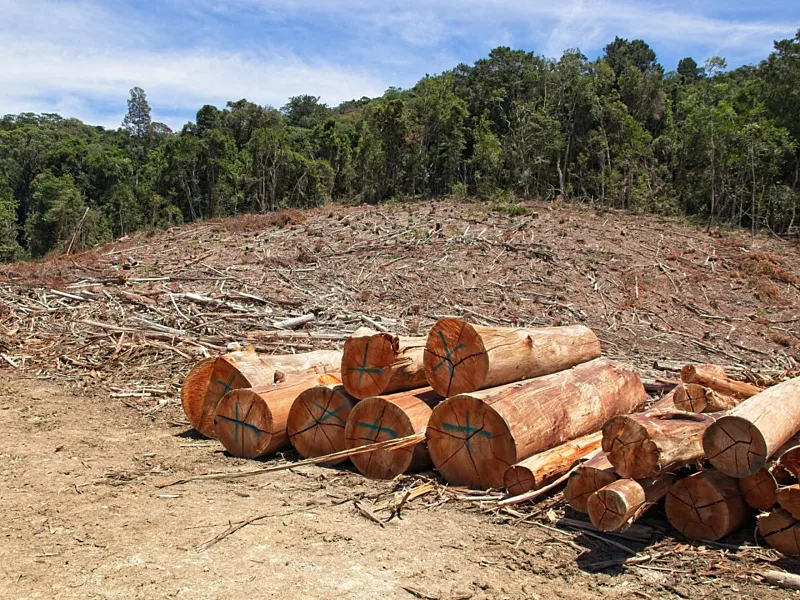
Destroying Forests, wetlands and watersheds undermines public finances, as sovereign debt pressure restricts the money available to protect those ecosystems.
A new analysis of nature, finance and development argues that sustainable growth requires making the economic value of natural capital visible in credit assessments, debt instruments and public investment.
Africa has a particular stake in breaking this debt–nature feedback loop.
Nature Protection Is Also Economic Infrastructure
A watershed is not a power station; however, it helps keep hydroelectric turbines operating, farms productive and city water supplies secure.
A mangrove forest does not resemble a seawall; however, it reduces damage caused by storm surges and coastal erosion.
When natural assets deteriorate, economic losses eventually appear in budgets, insurance claims and household livelihoods.
In Chapter Six of Nature, People, and Sustainable Development, Arend Kulenkampff and Julie McCarthy examine innovations that connect climate, biodiversity and development finance.
- They argue that nature loss, climate shocks and sovereign debt stress reinforce each other, particularly across lower- and middle-income economies.
For Africa, where agricultural livelihoods, tourism, forests, fisheries and hydropower remain essential to many economies, this diagnosis challenges a persistent policy gap:
- Nature spending is routinely treated as a cost, while the economic protection produced by resilient ecosystems is rarely given equal weight in finance decisions.
Money Still Rewards Nature Degradation Too Often
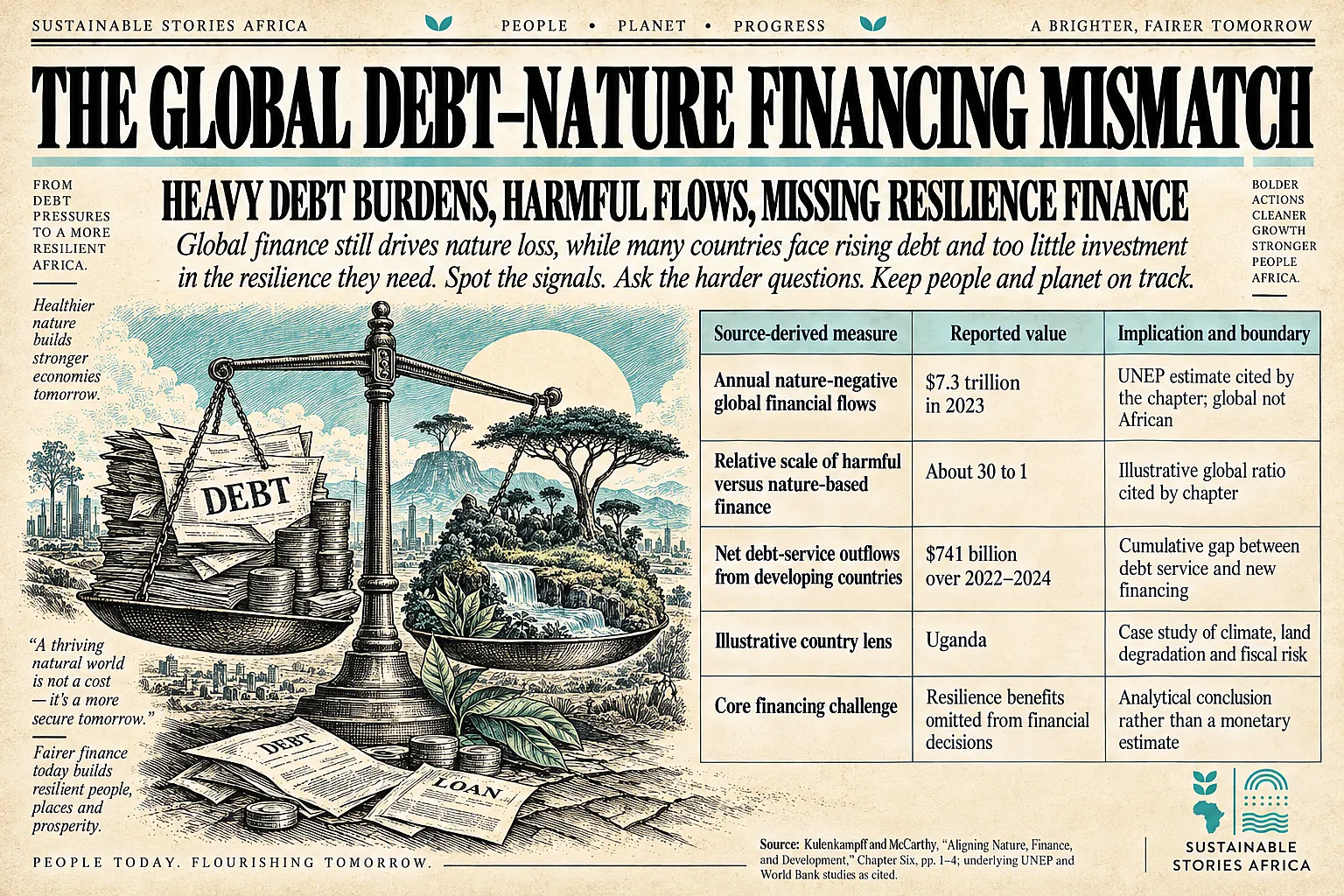
The chapter cites United Nations Environment Programme estimates of $7.3 trillion in global annual nature-negative financial flows in 2023, around 30 times the money directed to nature-based solutions.
- That is a global comparison, not an estimate of flows into or out of Africa.
- Nevertheless, it captures the scale of the mismatch between financial activity that degrades ecosystems and investment intended to sustain them.
The chapter also reports that developing countries paid $741 billion more in debt service than they received in new financing over 2022 – 2024, based on World Bank analysis.
- These cumulative net outflows restricted fiscal options during a period of rising climate and conservation needs.
- Public authorities facing debt pressure may postpone watershed restoration or land management, leaving future infrastructure and communities more vulnerable to floods and drought.
The vicious cycle is fiscal and ecological.
- Environmental degradation reduces agricultural and export performance; weaker growth and disaster losses raise perception of country risk; higher borrowing costs then reduce the resources available for resilience.
- The result can be a penalty for environmental vulnerability without a corresponding financial reward for reducing it.
New Instruments Link Ecology And Creditworthiness
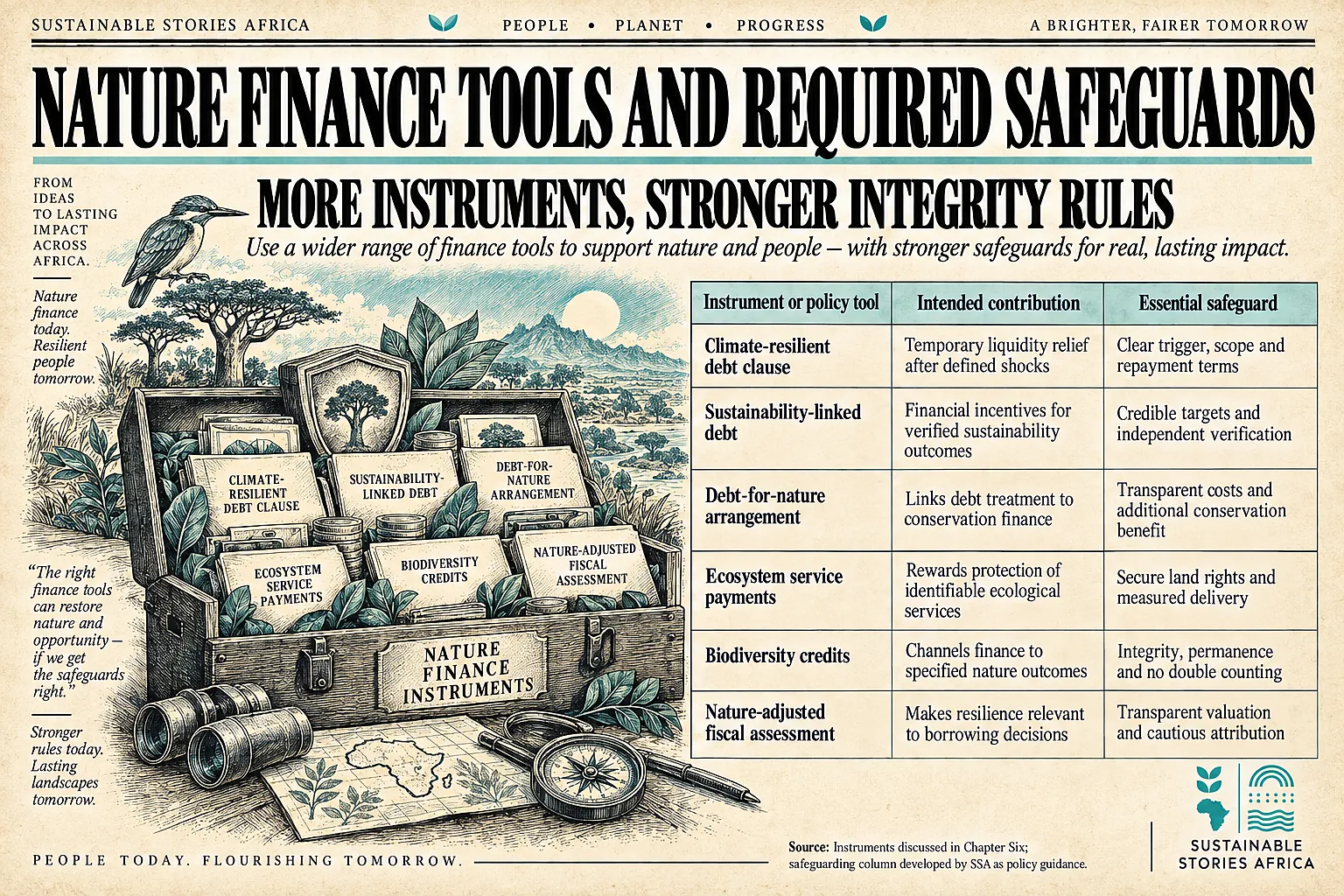
The chapter explores sustainability-linked bonds, debt conversions, climate-resilient debt clauses, sustainability-linked insurance, payments for ecosystem services, biodiversity credit mechanisms and country-level investment platforms.
- Their common purpose is converting environmental performance into financial incentives or budget protection.
Climate-resilient debt clauses, for example, can allow temporary debt-service suspension after predefined extreme events, reducing short-term liquidity pressure when governments need resources for recovery.
- They do not erase debt or fix an unsustainable borrowing structure. Sustainability-linked debt instruments can connect financial terms to measurable results, but only if indicators, verification and penalties are sufficiently robust to prevent superficial claims.
Uganda is used as a case where climate variability and land degradation threaten agricultural output and exports while high debt burdens limit adaptation.
- The authors reference work suggesting that targeted investment in climate- and nature-resilient agro-industrialisation could raise medium-term growth and reduce macroeconomic volatility.
- The key unresolved issue is how those gains can influence sovereign risk assessments and financing costs.
Not every new instrument is automatically beneficial.
- Biodiversity credits need defensible ecological baselines, clear treatment of permanence and safeguards for local land rights.
- Debt-for-nature transactions require transparent economics, independent conservation monitoring and confidence that promised benefits exceed transaction costs.
Without these controls, innovative labels can conceal weak accountability.
Resilient Ecosystems Can Strengthen Public Finances
If financial systems begin recognising restored catchments, productive soils and resilient coasts as economic assets, public investment decisions could improve.
- Governments might compare the cost of an engineered drainage structure with a combined wetland restoration and infrastructure solution.
- Lenders might investigate whether a flood-protection investment reduces future default exposure rather than recording only its upfront expense.
This matters for African economies seeking growth without increasing climate vulnerability.
- Healthier watersheds can support reliable hydropower and irrigation.
- Sustainable land management can protect rural communities' productivity.
- Coastal conservation can strengthen tourism, fisheries and disaster resilience.
These potential benefits need measurement, not assumption: ecological restoration does not automatically translate into lower borrowing rates.
- Recognising nature in credit models could also increase environment ministries' and local communities' influence over investment planning.
- However, the chapter emphasises the risk of fragmented pilots that cannot scale, capture too little value for host communities or neglect social protections.
The real opportunity is to embed ecosystem outcomes into the financial institutions that already allocate resources.
Make Resilience Visible In Financial Decisions
African finance ministries, debt offices, central banks and DFIs can begin by mapping dependencies between economic sectors and ecosystems.
- Fiscal risk statements should identify flood, drought, land degradation and water-security exposure alongside conventional debt risks.
Development banks can assess resilience benefits using published methodologies, conservative assumptions and independently verified outcomes.
- Transactions should proceed only when financial and ecological additionality can be evidenced.
Investors must avoid suggesting that a single restored landscape resolves national debt risk.
Communities should participate in decisions about resource access, compensation and benefit sharing; otherwise nature finance could recreate social inequalities while reporting favourable environmental metrics.
Public finance officials should also distinguish between annual flows and long-term stocks.
- A forest may contain substantial economic value, but that does not mean its estimated ecosystem-service value can be pledged as liquid collateral.
- Likewise, a projected reduction in disaster losses is not the same as immediate budget savings.
Credible frameworks should use scenario ranges, identify beneficiaries and consider how quickly protective effects are realised.
For market participants, the opportunity is to develop investable pipelines with land tenure clarity, baseline monitoring, maintenance budgets and community agreements.
- Without these foundations, nature finance can remain accumulations of small transactions that fail to change national resilience or sovereign credit conditions.
Path Forward – Finance Nature As Resilience Not Charity
Africa can begin to break the debt–nature cycle by integrating ecosystem risk and restoration benefits into sovereign financing, investment selection and budget planning.
The priority is not to multiply attractive financial labels.
The priority is to create verified mechanisms through which healthier ecosystems protect livelihoods, lower future vulnerability and strengthen the case for sustainable development finance.