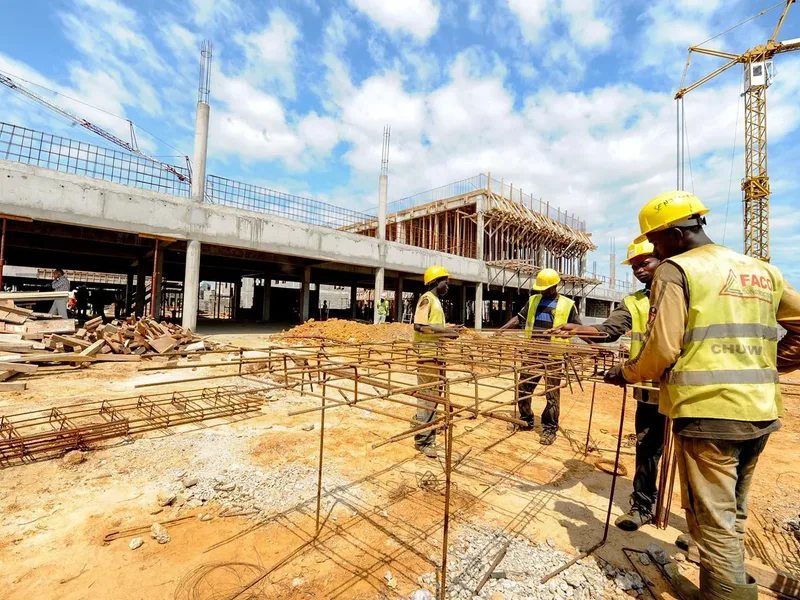
South Africa’s March 2025 draft Transformation Fund concept proposes mobilising R100 billion over five years to improve access to finance for majority black-owned enterprises.
The financing ambition is considerable, but the proposal’s development impact depends on implementation: credible governance, transparent resource mobilisation, patient capital and measurable improvements in enterprise survival, jobs and ownership.
The document describes a proposal, not evidence of a fully capitalised fund.
Bridging Enterprise Finance And Economic Exclusion
In South Africa, access to business finance is closely connected to a longer struggle over who owns productive assets, enters established supply chains and benefits from growth.
Historic economic exclusion cannot be addressed solely by telling entrepreneurs to borrow from commercial banks on terms they cannot meet.
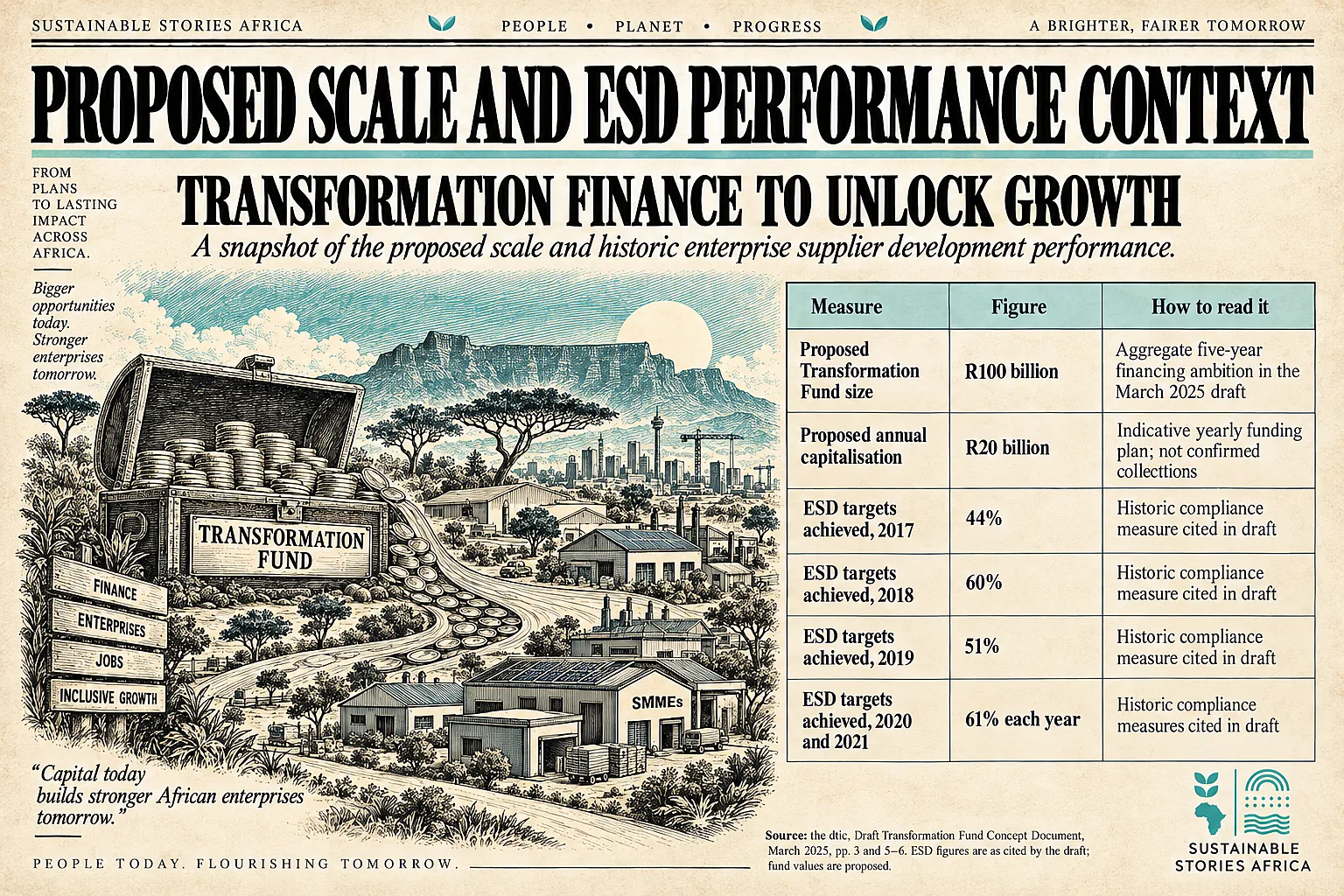
The Department of Trade, Industry and Competition's Draft Transformation Fund Concept Document, dated March 2025, proposes an aggregated R100 billion fund, intended to be capitalised at R20 billion a year for five years.
It envisages cooperation between government and private-sector contributors, with support directed towards majority black-owned and managed businesses.
The document is a policy blueprint.
- It does not by itself establish that contributions have been collected, the full fund has been launched, or beneficiary results have been achieved by October 2026.
The distinction matters: a strong proposal becomes transformative only when financing, selection processes and outcomes can be independently demonstrated.
One-Hundred-Billion-Rand Needs Accountability
A R100 billion ambition is not merely a financing headline.
- It proposes channelling capital into enterprises that face unequal access to loans, networks, procurement opportunities and specialised support.
- The draft anchors the initiative in South Africa’s constitutional equality provisions and the Broad-Based Black Economic Empowerment framework.
Its case for reform includes Enterprise and Supplier Development (ESD) performance data.
- The draft cites B-BBEE Commission findings that measured entities achieved 61% of ESD spending targets in 2021, following reported levels of 44% in 2017, 60% in 2018, 51% in 2019 and 61% in 2020.
- These figures describe the share of applicable targets achieved under the cited reporting framework, not annual growth in the fund or success rates of supported businesses.
The implication is that formal compliance contributions do not automatically produce broad-based economic participation.
An aggregated vehicle might coordinate resources, but concentration also creates risks of patronage, slow disbursement, and weak oversight unless its operating model has checks and balances.
Flexible Capital Meets Local Enterprise Needs
The draft distinguishes itself from narrowly loan-based approaches by envisaging debt, grants and equity, distributed through a combination of direct financing and wholesale intermediaries.
- It also proposes support before and after investment: feasibility and environmental studies, business planning, accreditation, export readiness and financial management training.
That design recognises a practical bottleneck.
- A rural agro-processor may require packaging certification and stable buyers before an affordable loan becomes viable.
- A township manufacturer may need equipment, premises and procurement access more urgently than a short-term credit facility.
- A technology supplier may possess commercial potential but lack engineering accreditations necessary to join larger contracts.
The concept proposes allocating resources to township and rural businesses, focusing on entities located in and employing people from those communities.
- It also references productive sectors including agriculture, services, tourism, manufacturing, technology and renewable energy.
- These priorities give the plan a potentially broader economic-development purpose than an ordinary small-business lending window.
The funding model envisages public and private contributions and a special-purpose vehicle (SPV).
- Its proposed governance structure includes an eight-member board appointed by the minister, a separate oversight committee and ring-fenced bank arrangements.
- These arrangements could establish accountability lines, but appointment processes, operational independence, transparent eligibility and public reporting remain decisive implementation questions.
Inclusive Capital Can Build Productive Ownership
Well-designed transformation finance can create value beyond the original grant or investment.
- Enterprises that survive, diversify and enter larger supply chains may contribute to job creation, skills transfer, local procurement and more geographically balanced development.
- In the green economy, access to project-preparation finance could help smaller companies compete for renewable-energy and efficiency contracts rather than remaining subcontractors without ownership stakes.
However, disbursement volume is an inadequate definition of success.
- A fund could meet annual spending targets while failing to increase enterprise productivity or expand participation beyond already well-connected businesses.
- Successful transformation would instead be visible in new firms reaching financial sustainability, better-quality jobs, more competitive suppliers, increased exports and measurable ownership change.
Fiscal and governance risks exist.
- Concessionary finance must be priced and provisioned responsibly; grants need transparent eligibility; and politically sensitive beneficiary selection must be insulated from conflicts of interest.
- Environmental and social safeguards should apply to supported projects, including worker protection and community impacts. Inclusive finance must not be exempt from rigorous impact and risk management.
Measure Real Transformation Beyond Announced Funding
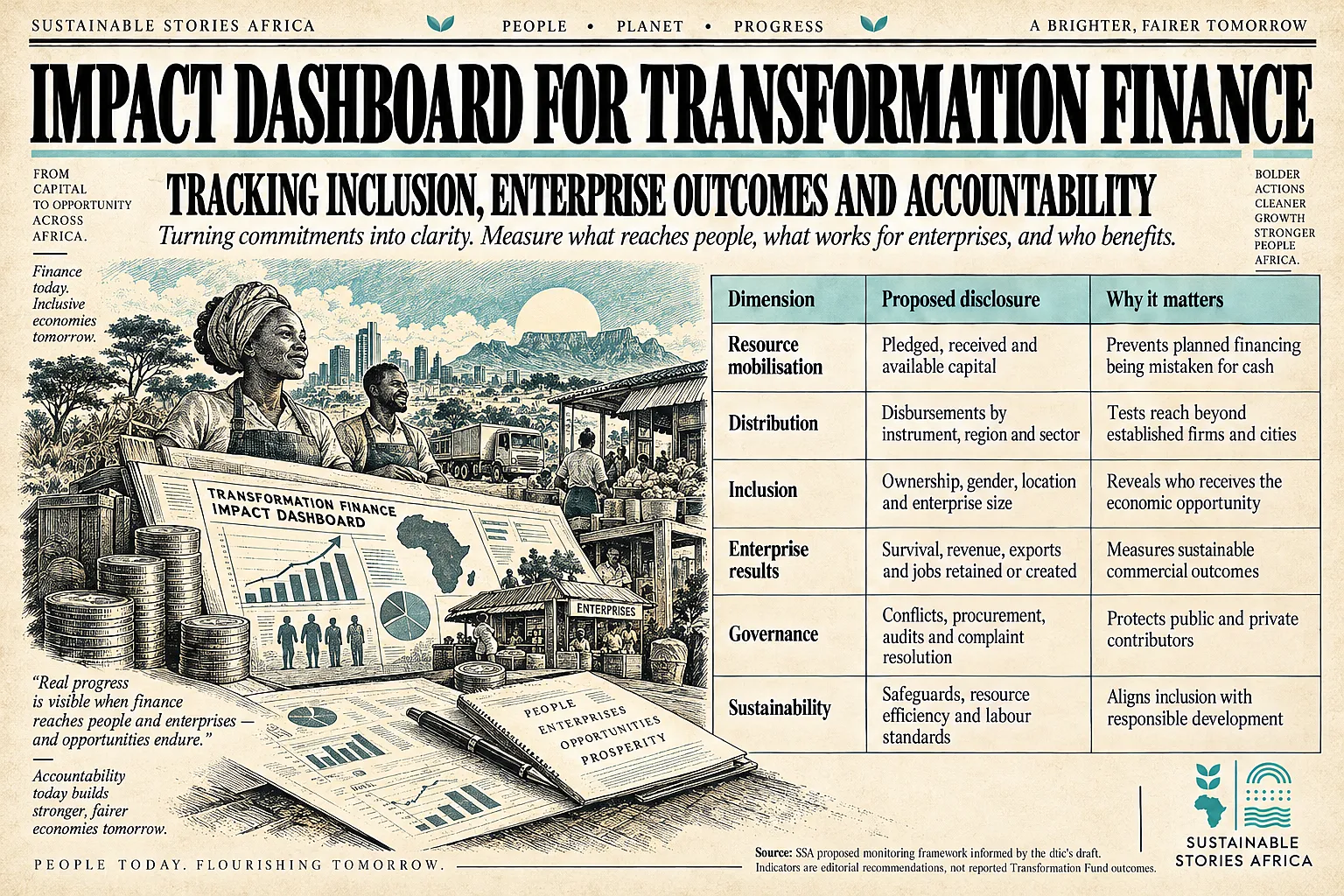
Before evaluating the proposed vehicle as an achievement, stakeholders should ask whether it has established its legal status, funding commitments, governance appointments, audited systems and disbursement procedures.
Once operating, reporting should distinguish committed capital from cash received, approved financing from amounts disbursed, and direct from intermediated support.
For other African economies, the bigger lesson lies in institutional design rather than replication of South Africa’s legal framework.
- Blended financing windows that combine investment readiness, capital and supplier access could help excluded enterprises.
- However, local eligibility, fiscal capacity and anti-corruption systems would need country-specific design.
A second question concerns crowding-in private finance.
- Public and concessional support may be most effective where it unlocks viable businesses that commercial lenders have overlooked, rather than subsidising firms that could already raise affordable funding.
- This requires clear additionality tests and a plan for businesses to graduate from subsidy to market finance.
- Periodic evaluation should also check whether intermediaries shift costs onto beneficiaries or channel financing to familiar customers.
The proposed mixture of grants, debt and equity offers flexibility, but it should not blur accountability.
Grants need evidence of public benefit, loans require prudent repayment and restructuring policies, and equity investments require rules on valuation, control and exits.
Path Forward – Turn Finance Commitments Into Measurable Inclusion
South Africa’s proposed Transformation Fund offers an ambitious template for linking enterprise finance to economic redress.
Its public value will depend on governance, actual capital mobilisation and evidence that supported businesses become more productive and competitive.
The next accountability test is not the size of the headline fund; it is transparent proof that money reaches excluded enterprises and produces durable economic participation.