
Multilateral development banks continue to report strong capital, liquidity and credit performance, according to their 2026 comparison report.
Those strengths support lending during shocks and provide a basis for discussions about expanding capacity.
For Africa, the question is how financial reforms can translate into additional development support while preserving institutions’ ability to lend through difficult economic conditions.
Strong Balance Sheets Support Development Lending
Multilateral development banks maintained strong financial positions through 2025, according to the Multilateral Development Banks Comparison Report 2026.
Its findings support examining how existing capital can sustain greater development activity, while cautioning against simple comparisons between institutions with different mandates and portfolios.
The report is a collective institutional publication of the Global Risk and Finance Forum, published by the Asian Development Bank.
ADB and the European Bank for Reconstruction and Development coordinated the exercise, with participating banks validating their contributions. It is not attributed to a single individual author.
For African countries seeking infrastructure, climate investment and support during shocks, these balance sheets matter because they underpin dependable access to long-term finance.
However, a stronger reported capital ratio does not automatically create a new loan commitment.
Lending also depends on risk appetite, policy decisions, borrower demand and the preparation of suitable projects.
Financial Resilience Provides Room For Discussion
The comparison exercise responds to the G20 capital adequacy review’s call for recurring benchmarking.
- It brings together information on exposures, capital, liquidity, credit performance and risk transfers.
- Most data relate to year-end 2025, with institution-specific reporting dates retained where needed.
- That timing should remain attached to every comparison.
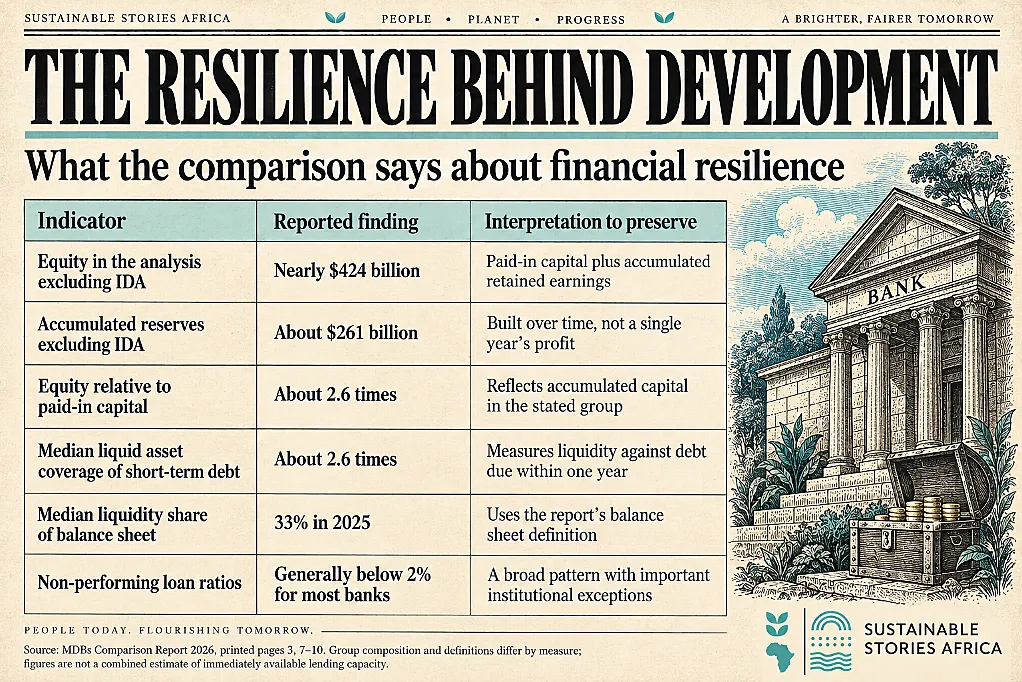
The report says accumulated reserves reached approximately $261 billion and equity nearly $424 billion for the analysis excluding the International Development Association.
- This represents capital built over time, not profit earned during 2025 alone.
- IDA is excluded because its concessional financing model and replenishment cycles make that particular comparison inappropriate.
Liquidity is also substantial.
- The report describes median liquid asset coverage of short-term debt at about 2.6 times and median liquidity relative to the balance sheet at 33% in 2025.
Such buffers help institutions meet obligations when market funding is disrupted.
- They represent the model’s resilience, not simply idle money available for immediate spending.
Capital Ratios Depend On Institutional Models
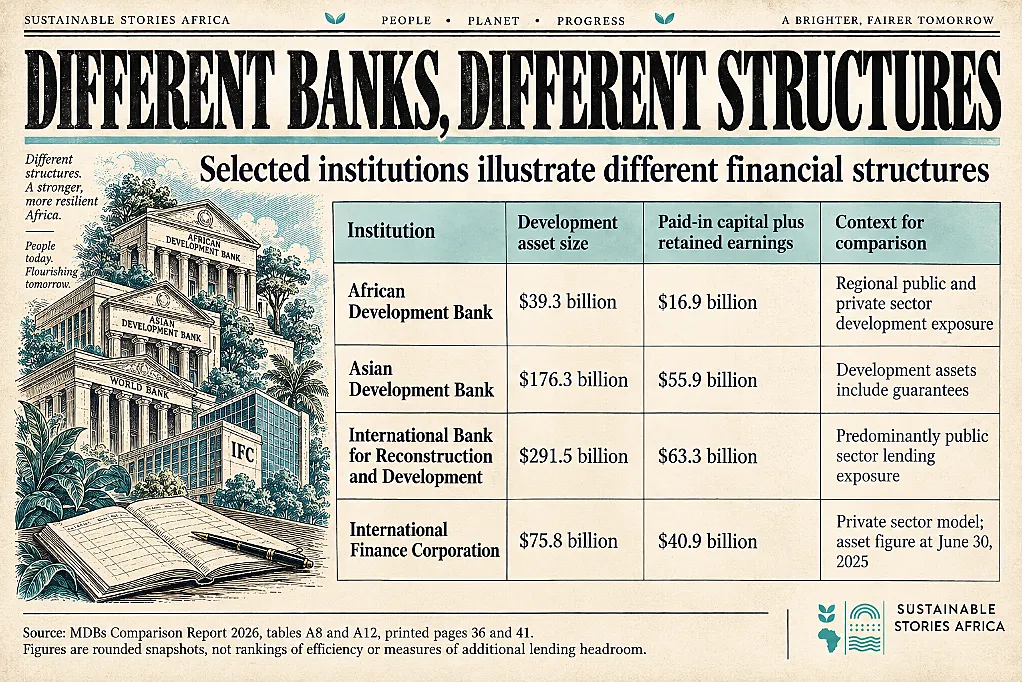
Development banks differ in the clients they serve and the instruments they use.
- A bank that lends mainly to governments has a different risk profile from one financing private enterprises or holding equity investments.
- Regional concentration and the credit quality of borrowers also affect the amount of capital needed to support a portfolio.
Preferred creditor treatment helps explain the historically strong performance of many sovereign lending portfolios.
- It reflects the priority that borrowers have generally given to repaying these institutions.
- It is a structural consideration in risk assessment, not an assurance that losses can never occur or that every exposure deserves identical treatment.
The report also describes changes in credit rating methodologies.
- S&P’s 2025 revision contributed to an average 15% improvement in the risk-adjusted capital ratios of sovereign-focused institutions by year-end.
- That is a relative improvement in the measured ratio, not a 15 percentage point gain or an equivalent injection of cash from shareholders.
Different rating agencies can produce different assessments of headroom.
- An institution that appears well capitalised under one framework may face tighter limits under another.
- Internal policies, statutory limits and the ability to retain a target rating can all constrain lending.
A single ratio cannot resolve these questions.
Reform Could Support Additional Development Finance
Better recognition of risk characteristics, carefully designed guarantees and portfolio risk transfers may help institutions use capital more effectively.
- The report discusses instruments including loan guarantees, first-loss arrangements and synthetic securitisations.
- Their value depends on which risks move, who takes them and whether the relevant capital framework recognises the protection.
For African borrowers, additional capacity would be most useful when it supports projects that would otherwise face a clear financing constraint.
- Renewable generation may need transmission investment; climate resilience may require public infrastructure with limited direct commercial revenue.
- Financial engineering has a development purpose when it helps suitable projects proceed on sustainable terms.
Concessional resources remain important.
- Increasing ordinary lending capacity does not replace grants or highly concessional funding for countries with limited debt capacity.
- Nor does an institution’s strong balance sheet remove the need to assess a borrower’s ability to repay.
The terms and development value of finance matter, as well as the amount.
Connect Financial Reform With Project Delivery
Shareholders and management should explain how proposed capital changes affect lending capacity under the full set of applicable constraints.
- Public discussion should distinguish changes in measurement from new capital, and potential headroom from actual financing approvals.
- That would make the reform's contribution easier to assess.
Borrowing countries need well-prepared projects and credible implementation arrangements to make use of finance.
- Preparation should include procurement, debt sustainability and environmental and social considerations.
- A larger institutional lending envelope will achieve less if unresolved design, land, administrative or implementation problems keep projects delayed.
Development banks should report how expanded capacity translates into commitments, disbursements and observable results.
- Strong liquidity and capital remain necessary to support clients during shocks.
- The objective should be to use those strengths effectively while retaining the ability to respond when private funding retreats and public investment needs become more urgent.
Path Forward – Translate Financial Strength Into Development Results
MDB reform can expand useful finance when capital decisions match suitable projects and sustainable borrower terms.
Comparisons should retain the differences in mandates, risks and accounting periods that shape each institution’s position.
For Africa, assess progress through additional services, resilient infrastructure and credible delivery, alongside the continued financial strength that makes development banks dependable partners.