Nigeria’s financial inclusion gains are bringing millions more adults into formal services.
However, the 2026 survey highlights show that access often coexists with financial stress, limited insurance and weak emergency buffers.
The next policy challenge is to measure whether accounts, payments and credit help households withstand shocks and improve everyday financial security.
More Access Leaves Financial Security Uneven
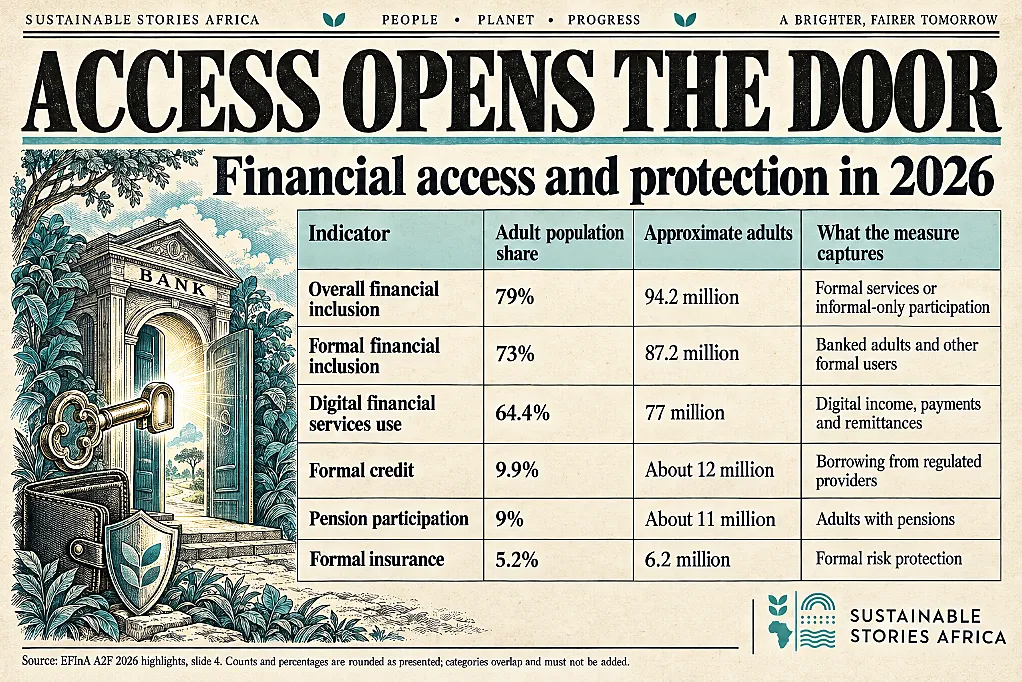
Nigeria’s formal financial inclusion reached 73% of adults in 2026, but only about a quarter of adults were classified as financially healthy.
The difference challenges policymakers and providers to assess the benefits of participation as closely as its reach.
Enhancing Financial Inclusion & Advancement (EFInA), the institutional author of the Access to Financial Services survey, highlights.
- Nigeria’s National Bureau of Statistics designed the sample and weighted the results.
- The survey achieved 18,679 interviews with adults aged 18 and above across all 36 states and the Federal Capital Territory, with fieldwork from April to June 2026.
The evidence points to substantial progress alongside persistent vulnerability.
- Digital channels are widely used, while formal borrowing, insurance and pensions remain much less common.
- For households facing uncertain incomes, the value of financial inclusion depends on affordability, reliability and the ability to manage an emergency without deepening financial distress.
National Gains Conceal Unequal Financial Progress
Overall financial inclusion, including adults relying only on informal services, reached 79%.
- Formal inclusion was lower at 73%.
These indicators answer different questions and should not be used interchangeably.
- An adult participating through an informal savings arrangement may be included in the broader measure without using a regulated provider.
Formal inclusion rose from 64% in 2023, improving by 9 percentage points.
- Digital financial services use increased particularly quickly, reaching 64.4% in the 2026 highlights.
- However, formal credit reached 9.9%, insurance 5.2% and pensions about 9%.
The system’s capacity to process transactions is reaching many more people than its protection and long-term planning products.
The national average also hides widening differences.
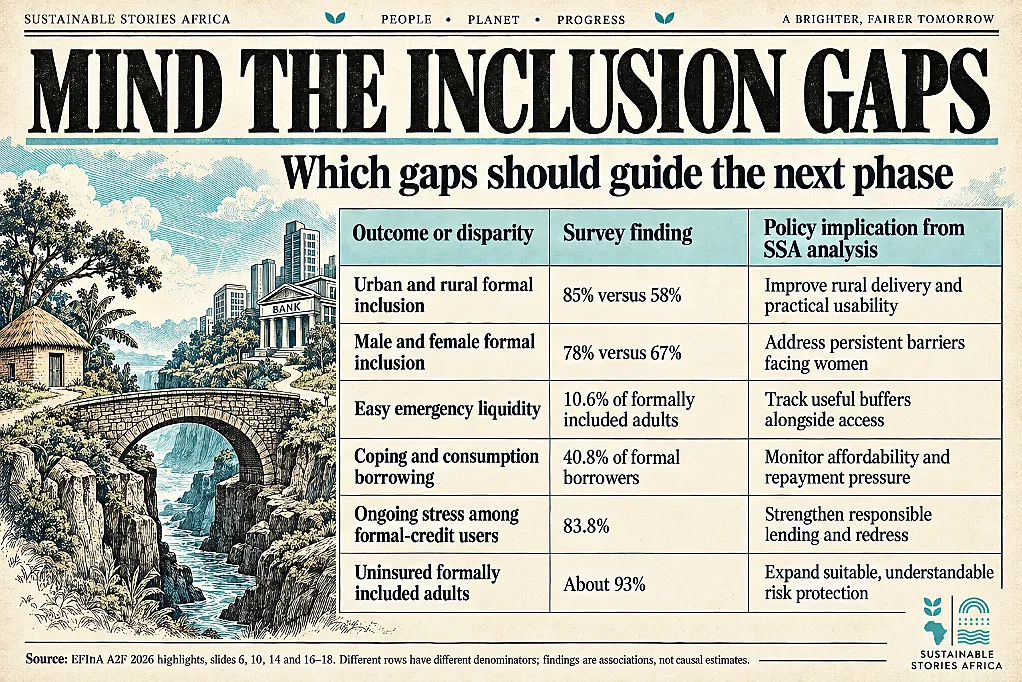
- Formal inclusion stood at 85% in urban areas and 58% in rural areas.
- The 27-percentage-point gap was wider than the 24-point gap in 2023.
- Women’s formal inclusion rose to 67%, but men remained ahead at 78%, leaving the gender gap unchanged at 11 points.
Financial Participation Often Coexists With Stress
The survey’s emergency liquidity measure asks whether adults can raise N156,000 within seven days without difficulty.
- Only 10.6% of formally included adults could do so, compared with 3.7% of those outside formal services.
- Access is associated with an advantage, but the absolute level remains low.
Financial stress is widespread in both groups.
- This highlights ongoing financial or welfare distress among 70.1% of formally included adults and 71.9% of those not formally included.
- Having a financial account clearly cannot substitute for adequate income, affordable living costs or a dependable buffer against shocks.
Borrowing patterns deserve attention.
- Among formal borrowers with a valid reported purpose, coping and consumption accounted for 40.8% in 2026, up from 31.7% in 2023.
- Productive enterprise borrowing fell from 40.2% to 34.3%.
- Credit used for immediate household needs can be necessary, but repeated borrowing to cover a persistent income shortfall can leave little room for repayment.
These are descriptive findings.
- The survey does not establish that using credit causes stress, that insurance causes resilience, or that digital payments cause better financial health.
- Income, education, employment and other characteristics may influence both service use and household outcomes.
This limitation matters when deciding which interventions to fund.
Better Products Could Strengthen Household Resilience
The results suggest room to improve the fit between services and people’s financial lives.
- A trader with irregular takings needs savings and repayment arrangements that reflect variable cash flow.
- A rural household needs a service that remains usable when network coverage is weak, and cash access is costly.
Insurance is a major gap.
- The report estimates that 81 million formally included adults remain uninsured, equivalent to about 93% of that group.
- Broader participation in payments has therefore not translated into broad protection against insured risks.
- Affordable cover could help, provided exclusions, claims procedures and the reliability of settlement are clear.
Trust also matters after access is established.
- Among existing formal users who trusted their provider, 96.9% had used the service within 90 days, compared with 65.6% among those who distrusted it.
- The association supports closer attention to reliability and redress; it does not prove that trust alone explains continued use.
Measure Outcomes Alongside Accounts And Transactions
Regulators should place financial health, emergency liquidity and repayment stress beside conventional access targets.
- Providers should examine whether customers use accounts regularly and can resolve failed transactions or unexpected charges.
- An open account is a starting point, while sustained, beneficial use is the more demanding objective.
Delivery strategies should reflect the groups left behind.
- Rural residence, lower educational attainment and poverty are associated with substantial inclusion gaps.
- Infrastructure and agent expansion can help, but assisted use, understandable pricing and products linked to real income patterns are also necessary.
- Uniform national campaigns can miss these differences.
The survey itself provides a basis for measurement rather than a final explanation of every gap.
- Its approximately equal state samples were weighted to represent the adult population.
Policymakers should retain those weights and definitions when comparing groups, and commission further analysis before treating observed differences as evidence that a particular product caused an improvement.
Path Forward – Make Financial Health The Next Benchmark
Nigeria’s progress in formal access creates an opportunity to improve the quality of financial participation.
Providers and policymakers should now test whether services help people manage income, build buffers and recover from shocks.
Success should include narrower rural and gender gaps, suitable protection and less harmful repayment pressure, alongside the continued expansion of dependable financial services.