Shipping’s regulatory agenda combines emissions reduction, worker protection, safe recycling and the governance of new technology.
These issues determine who bears the risks of moving the world’s goods.
UNCTAD’s maritime review provides the foundation, while developments through October 2026 show why proposals, adopted instruments and rules already in force must be carefully distinguished.
Shipping Governance Must Address Connected Risks
African maritime authorities and businesses face a regulatory agenda that touches climate policy, labour rights, vessel safety and the integrity of ship registration.
Effective implementation requires institutions capable of handling those responsibilities together, while recognising that each legal instrument has its own scope and status.
This is according to the UN Trade and Development (UNCTAD) Review of Maritime Transport 2025.
The chapter surveys developments including proposed IMO emissions measures, seafarer protection, the Hong Kong ship recycling convention and work on autonomous shipping.
Several of its forward-looking statements now require updating.
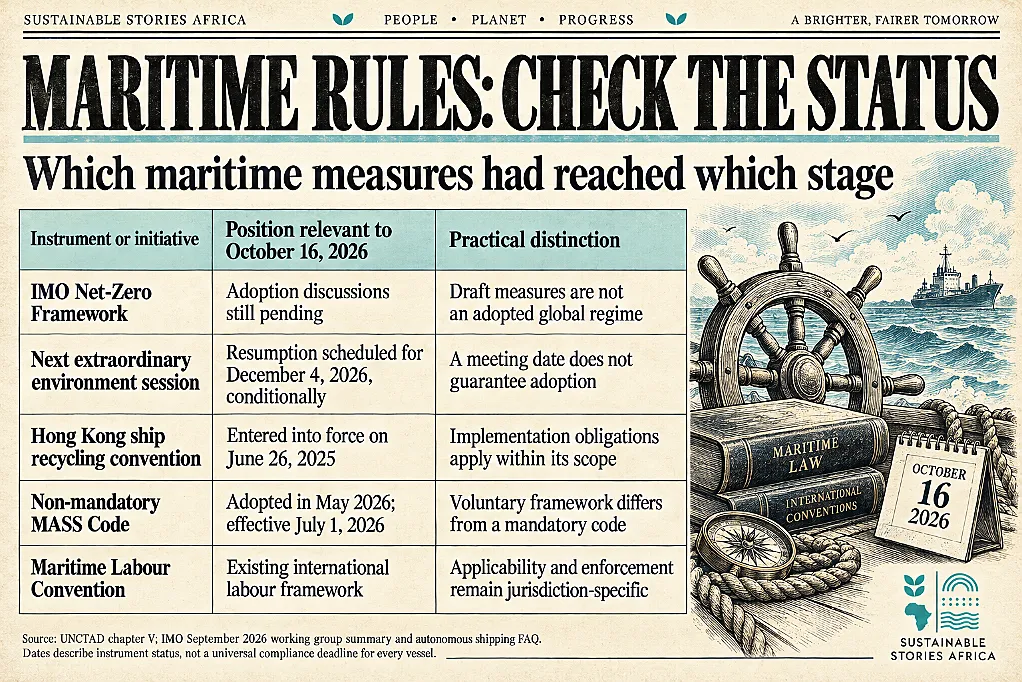
By October 16, 2026, the IMO Net-Zero Framework remained under discussion, while a non-mandatory autonomous shipping code had been adopted.
For ports, shipowners and workers, accurate distinctions matter because investment, training and enforcement decisions depend on what has actually become applicable.
Climate Rules Need Accurate Implementation Timelines
International shipping produced almost 3% of global human-caused greenhouse gas emissions in 2018, according to the IMO research cited by UNCTAD.
- This is a historical estimate, not a newly measured 2026 share.
- It explains the sector’s importance to climate policy without suggesting that the chapter contains current emissions totals.
The 2023 IMO strategy set ambitions for reducing shipping emissions, while subsequent negotiations developed proposed mid-term measures.
- The draft Net-Zero Framework combines a fuel standard with an economic mechanism.
- Approval of draft text, formal adoption and entry into force are separate stages, each with different implications for operators.
The October 2025 adoption meeting was adjourned.
- IMO’s September 2026 update describes further work on concerns about the draft and schedules the extraordinary session to resume on December 4, subject to discussions at the preceding committee meeting.
- The 2025 chapter’s original implementation expectations should therefore not be repeated as settled deadlines.
Seafarer Protection Remains A Material Concern
The chapter places the global seafaring workforce at about 1.9 million people.
- Their work sustains the movement of food, fuel and industrial goods, often under difficult conditions and multiple jurisdictions.
- Rerouting can extend time at sea, increase fatigue, separate families and increase commercial voyage costs.
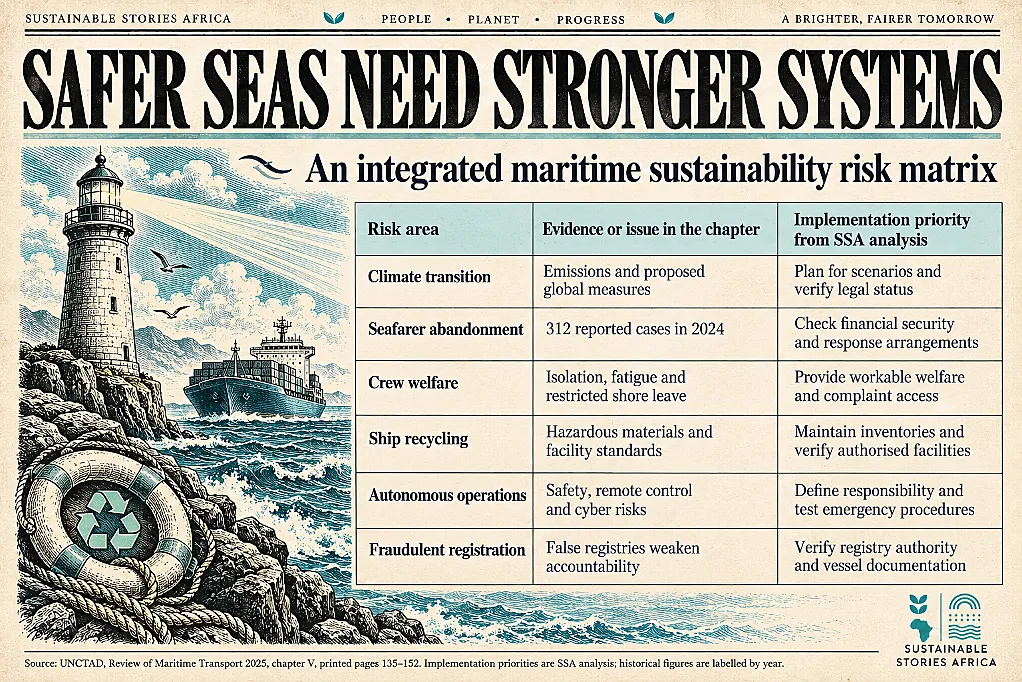
UNCTAD cites 312 reported abandonment cases involving 3,133 seafarers in 2024, compared with 78 cases in 2020.
- These are reported cases in the referenced international database, not a complete count of every violation.
- The comparison nevertheless highlights a substantial protection problem that shipowners, states and financial security providers need to address.
Abandonment can leave workers without wages, adequate support or a clear route home.
- The transnational structure of shipping complicates the response: the flag state, port state, employer and worker’s home country may all be different.
- Effective contact points and cooperation are therefore part of the protection system, alongside the legal obligation itself.
Shore leave is another operational and welfare issue.
- The chapter describes restrictions that persisted after pandemic-related disruptions eased.
- Security procedures need to protect ports without unnecessarily denying workers access to welfare facilities and time ashore.
- Assess labour conditions through visible indicators of maritime sustainability, rather than letting fuel and vessel technology overshadow them.
Safer Recycling And Technology Offer Opportunities
The Hong Kong Convention addresses the safe and environmentally sound recycling of ships.
- Its entry into force in June 2025 creates a framework covering ships and recycling facilities within its scope.
- Hazardous material inventories, facility authorisation and vessel-specific recycling plans link end-of-life decisions with environmental and worker protection.
For economies considering investment in maritime services, compliant recycling can offer a route to recover materials and develop skills.
- These opportunities depend on safe facilities, capable supervision and clear responsibilities.
- Recycling should not be presented as sustainable simply because it recovers steel while exposing workers or nearby communities to hazardous substances.
Autonomous shipping creates a different set of governance questions. IMO adopted the non-mandatory MASS Code in May 2026, and its FAQ states that it took effect on July 1.
- Consider benefits alongside cybersecurity, remote operation and accountability for safety.
- The code’s adoption does not mean that all commercial ships are becoming autonomous or that human responsibilities disappear.
Strengthen Institutions Across Maritime Risk Areas
National authorities should maintain current records of the conventions and rules applicable to their fleets, ports and service providers.
- A legal inventory should connect each obligation to inspection capability and an identifiable responsible institution.
- Ratification and publication are necessary steps, but effective implementation depends on operational capacity.
Shipowners and charterers should review labour and registration risks alongside vessel performance and emissions.
- Check registry documentation against authorised sources, particularly where ownership and operating arrangements are complex.
- Fraudulent registration can interrupt accountability for pollution, worker protection, and maritime security.
African governments and development partners should support technical training, welfare coordination and participation in international negotiations.
- Transition planning should account for differences in financial and institutional capacity.
- Cleaner shipping will have a stronger development case when environmental improvements are measured by safe work, credible enforcement and practical support for economies facing adjustment costs.
Path Forward – Connect Cleaner Shipping With Worker Protection
Maritime sustainability requires climate action alongside enforceable labour rights, safe recycling and accountable vessel operations.
African institutions should prepare for regulatory change while distinguishing confirmed proposals from requirements.
Immediate priorities include stronger implementation capacity, coordinated responses to worker abuse and investment decisions based on current legal status rather than outdated expectations about when new rules would begin.