
Nigeria’s financial reporting rules go beyond accounts presentation.
They link professional identification, audit independence, timely filing and responses to non-compliance with the reliability of corporate information.
For companies and auditors, the practical challenge is integrating these requirements into reporting processes and clearly explaining material risks to people who rely on the accounts.
Reporting Accountability Extends Beyond Published Numbers
Nigeria’s financial reporting framework places responsibility on company leaders, reporting professionals and external auditors to support credible corporate information.
The House of Accountants summary of 14 Financial Reporting Council rules shows how certification, disclosure, filing and audit conduct fit together.
The Financial Reporting Council of Nigeria is the institutional author and issuer of the underlying rules.
- Its published compilation confirms that the numbered list spans different release dates and includes a withdrawn provision.
- It should therefore be understood as an evolving regulatory framework rather than 14 newly introduced requirements taking effect together in October 2026.
For investors and other users, the significance lies in accountability.
- A signed certification should identify the professional responsible; an audit fee disclosure should make potential independence concerns easier to examine.
- Stronger reporting also supports sustainability communication when risks described in a company’s narrative have consequences for costs, liabilities or business continuity.
Professional Identification Makes Responsibility More Visible
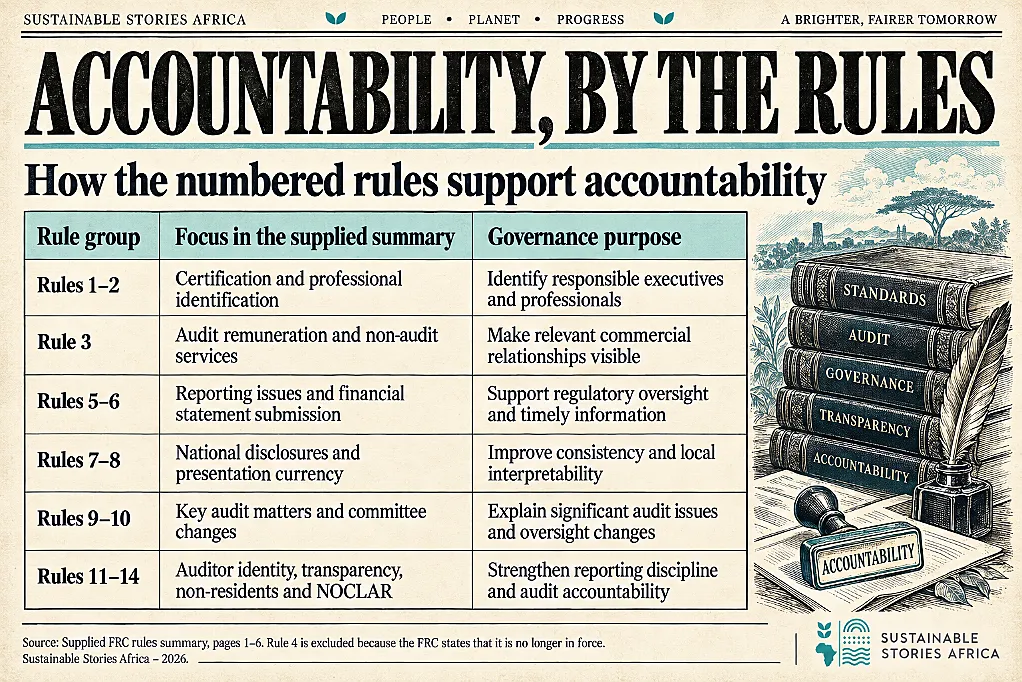
The first rules address who stands behind financial information.
- The rule requires chief executives and chief financial officers to include FRC registration numbers in certifications, with a relevant professional accounting qualification for the CFO.
- Professionals certifying financial information must also identify themselves and their registrations.
These requirements create a traceable link between a document and the people responsible for it.
- Their practical value depends on accurate records, current professional status and appropriate review before certification.
- A registration number alone cannot show that a material estimate is reasonable or that a control operated effectively.
Auditor remuneration and non-audit services create another area of scrutiny.
The presentation highlights that audit remuneration be disclosed separately and that details and fees relating to non-audit services be reported.
- Where none were provided, that fact is also disclosed.
- Transparency helps users assess relationships that may affect perceived independence.
Different Obligations Need Distinct Reporting Controls
The framework contains several reporting triggers.
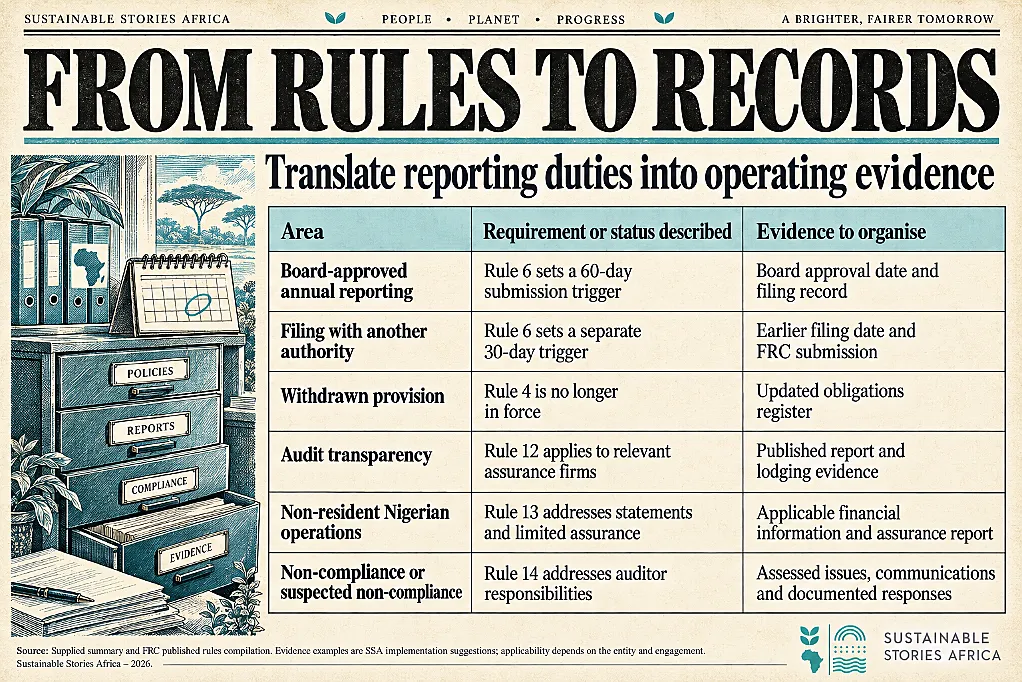
- Under Rule 6, public interest entities submit annual reports and financial statements within 60 days of board approval.
- A separate obligation concerns filing copies with the Council within 30 days after filing with another government department or authority.
- A single annual deadline would not capture both triggers.
The presentation also addresses reports containing matters other than an unqualified opinion.
- Terminology needs care: an emphasis of matter paragraph does not itself modify an audit opinion under international auditing standards.
- Companies should therefore avoid treating every report mentioned in the summary as the same category of modified opinion.
Presentation currency is another practical issue.
- Rule 8 specifies naira presentation for general-purpose financial statements in Nigeria and permits supplementary information in the functional currency, with the relevant exchange rates disclosed.
- The underlying functional currency follows accounting principles; it is not simply an elective label used to make results appear stronger.
The withdrawn Rule 4 is an important reminder of what regulatory inventories uphold.
- Its removal does not, by itself, remove obligations arising under other legislation.
- An organisation needs to identify the instrument creating each requirement and update its controls when that instrument changes.
Clearer Disclosure Can Improve Stakeholder Understanding
Key audit matters can help readers understand the areas that required significant auditor attention, including difficult estimates and management judgements.
- Their usefulness depends on specificity.
- Repeated generic wording gives stakeholders little insight into why a particular matter was important to the audit.
The relationship with sustainability reporting is practical.
- Environmental obligations, litigation, operational disruption or regulatory breaches may affect the financial statements.
- Where material, a company should explain the financial consequences consistently with its broader narrative.
- The FRC rules discussed here do not automatically turn every environmental or social statement into an assured sustainability disclosure.
Audit firm transparency reporting provides enough window into quality management, governance and independence practices.
The summary states that, from January 2023, firms auditing or providing assurance services to public interest entities must provide it.
- Readers can use it to ask informed questions about a firm’s systems without assuming that publication guarantees audit quality.
Build Compliance Into Reporting And Assurance
Finance teams should map obligations to dates, responsible staff and evidence of completion.
- The register should distinguish company requirements from audit firm requirements and identify the relevant public interest entity scope.
- A review before board approval can expose omissions while there is time to correct them.
Audit committees should ask how to assess significant non-compliance concerns, escalate them, and reflect them in reporting.
Rule 14 concerns the auditor’s response to non-compliance or suspected non-compliance, including matters that can affect the financial statements through the business’s operations.
- Management remains responsible for running the business and complying with applicable law.
Companies and auditors should resolve interpretations against the current authoritative text, especially where a short training summary compresses a detailed obligation.
- That is particularly relevant to modified reports, non-resident operations and pre-signing communications.
The objective is an evidence-backed reporting process that can withstand scrutiny and give users a clear account of material matters.
Path Forward – Turn Reporting Requirements Into Reliable Practice
Nigeria’s rules can strengthen confidence in organisations by maintaining current requirements, clear responsibilities and records showing that the required work occurred.
Audit committees should connect filing discipline with the quality of judgements and disclosures.
The priority is to make significant risks and professional responsibility visible, while keeping financial and sustainability narratives consistent with the underlying evidence.