Smuggling can lower an individual buyer’s bill while weakening the factories, tax revenues and product safeguards on which the wider economy depends.
Bismarck Rewane’s October presentation puts those competing incentives at the centre of Nigeria’s trade debate.
The policy question is how to make lawful commerce affordable and predictable while targeting the networks that profit from evasion.
Cheaper Goods Carry Wider Economic Costs
Nigeria’s response to smuggling needs to address the price differences and trading costs that make evasion attractive, alongside enforcement.
That is the central economic argument in Bismarck Rewane’s presentation, delivered at the Lagos Business School Breakfast Session on October 7, 2026, under the theme “Smuggling Paradox”.
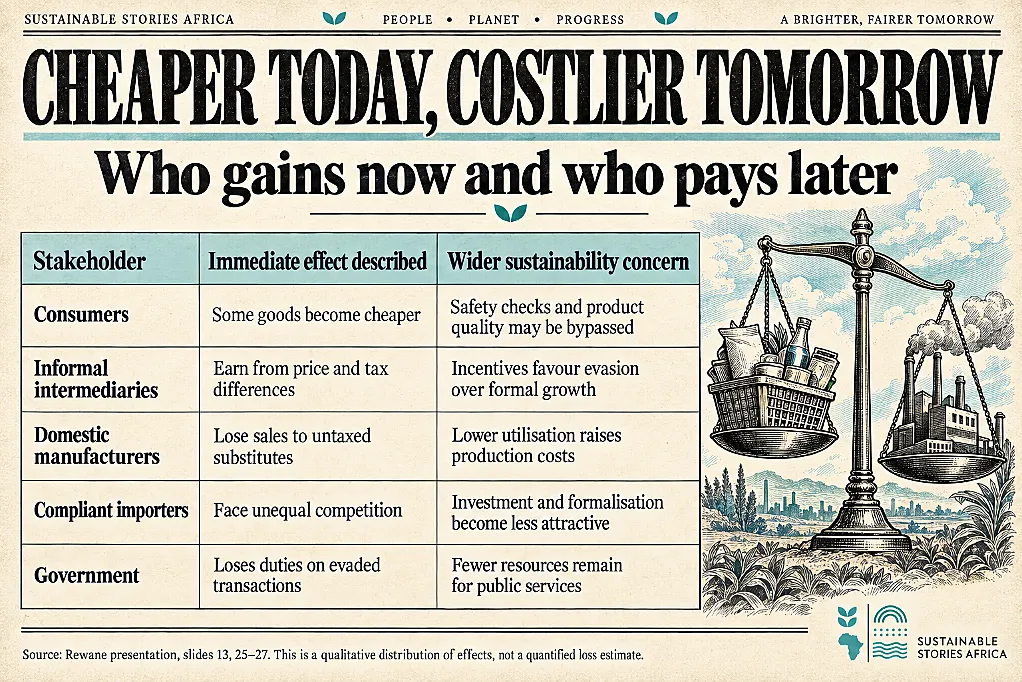
Rewane, managing director and chief executive of Financial Derivatives Company, describes a market where consumers temporarily buy cheaper goods while formal producers lose sales and the government loses revenue.
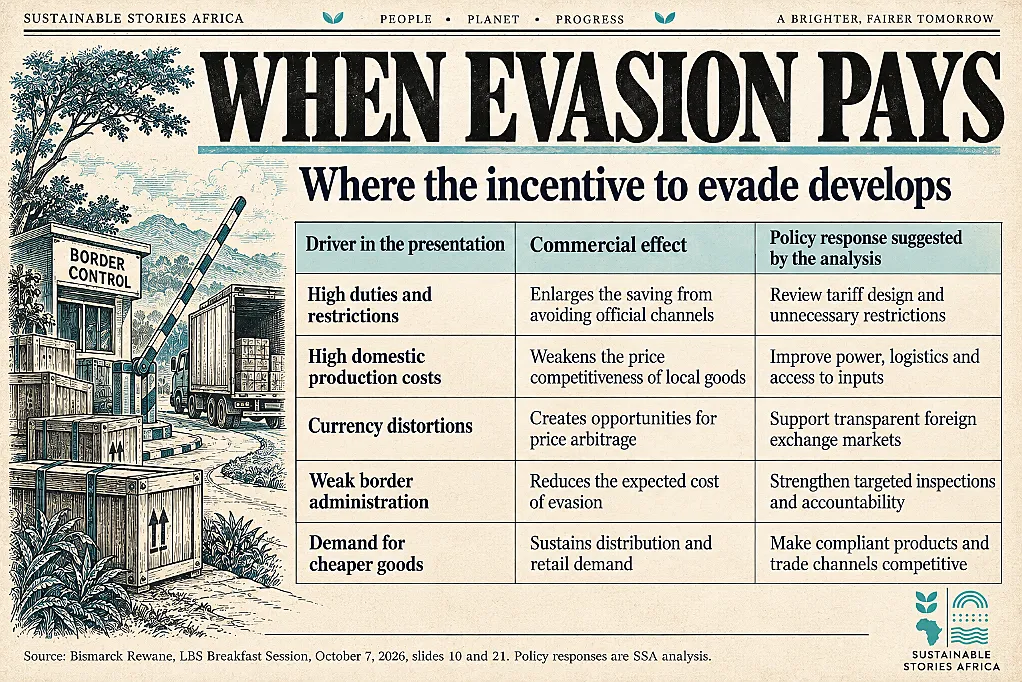
His analysis links the incentive to high duties, production costs, restrictions and weaknesses in border administration.
For African markets pursuing industrialisation and regional integration, the implications extend beyond customs collections.
Trade rules influence whether enterprises invest, employ workers and enter formal supply chains.
The task is to protect legitimate commerce without making compliance so costly that smaller traders see little reason to participate.
Price Differences Keep Informal Routes Attractive
A cheaper product can attract a household with an already stretched income.
- The immediate saving is visible; the costs of weaker manufacturing, unsafe products or lost public revenue are spread across many people and appear later.
- That helps explain why smuggling can survive public condemnation and repeated enforcement campaigns.
The presentation identifies seven drivers, including high tariffs, domestic and foreign price differences, exchange rate overvaluation, import restrictions, high production costs, weak controls and demand for cheaper goods.
These interact.
- A manufacturer facing unreliable electricity and expensive finance can struggle against untaxed imports even when its production processes are reasonably efficient.
However, informal cross-border activity should not automatically be described as smuggling.
The relevant distinction is deliberate evasion of applicable duties or trade rules.
- Small traders can operate informally because of administrative complexity and limited information.
- Treating them as organised criminals would weaken the case for formalisation and obscure differences in conduct.
Seizure Values Reveal Only Partial Evidence
Rewane’s slides report more than 2,500 seizures worth over N59 billion in 2025, and 3,555 seizures during 2023 – 2024, including 183,527 bags of rice and more than 1.7 million litres of fuel.
- These figures indicate enforcement activity and the kinds of goods intercepted.
- They do not show a complete scale of illicit trade.
The comparison also uses unequal periods: one year against two.
- Changes in seizure values can reflect inflation, exchange rates, enforcement intensity or the composition of intercepted goods.
- A rising naira value cannot, on its own, establish that the physical volume of smuggling increased.
The presentation’s exchange rate relationship is therefore a starting point for investigation rather than proof of causation.
- The slides place customs revenue at N7.28 trillion in 2025, against N6.11 trillion in 2024.
- These are attributed presentation figures, not an estimate of revenue lost to smuggling.
They highlight the formal import system's strategic importance to public finance.
- Lost duties matter, but so does a trading environment that allows compliant businesses to survive.
Sector exposure differs.
- The presentation ranks fast-moving consumer goods as most vulnerable, followed by downstream oil and gas and textiles.
- This is an analytical ranking, not a measured probability of loss.
For investors, it suggests examining whether a company’s earnings depend heavily on sales volumes, thin margins and protection from imported substitutes.
Regional Integration Could Improve Lawful Commerce
The African Continental Free Trade Area offers a route to reduce some incentives for evasion by lowering the cost of eligible trade.
- Firms can serve larger markets and spread fixed costs across greater output.
- Traders gain when legitimate routes become easier to understand and more reliable than informal alternatives.
These benefits depend on implementation.
- Preferential tariffs apply to qualifying goods, and rules of origin determine eligibility.
- Re-labelling a third-country product does not make it African.
- Weak verification can allow trade diversion and undermine confidence among participating countries, while unnecessarily complex certification can exclude smaller enterprises.
The presentation also identifies roadblocks, multiple levies, poor transport infrastructure and payment frictions as obstacles to West African integration.
- Addressing them would help traders even where tariffs are already low.
- Assess regional integration through actual border experience, including the time and expense required to move a compliant consignment.
Target Enforcement While Lowering Compliance Costs
Customs authorities should concentrate intelligence and inspection resources on high-risk consignments and networks, while making routine compliance more predictable.
- Published procedures, clear fee schedules and reliable appeals can reduce opportunities for arbitrary treatment.
- These are practical responses to the incentives identified in the presentation, rather than announced government commitments.
Trade ministries should examine which restrictions protect a credible industrial objective and which mainly enlarge the reward for evasion.
- Any reform needs to consider fiscal effects and adjustment costs for producers.
- Abrupt changes without consultation can create a different source of uncertainty for firms planning investment or employment.
Businesses should review exposure to untaxed substitutes and improve traceability through distributors.
- Public reporting can track clearance times, formal trader participation and product safety alongside seizures.
Together, these measures would show whether legal commerce is becoming more attractive and whether enforcement is protecting consumers and productive activity.
Path Forward – Make Formal Trade The Better Choice
Nigeria can reduce the attraction of smuggling by improving the economics of lawful trade and directing enforcement towards deliberate evasion.
Regional agreements will help where border procedures, origin verification and infrastructure work in practice.
The test is whether more goods move through accountable channels while manufacturers and consumers benefit from fairer competition, dependable supplies and credible product safeguards.