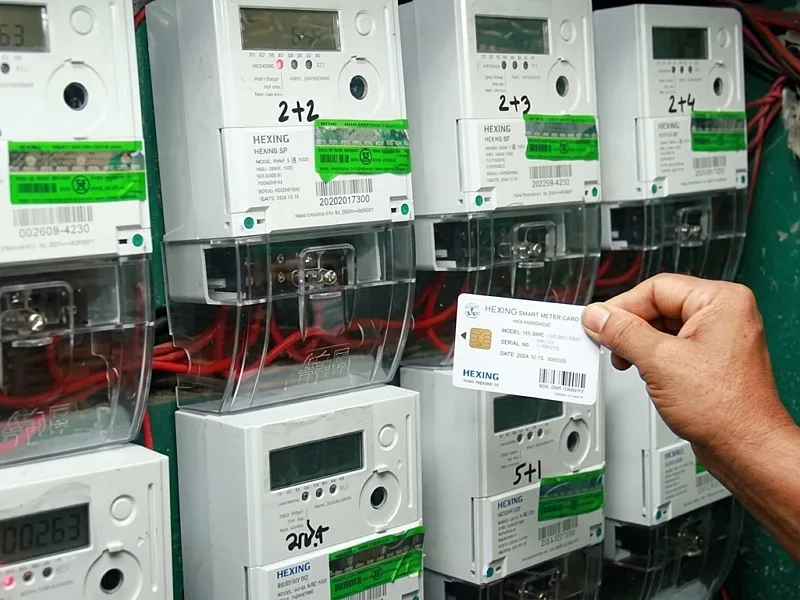
Nigeria’s fintech sector operates across payment, banking, securities and data protection frameworks.
A service that looks simple on a mobile screen may involve several regulated activities and distinct responsibilities.
The opportunity is to expand useful financial services while ensuring that licensing, customer consent and operational safeguards keep pace with product development.
Financial Innovation Depends On Clear Responsibilities
Nigeria’s fintech development depends on matching each business activity to the appropriate regulatory framework and building customer protection into delivery.
The Udo Udoma & Belo-Osagie brief, explains why there is no single authorisation covering every service offered under the fintech label.
- The brief’s authors are Yinka Edu, Joseph Eimunjeze, Pamela Onah and Precious David of Udo Udoma & Belo-Osagie.
- Additional contributions by Oluwatobi Akintayo, Tochukwu Nwankwo, Praise Darego, Ayomide Soretire, Ifunanya Chinwuba and Asekhamhe Oshiomah.
Their analysis covers payments, digital assets, open banking and other aspects of Nigeria’s financial innovation framework.
For users, the distinction between a payment gateway, a wallet and an investment platform is often less visible than the interface.
- It becomes consequential when money is held, a transaction fails, or an investment loses value.
Clear responsibilities can help innovation expand access without leaving customers uncertain about who must respond.
One Product Can Involve Several Regulators
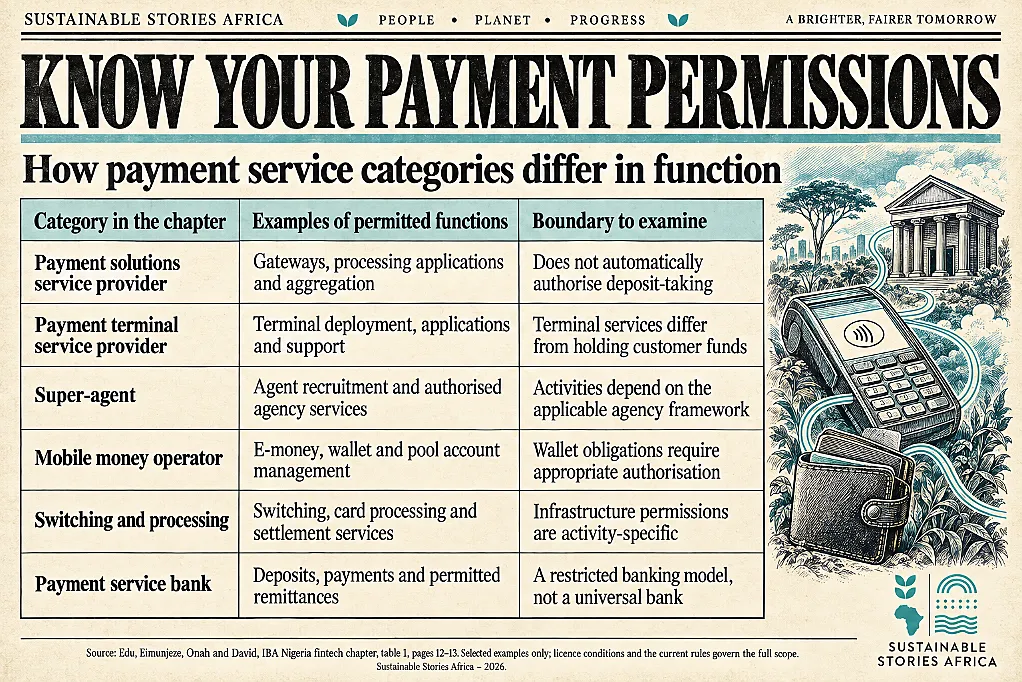
The brief identifies the Central Bank of Nigeria as the principal regulator of banking and payment activities, while the Securities and Exchange Commission oversees capital market activities within its remit.
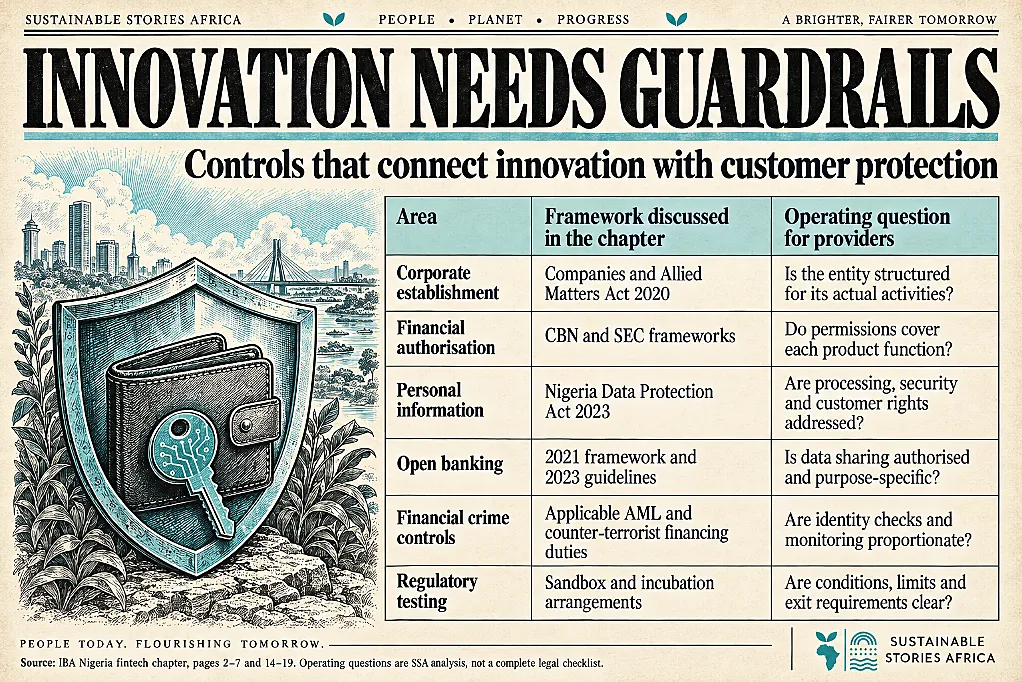
- Corporate law, data protection and anti-money laundering requirements can also apply.
- Regulation follows what a company does, not simply the name it gives its product.
A company processing a merchant’s payments performs a different function from one issuing electronic money or accepting deposits.
- The permitted activities under each licence therefore matter.
- Integrating another firm’s service does not remove the need to understand which entity carries the regulated responsibility and how the relationship is disclosed to users.
The Investments and Securities Act 2025 recognises virtual and digital assets within its securities framework.
- That brings relevant activities into the SEC’s regulatory remit, but it does not make every platform lawful by default.
- Nor does supervision guarantee an investment return or eliminate market, technology or fraud risks.
Data Sharing Creates Opportunities And Exposure
Open banking can allow eligible participants to share information and develop services around customers’ financial needs.
- The brief discusses the 2021 framework and 2023 operational guidelines, including the roles of data providers, application users, programming interfaces and customers who authorise access to their information.
Benefits include better account information, payment services and credit assessment.
- However, richer data can also increase the consequences of misuse or a security breach.
The brief distinguishes general product information from individual transaction data and sensitive assessments such as credit scores.
- These categories should not receive identical risk treatment.
Consent must be clear and linked to a defined purpose.
- A customer should be able to see what information is requested and why.
- Providers also need arrangements for security, breach response and responsibility when several firms participate in delivering one service.
- Legal permission to share data does not excuse careless handling.
Digital assets create a separate set of classification and compliance questions.
The brief discusses SEC rules, proposed amendments and incubation arrangements, which must be distinguished from each other.
- A proposal is not an effective requirement, and conditional participation in a regulatory programme should not be described as unrestricted authorisation for every activity.
Useful Innovation Can Improve Financial Participation
Well-designed fintech services can reduce the inconvenience of everyday transactions and help small businesses receive payments through more channels.
- These benefits depend on reliability and the total cost of using the service.
- A low advertised fee becomes less useful when settlement is delayed, or a customer cannot resolve a failed transfer.
Regulatory sandboxes and incubation programmes can give authorities a controlled setting in which to understand new business models.
- They can also help companies identify risks before wider expansion.
- The brief describes both CBN and SEC initiatives, each with its own scope and conditions. The purpose is supervised learning, not a permanent exemption from regulation.
The governance challenge grows when customer acquisition accelerates operational capacity.
- A provider needs sufficient systems for reconciliation, complaints and suspicious transaction monitoring.
- Social impact claims about reaching underserved users should therefore be supported by evidence of continued use, service quality and the suitability of products offered.
Map Obligations Before Scaling Financial Products
Boards and founders should map the flow of money and information through each product.
- That exercise helps identify who receives customer funds, who processes data and which firm is responsible for settlement or complaints.
- It should be updated when new services or partners change the underlying business activity.
Compliance teams should distinguish effective legislation from older regimes and proposals.
- The brief describes tax reforms effective from January 2026 alongside historical tax provisions.
- Those earlier rates should not be carried forward as current guidance without checking the applicable law.
- Product and tax decisions require a current activity-specific assessment.
Regulators can support responsible growth by clearly explaining authorisation status and accessible complaints channels.
Providers should communicate permissions accurately and avoid presenting a regulatory relationship as an endorsement of investment performance.
These measures can improve informed participation while allowing legitimate innovation to develop within a more understandable framework.
Path Forward – Build Trust Through Accountable Financial Innovation
Nigeria can expand useful digital financial services when regulation, product design and operational capability develop together.
Clear authorisation and transparent responsibility help users understand the services they rely on.
The next measure of progress should include reliable payments, appropriate data use and effective redress, alongside customer growth and investment in new technology.