
Hidden payments in procurement can divert money from the equipment, staff and services a contract is supposed to fund.
Nigeria’s corruption evidence gives that familiar business problem a wider economic context.
Treating commercial ethics as part of business infrastructure means examining how money moves, who influences awards and whether fair suppliers can compete.
Hidden Payments Divert Capital From Production
Commercial integrity should be assessed as a factor in business productivity because undisclosed payments can change supplier selection, inflate contract prices and reduce the resources available for delivery.
“Commercial ethics as economic and business sustainability infrastructure”, makes that case for Nigeria’s business community.
Its statistical foundation is the national corruption survey co-produced by Nigeria’s National Bureau of Statistics and the United Nations Office on Drugs and Crime.
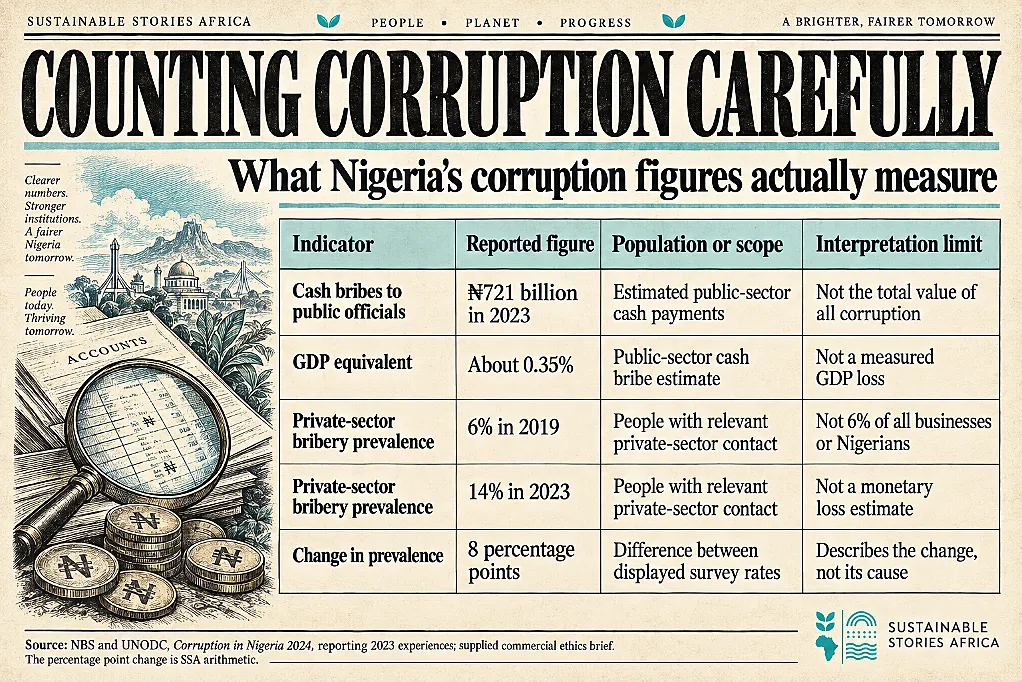
Their 2023 survey estimated N721 billion in cash bribes to public officials, equivalent to about 0.35% of GDP.
It also recorded higher reported bribery prevalence among people who had contact with private-sector actors.
Those measures do not establish the total cost of commercial corruption.
- They do, however, help explain why fair dealing belongs in discussions about investment and business sustainability.
Money diverted before work begins can affect the quality of goods delivered, the prospects of responsible suppliers and the returns available for reinvestment.
Procurement Decisions Shape Where Money Goes
A procurement process determines which enterprise receives money and what it must deliver in return.
- When an undisclosed personal benefit influences that decision, the award can favour the ability to pay rather than competence, quality or price.
- Even a completed project may therefore represent poor value.
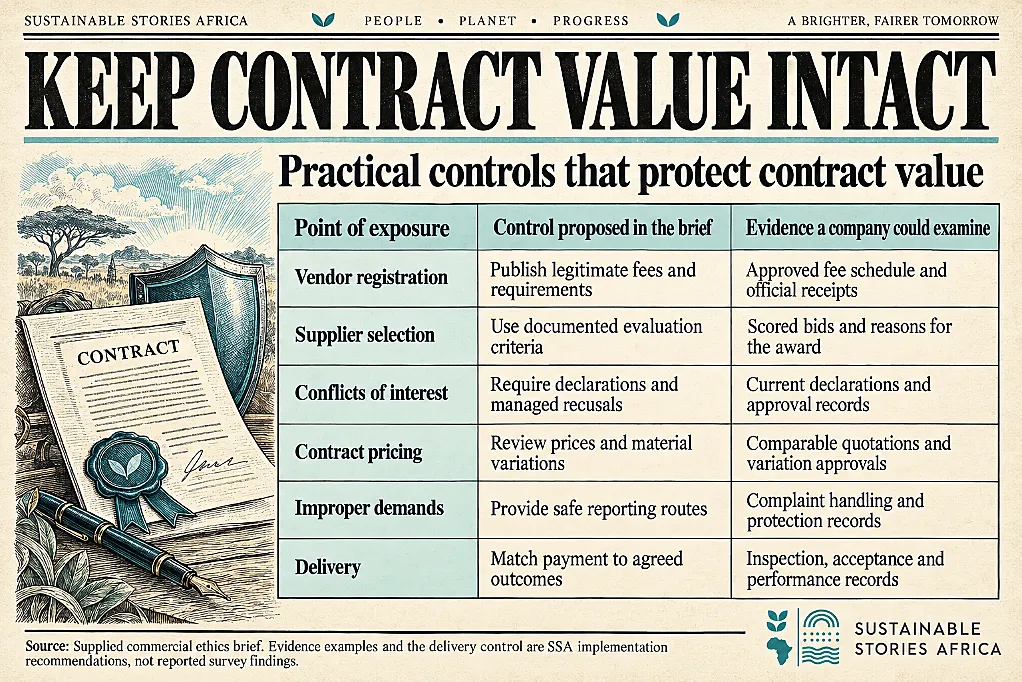
The brief describes demands for a percentage on a local purchase order, kickbacks embedded in prices and payments to secure vendor registration.
- These are examples of how improper influence can enter ordinary transactions.
They are not allegations against any named company, and the available evidence does not show how frequently each practice occurs.
- For an honest supplier, the effect can be exclusion before its capability is considered.
- For a purchaser, an inflated price can leave less funding for materials or service delivery.
- For staff, pressure to recover hidden costs can appear later as reduced resources, unrealistic schedules or disputes over the quality expected.
Survey Evidence Supports Careful Economic Interpretation
The increase from 6% to 14% is an eight-percentage-point rise in reported private-sector bribery prevalence among people who had contact with the relevant actors.
- It should not be described as the share of procurement contracts carrying kickbacks, or as the share of Nigerian businesses participating in corruption.
- These are different populations and measures.
Similarly, the N721 billion estimate concerns cash bribes paid to public officials.
- It does not measure every private commercial payment, the value of contracts affected, or the total economic output lost.
- A bribe payment is a transfer of money; its wider economic damage can arise through distorted decisions, inferior work, exclusion and reduced trust.
The distinction matters for credible sustainability communication.
- An article can explain how corrupt procurement may weaken productivity without inventing a national return on eliminating it.
- The evidence supports concern and practical controls, while the size of the resulting productivity gain remains a question for further research.
Company-level analysis can make the issue more concrete.
- Comparing quoted prices, approved variations, payment recipients and delivered outputs can reveal where contract value is being lost.
- Such reviews need context: a higher price may reflect better materials or a legitimate delivery risk rather than improper conduct.
Controls should test explanations and evidence.
Fair Competition Can Improve Business Sustainability
Transparent awards can give capable suppliers a stronger chance of winning work.
- Over time, that can support investment in equipment, staff training and quality systems because success depends more reliably on performance.
- Purchasers can benefit through clearer accountability for the price paid and the result delivered.
Commercial ethics also affects smaller firms’ ability to grow.
- A supplier asked to fund an improper payment before receiving an order faces an additional financing burden.
- A business that refuses may lose the opportunity entirely.
- Removing such demands can lower a barrier to participation, although the brief does not quantify how many firms would benefit.
Legitimate profit, negotiation and disclosed commercial fees remain part of ordinary business.
- A commission paid under a transparent, authorised agreement is different from an undeclared benefit that compromises an award.
- Procurement policies should define acceptable arrangements clearly so staff and vendors can distinguish normal commercial practice from prohibited influence.
Boards Should Test Controls In Practice
Boards and executives should assign clear responsibility for procurement integrity and examine whether staff can challenge an unusual payment or award.
- A policy nobody uses has limited value.
- Reporting mechanisms need an independent route when the concern involves the person who would ordinarily receive the complaint.
Procurement and finance teams should make vendor requirements clear, document exceptional decisions and check whether intermediaries provide a legitimate service.
- Controls should be proportionate to contract risk.
- Excessive paperwork can delay smaller suppliers without improving scrutiny of the transactions that create the greatest exposure.
Management can track the completeness of conflict declarations, the proportion of competitive awards, unexplained variations and the time taken to resolve substantiated concerns.
- These are suggested operational indicators, not established national benchmarks.
- They show whether decisions are becoming more accountable and whether identified weaknesses are corrected.
Path Forward – Let Contract Spending Reach Productive Work
Commercial ethics can protect investment when transparent selection, documented approvals and safe reporting become routine business practices.
Companies should assess whether their controls influence real procurement decisions and improve the value delivered.
Evidence of Nigeria’s corruption supports that effort, while careful measurement should distinguish public-sector bribes, private-sector prevalence and company-specific losses.
Credible reform starts with knowing which problem is being measured.