Africa's small businesses can generate useful evidence of creditworthiness through payments, sales and supply relationships.
IFC's MSME Banking in the Digital Era handbook explains how lenders can use those records to improve access to finance.
The opportunity depends on sound data governance, suitable products and responsible lending.
This analysis uses the September 2025 handbook and labels its earlier estimates and case studies accordingly.
Small Businesses Need More Than Apps
African lenders can reach underserved micro, small and medium enterprises more effectively by using digital transaction records, partnerships and products designed around business needs, according to IFC's MSME Banking in the Digital Era handbook.
The September 2025 publication, researched with Accion, provides a practical framework for transforming how institutions serve smaller firms.
Its case remains relevant to enterprise development.
- Many businesses can demonstrate regular trading activity yet struggle to supply the collateral, formal accounts and documentation expected by conventional lenders.
Digital records can help bridge that information gap, provided institutions assess repayment capacity and protect customers' information.
- For a retailer, the practical question is whether finance arrives in time to replenish stock.
- For a farmer, it is whether repayments match the production cycle.
These are illustrative needs, not reported interviews.
The handbook's contribution is to show how technology, customer understanding and institutional reform can work together to address them.
The Financing Gap Reflects Missing Information
The handbook cites an estimated $331 billion MSME financing gap in sub-Saharan Africa.
- Its country examples include unmet demand of $32.2 billion in Nigeria and $8.8 billion in Uganda.
- These figures come from earlier research referenced in the publication; they are not new estimates for 2026 and should not be added together.
The constraint is partly economic.
- Serving small borrowers through paper records and repeated visits can be expensive relative to loan size.
- Limited financial histories make risk difficult to assess, while collateral requirements can exclude enterprises with viable cash flows.
- Digitisation can reduce some of those costs and improve visibility into business activity.
However, a digital footprint remains an incomplete account of a business.
- Cash transactions may be invisible, records can be inconsistent and seasonal sales can distort a short observation period.
- A sound lending model must recognise these limits rather than interpreting every missing record as evidence of poor performance.
The development goal is therefore better access to suitable finance
- Faster approvals are useful when they produce manageable obligations and support viable trading, rather than merely increasing the volume of loans issued.

Digital Records Can Reveal Business Potential
The handbook's model begins with understanding customer segments and then adapting the institution's operating systems, channels, risk management and partnerships.
- A market trader using a basic phone, an online seller and a small manufacturer may require different onboarding methods, repayment schedules and support.
Payment histories, account transactions and ordering records can help lenders assess turnover and cash flow.
- Partnerships with distributors, platforms or mobile money operators may provide information that a bank cannot obtain through its own accounts.
- Data must be accurate, relevant and obtained through appropriate arrangements, with customers understanding how it will be used.
Supply chain finance offers a related route.
- A lender can use information about orders, deliveries and payments between a smaller enterprise and a larger buyer to understand working capital needs.
- The relationship may improve visibility, but the lender still needs to examine the buyer’s reliability and whether the transaction genuinely supports repayment.
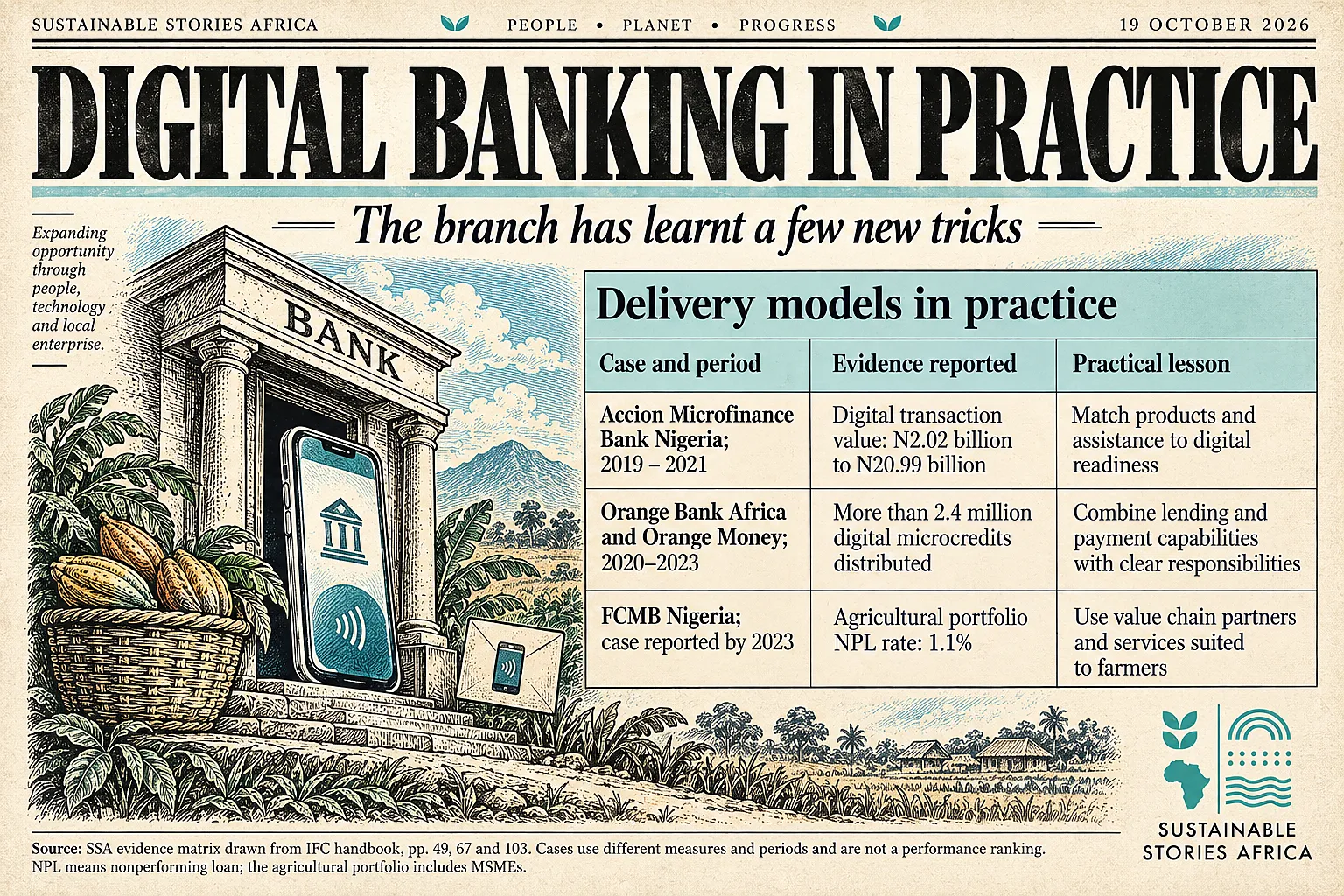
Nigeria's Accion Microfinance Bank illustrates the importance of customer behaviour.
- Its case study describes product redesign, research, targeted incentives and assistance from account officers. Reported digital transaction value rose from N2.02 billion in 2019 to N20.99 billion in 2021.
- This is historical transaction growth, not evidence that lending or customer incomes increased by the same proportion.
In Côte d'Ivoire, Orange Bank Africa's partnership with Orange Money combined a bank's lending capability with a mobile money customer channel.
- The handbook reports more than 2.4 million microcredits distributed between 2020 and 2023.
- The case demonstrates reach, while also stressing the need to agree responsibilities, commercial arrangements and customer protection.
Better Finance Can Strengthen Everyday Livelihoods
Well-designed services can reduce the time entrepreneurs spend applying for finance and managing routine payments.
- Better visibility into trading patterns can support working capital that fits actual needs, while savings, insurance and business tools can help customers manage fluctuations.
- These benefits depend on product design and cannot be assumed from account registration alone.
Agriculture offers a useful example.
- FCMB's Nigerian case links finance with aggregators and buyers, digital channels and training.
- Partners help organise inputs and market access, while the bank considers farmers' seasonal incomes.
- The handbook reports an agricultural portfolio nonperforming loan rate of 1.1% by 2023. This is a case-specific observation, rather than a guarantee that similar programmes will achieve the same result.
The case also reports reaching more than 31,000 farmers under a Mastercard programme, with women accounting for 69% of participants and youth 64%.
- These categories overlap.
- Their significance is that inclusion can be designed into distribution and support arrangements, then measured, instead of being inferred from overall growth.
From an ESG perspective, stronger enterprise finance can support livelihoods and participation in markets.
- Its value should be assessed through affordability, resilience and business outcomes alongside portfolio performance.
- More borrowing alone does not establish that customers are better off.
Non-financial services can make financial products more useful.
- Bookkeeping support, digital skills and inventory tools help entrepreneurs understand their own operations while potentially improving the records available for assessment.
- Providers should evaluate whether customers use these services and find them valuable, rather than assuming that a bundled offer automatically builds capability.
Build Trust Before Scaling Automated Credit
Lenders should start with a defined customer problem and test a manageable product before expanding.
- Existing account data can be combined gradually with validated external information.
- The handbook recommends testing predictive performance, introducing alternative data progressively and refining models through repayment experience and feedback. [4]
Boards and risk teams must also govern automated decisions.
- Incomplete or unrepresentative training data can reproduce bias and exclude groups with limited digital histories.
- Clear explanations, appropriate human review and monitoring across customer segments are practical safeguards.
- Payment data should support a proportionate assessment of business capacity, not become an excuse for indiscriminate data collection.
Partnership contracts should establish who handles customer complaints, protects information and responds when a platform fails.
- Institutions need cybersecurity controls and credible recovery arrangements, while customers need clear pricing, repayment information and accessible help.
- These protections are part of service quality and sustainable portfolio management.
Regulators should assess whether digital delivery improves access without weakening responsible lending.
Development partners can support shared infrastructure, institutional capacity and training for entrepreneurs.
Providers should retain assisted routes for customers who need help using digital channels.
SSA's interpretation is that progress requires a broader scorecard:
- Active usage, cost to serve, repayment performance, customer complaints and access among underserved groups.
- Evaluations should also ask whether finance helps businesses maintain stock, withstand disruption or invest productively.
A phased pilot should follow customers through repayment, not end at approval.
- Institutions can compare expected and actual losses, investigate rejected applications and review how customers cope with repayment schedules.
This feedback helps identify both commercial weaknesses and products that appear convenient initially but create avoidable strain later.
Path Forward – Make Digital Inclusion Measurable
African lenders should combine customer research, useful transaction data and partnerships with responsible credit assessment.
Products should reflect business cycles and provide assistance where digital capability is limited.
Regulators and development partners should support secure infrastructure and accountable delivery.
Success should mean affordable services, sustainable repayment and stronger businesses, with outcomes measured beyond registrations, application speed or loan volumes.