South Africa could regain investment grade by 2028 under an Investec scenario requiring sustained fiscal discipline, stronger growth and political stability.
The proposed path includes potential upgrades in late 2026 and late 2027.
For citizens, the stakes extend to borrowing costs, infrastructure and public services.
The October 21 budget statement and November 4 local elections are near-term tests; the ratings outcome remains conditional.
South Africa Approaches A Credibility Test
South Africa has a plausible but demanding route back to investment grade by 2028 if fiscal improvement translates into lower debt burdens, stronger investment and sustained institutional credibility, according to an Investec roadmap by investment strategist Osagyefo Mazwai.
- Its scenario, assigns a probability above 50% to that outcome.
- This is Investec's assessment, rather than a ratings agency commitment.
The immediate calendar gives that argument practical importance.
- Finance Minister Enoch Godongwana is scheduled to deliver the Medium-Term Budget Policy Statement on October 21, while local government elections are scheduled for November 4.
- Both events lie ahead.
Investment grade signals comparatively stronger creditworthiness.
- For South Africans, the broader question is whether improved confidence can help reduce financing pressures and support public investment.
These gains require sustained delivery: a more favourable market mood does not repair water networks, improve freight capacity or create productive investment by itself.
Market Optimism Still Needs Fiscal Proof
The roadmap reports a five-year sovereign credit default swap spread of 143 basis points.
- Such contracts price protection against credit events; a lower spread generally indicates a lower market-implied risk premium. Investec argues that pricing around 150 basis points or below is consistent with ratings roughly one notch beneath investment grade.
- It does not establish that an upgrade has been approved.
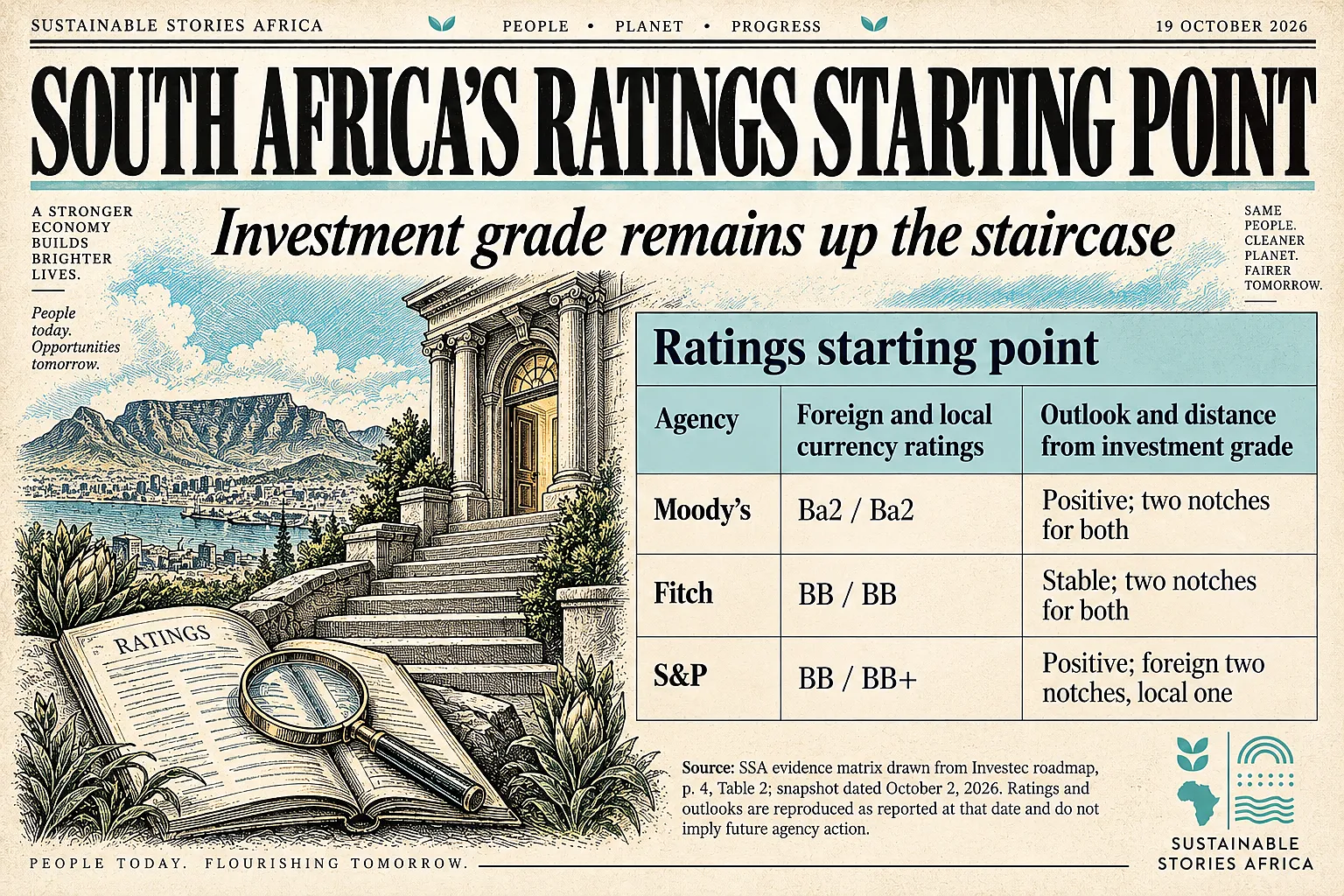
The report's ratings snapshot, dated October 2, places all three agencies' foreign currency ratings two notches below investment grade.
- Local currency ratings differ: S&P's is one notch below, while Moody's and Fitch's remain two notches below.
- Positive outlooks at Moody's and S&P offer potential scope for action, but an outlook is not a promise.
Investec's path envisages an initial upgrade window after the 2026 budget statement, followed by further evidence from the February 2027 Budget Review and the 2027 medium-term statement
- A possible investment grade upgrade in late 2027 would allow consolidation during 2028.
- These dates describe the analyst's sequence, not scheduled agency decisions.
Debt Costs Reveal The Development Tradeoff
Fiscal credibility begins with the primary balance: revenue less spending before interest payments.
- Investec supports a stronger fiscal anchor, potentially established in law, with a clear debt objective, transparent escape provisions and corrective action when targets are missed.
- The purpose is to make sustainable finances a durable institutional commitment.
The distinction between stabilising and reducing debt relative to GDP is crucial.
- A debt ratio that stops rising provides relief, but a sustained decline offers stronger evidence of improving capacity to manage obligations.
- Nominal debt need not fall for the ratio to decline if the economy and revenues grow sufficiently.
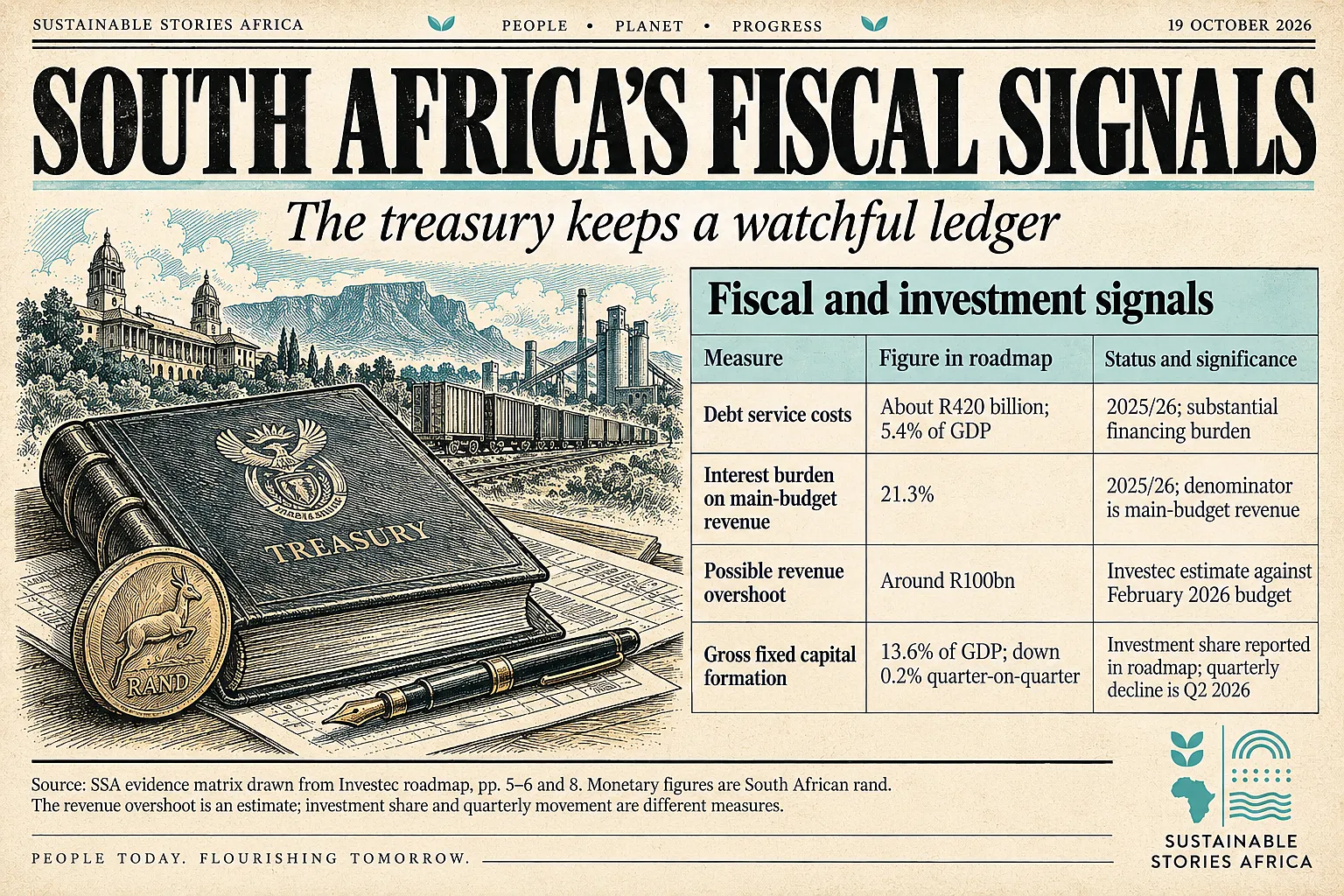
The roadmap places 2025/26 debt service costs at approximately R420 billion, or 5.4% of GDP and 21.3% of main-budget revenue.
- It separately discusses consolidated revenue and spending ratios.
- These denominators differ; this article uses the explicitly labelled main-budget revenue measure to keep the comparison clear.
Investec also estimates that revenue could exceed the February 2026 budget projection by around R100 billion.
- It attributes much of the potential improvement to mining-related windfalls.
- A temporary commodity boost can ease pressure, but agencies will need evidence of recurring revenue and expenditure discipline before treating the improvement as lasting.
The report also models potential debt service savings of R40 billion to R60 billion if the burden relative to consolidated revenue had been lower in 2025/26.
- This is a counterfactual illustration, not money already available for allocation.
- It shows the scale of the opportunity cost, while leaving the actual savings dependent on financing conditions and debt dynamics.
Municipal Delivery Can Unlock Productive Investment
The strongest development case for improved creditworthiness is the possibility of easing financing pressures and creating more room for productive expenditure.
- Lower borrowing costs can help over time, but the benefit depends on the timing of debt issuance, market conditions and how any fiscal space is used.
- An upgrade would not automatically create a fixed amount of budget savings.
Investec identifies local government reform as a key route to stronger growth.
- Businesses make investment decisions in places where reliable water, functioning roads and dependable municipal services matter.
- Improvements in national electricity and logistics systems need to be matched by delivery at the local level.
The investment evidence shows why that matters.
- Gross fixed capital formation stood at 13.6% of GDP in the roadmap and fell 0.2% quarter on quarter in the second quarter of 2026.
- Reform progress had therefore not yet produced a sufficiently broad investment response.
- Higher freight and port volumes would provide another practical test of whether improved systems are supporting activity.
SSA's assesses that the social value of fiscal reform depends on this connection to delivery.
- Affordable public finance, capable municipalities and productive private investment can reinforce one another.
- Weak services can interrupt that relationship, leaving confidence gains with limited effects on households and enterprises.
The distribution of benefits also matters.
- Reform should improve the environment for smaller firms and communities whose costs rise when services fail.
- Better procurement, maintenance and project execution can help convert available resources into functioning infrastructure.
Assessing those outcomes alongside fiscal aggregates keeps the development purpose of creditworthiness visible.
Make Reform Evidence Stronger Than Sentiment
National Treasury should explain how recurring revenue, expenditure control and the primary surplus support a declining debt ratio.
- Commodity windfalls and reserve transactions should be distinguished from structural improvements, with assumptions and sensitivities available for scrutiny.
- A fiscal anchor will be credible only if its design and implementation survive political pressure.
Government should also disclose contingent liabilities: obligations that may become actual costs if state enterprises, municipalities or guaranteed projects require support.
- Investec sees progress at Eskom and Transnet but warns that risks remain, including at large municipalities.
- Public private partnerships can mobilise investment, yet their guarantees and risk allocation require transparent treatment.
Municipal leaders and national authorities should translate reform into measurable service and investment outcomes.
- Reliable water provision, better infrastructure maintenance and functioning logistics offer evidence that businesses can use.
- Political stability matters because uncertainty can raise financing costs and interrupt implementation.
External conditions remain a substantial constraint.
- The roadmap highlights conflict-related oil and inflation risks, global interest rates, weaker commodity demand and exchange rate pressures.
- These can slow growth or raise borrowing costs even when domestic reform advances.
- Planning should therefore test adverse scenarios as well as the preferred upgrade path.
Investors and public institutions should judge the roadmap through delivered budgets, debt trends and service performance.
- The case for investment grade strengthens when those indicators improve together and remain resilient through political and economic shocks.
Partnerships should be assessed project by project.
- Private participation can improve capacity and delivery, but it does not erase public obligations or commercial risk.
- Clear contracts, disclosed guarantees and credible oversight help determine whether infrastructure investment strengthens public finances or creates liabilities that emerge later.
Path Forward Earn Confidence Through Consistent Delivery
South Africa's route to investment grade requires sustained primary surpluses, credible debt reduction, stronger investment and contained fiscal risks.
The October budget statement should clarify how these objectives will be delivered.
Municipal performance and political continuity must support the national programme.
Investec's 2028 scenario remains conditional; its development value will depend on whether greater credibility translates into reliable services, productive activity and durable fiscal space.