When a megaproject begins to slip, investors often face a false choice: close it down or keep financing the original plan. Both reactions can destroy value.
A McKinsey analysis proposes an independent project challenge team that tests the economic case, not just the engineering schedule.
Its lessons could strengthen African infrastructure investment decisions amid fiscal pressure and rising execution costs.
Troubled Megaprojects Demand Decisions Beyond Instinct Alone
A partially completed power station cannot serve households merely because funding has already been spent.
Nor does cancellation automatically protect the public if the project would still deliver positive benefits after changes to scope, procurement or commercial design.
- Capital allocation requires a fresh investment judgment rather than an emotional defence of sunk costs.
McKinsey’s July 2025 Operations Practice article, Don’t Cancel or Coddle At-Risk Capital Projects—Challenge Them, argues for independent project challenge teams.
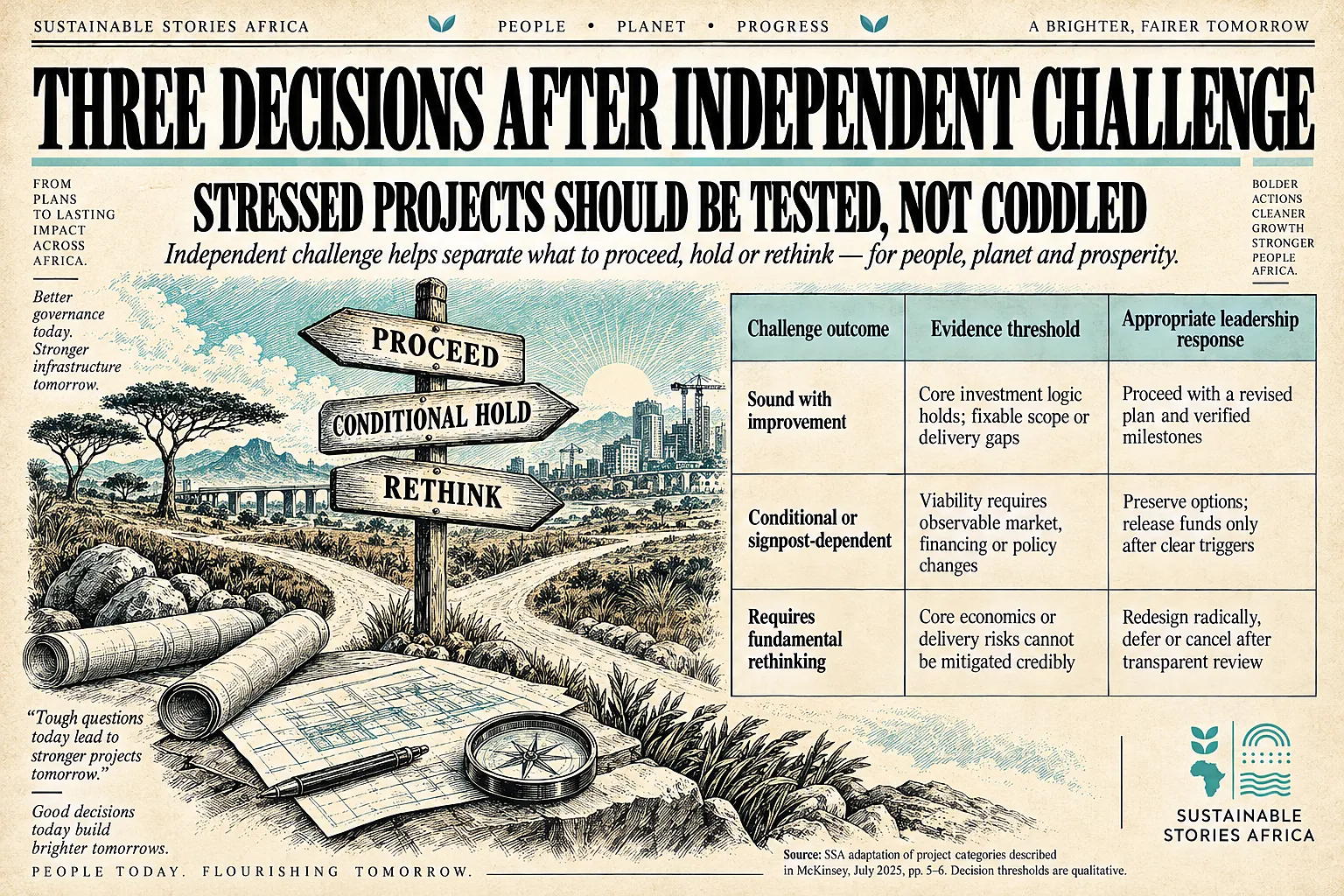
- These groups scrutinise technical plans and the entire investment thesis, then present leadership with evidence for improvement, conditional progression or a fundamental reset.
For African infrastructure sponsors, the issue touches public debt, energy security, industrial capacity and trust.
The study’s project statistics are global, not country-level forecasts for Africa; nevertheless, they illustrate why governance at investment approval and restructuring deserves rigorous attention.
Global Megaproject Results Expose Structural Weaknesses
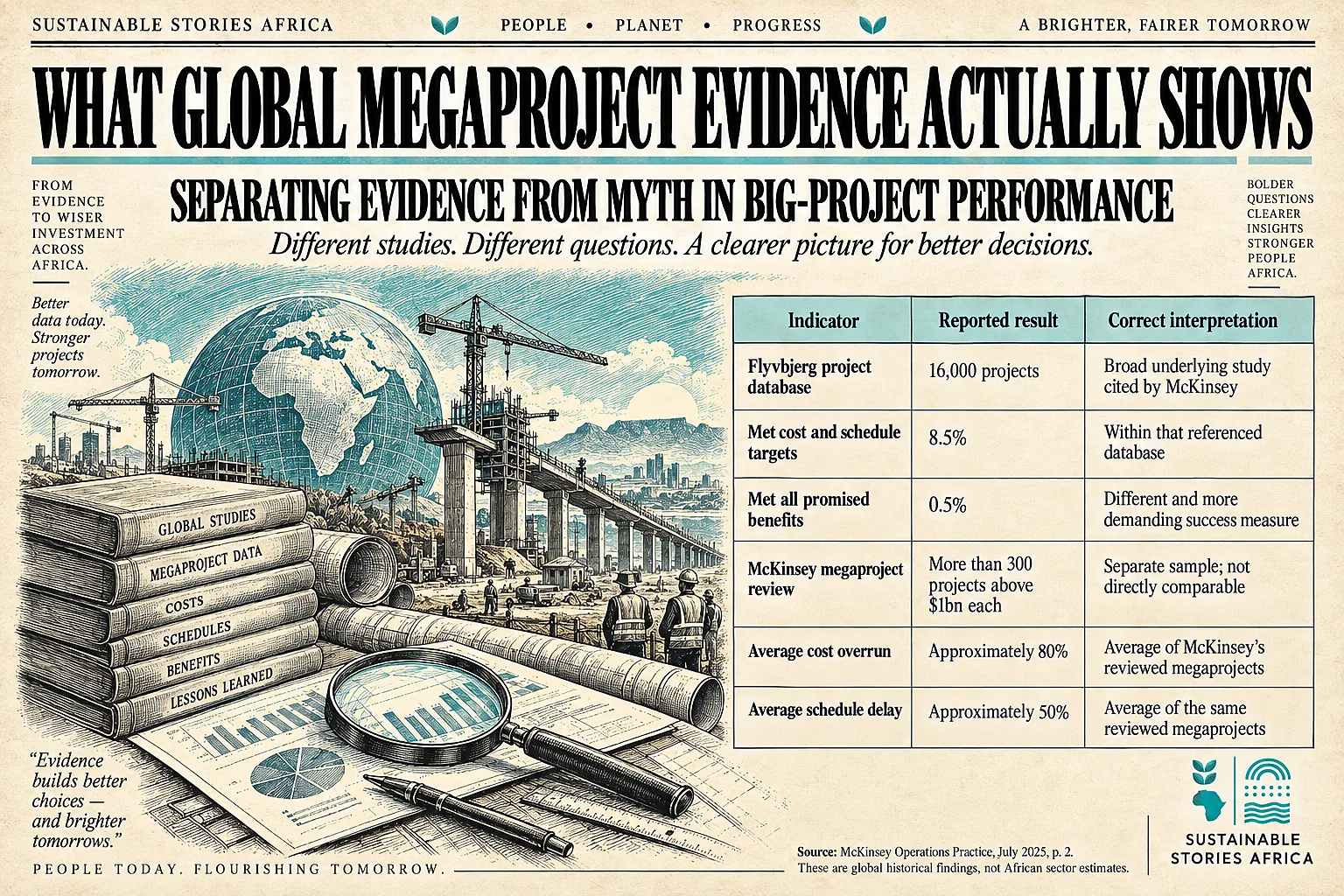
Citing research by economic geographer Bent Flyvbjerg, McKinsey reports that only 8.5% of 16,000 projects met both cost and schedule targets, while just 0.5% achieved all promised benefits.
- In McKinsey’s separate review of more than 300 projects each exceeding $1 billion, average cost overruns were approximately 80% and schedule delays about 50%.
The samples and metrics differ and must not be combined into a single performance rate.
- Together, however, they challenge the assumption that signed contracts and sophisticated schedules automatically generate reliable outcomes.
The report also estimated $24 trillion in heavy-industrial capital ready for global deployment over a five-year window from its 2025 publication, increasing the stakes of weak approval processes.
For an African government considering an industrial complex or energy project, a delayed facility can simultaneously burden public finances, disrupt supplier plans and postpone employment.
The rational response is to test whether the asset remains competitive under today's conditions, rather than defend yesterday's assumptions.
Independence Changes What Investment Teams Examine
Traditional peer reviews frequently privilege engineering feasibility and technical design.
- Their experts may share assumptions as project managers and often lack authority to demand commercial changes.
- The opposite model, a committee empowered primarily to cancel, can become politically difficult in complex institutions with numerous stakeholders.
McKinsey’s middle path is an independent challenge team sponsored by executive leadership.
It has five features:
- Genuine objectivity
- External perspectives
- An investor mindset
- A focus on competitiveness
- Meaningful influence on decisions.
Its mandate is to examine the project’s scope, returns, cost curves, suppliers, demand, market risk, construction sequence and exposure to new regulations or trade disruptions.
- One source example describes a $1.5 billion offshore energy project where engineering scope reductions of $250 million could preserve viability even under unusually low price conditions.
- Another example describes an energy company whose capital portfolio had lost much of its potential net present value to underperformance.
The article reports that the company subsequently institutionalised reviews to challenge project assumptions before final decisions.
For African public infrastructure, such teams could integrate engineering, finance, environmental and social specialists, procurement experts and independent market advisers.
- They should also consider end-user affordability, fiscal contingent liabilities, displacement safeguards and whether demand projections are defensible.
Better Questions Produce Better Investment Choices
The desired outcome is not a higher cancellation rate. It is better allocation of scarce capital.
- A project that needs modest redesign should not be sacrificed merely because it has encountered a setback.
- Equally, managers should not draw down further funds if credible evidence shows that future benefits no longer justify future expenditure.
Independently challenging assumptions can create opportunities to renegotiate contracts, redesign work packages, sequence investments or preserve key infrastructure while abandoning uneconomic components.
- This is particularly important for projects whose social value exceeds direct project cash flow.
- Economic evaluation should transparently consider public benefits, but it should not disguise unaffordable financing structures or implausible demand.
A credible review also supports investor confidence.
When sponsors document the grounds for continuing or pausing, lenders and taxpayers can distinguish disciplined adaptation from political indecision.
Social and environmental commitments become testable investment conditions instead of aspirational annexes attached to the approval memorandum.
Build Credible Gates Into Capital Allocation
Governments, sovereign funds, DFIs and corporate investment committees should mandate a challenge before final approval and at material cost, schedule or market triggers.
- Challenge teams must report directly to decision-makers, disclose conflicts of interest and apply comparable criteria across projects.
- Recommendations should identify the action, the evidence and the person responsible for implementation.
For Africa, the strongest safeguard may be to publish concise decision records describing the revised business case, lifecycle costs, delivery timetable, environmental and social obligations, and consequences for public finances.
- Reviews should occur early enough to change outcomes. A comprehensive report delivered after most expenditure is irrecoverable provides much less protection.
The timing of the challenge is therefore critical.
- At concept stage, reviewers can test whether the problem has been correctly defined and whether alternatives offer greater value.
- Before construction, they can probe design maturity and commercial assumptions.
- Mid-project, they can challenge whether new evidence justifies a smaller scope or a revised procurement strategy.
- At commissioning, they can ask whether the operating model remains financially and technically credible.
For state-backed projects, review independence should not depend on a change in political leadership. Stable review rules, published conflict-of-interest disclosures and independent technical records can reduce the risk that a project is either protected or attacked for political reasons rather than evaluated on value.
Path Forward — Challenge Value Before Defending Sunk Costs
Capital projects deserve neither automatic rescue nor reflexive cancellation.
Their future depends on independently tested economics, realistic execution plans and demonstrable public value.
African sponsors can strengthen infrastructure outcomes by giving impartial reviewers access to evidence, requiring decision-ready recommendations and linking each funding release to a credible, updated case for investment.