McKinsey’s September 2026 Global Energy Perspective reframes the energy transition as an expansion: demand is growing, security risks are multiplying, and grids can limit progress even where generation is affordable.
For Africa, the strategic issue is how to expand reliable energy access while avoiding costly infrastructure lock-in, commodity shocks and a widening climate gap.
The report’s scenarios are possible futures, not forecasts guaranteed to occur.
Energy Growth Tests Africa’s Development Choices
An African manufacturer may not care whether its electricity comes from the newest technology; it needs dependable power at a price that allows the business to survive.
- A rural health facility requires lighting, refrigeration and communications through the night.
- A utility must provide those services while paying for networks, maintenance, storage and backup capacity.
McKinsey’s Global Energy Perspective 2026, published in September, argues that the global energy story has changed.
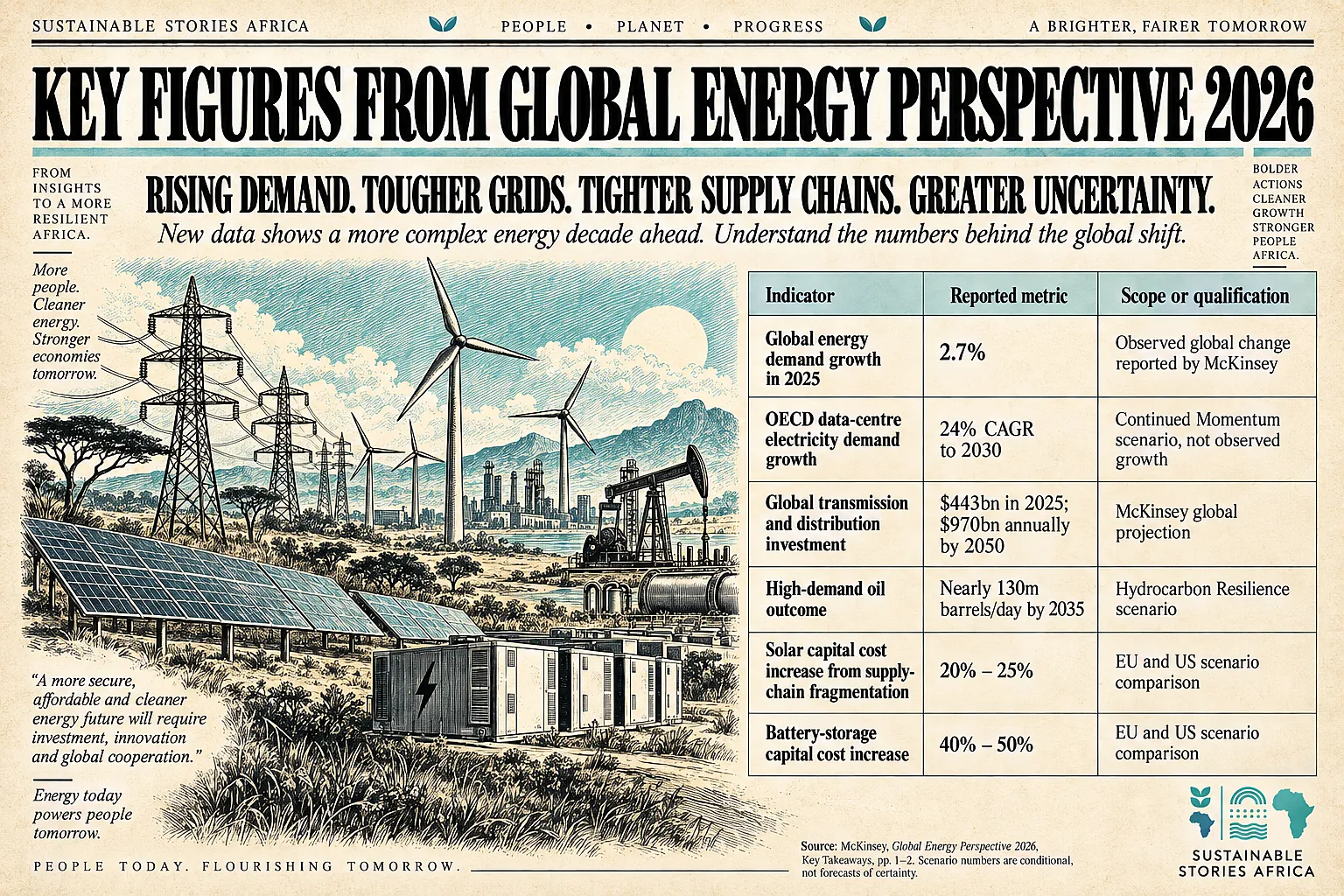
- Rather than a simple substitution in which one fuel disappears and another grows, 2025 saw oil, natural gas, coal and renewables all expand as total energy demand increased 2.7%.
The report constructs five scenarios to explore how affordability, energy security and emissions pathways may unfold.
For African policymakers and investors, the strongest insight is that access, reliability and decarbonisation must be planned as a system rather than competing slogans.
More Generation Does Not Guarantee Reliability
The study identifies grids as a binding constraint on the pace of electrification.
- Electricity demand can rise while weak transmission, delayed interconnection, insufficient firm capacity or shortages of skilled labour and equipment stagnate new generation.
- Cheaper solar modules do not automatically deliver lower bills if the power system requires major investment in flexibility and distribution.
McKinsey projects global annual transmission and distribution investment rising from $443 billion in 2025 to $970 billion by 2050 across its modelling context.
- The numbers are global scenario-based estimates, not a budget allocated to African grids.
Their message remains important for utilities that have historically faced losses, inadequate maintenance and unreliable service.
Energy supply chains have also become a security issue.
- The report warns that geopolitical fragmentation could raise solar capital costs by 20% – 25% and battery storage capital costs by 40% – 50% in the European Union and United States if supply chains were rebuilt outside China.
These specific price estimates should not be transferred mechanically to Africa, although import-reliant African projects would also have reason to examine trade and procurement exposure.
Five Scenarios Reveal Diverging Strategic Risks
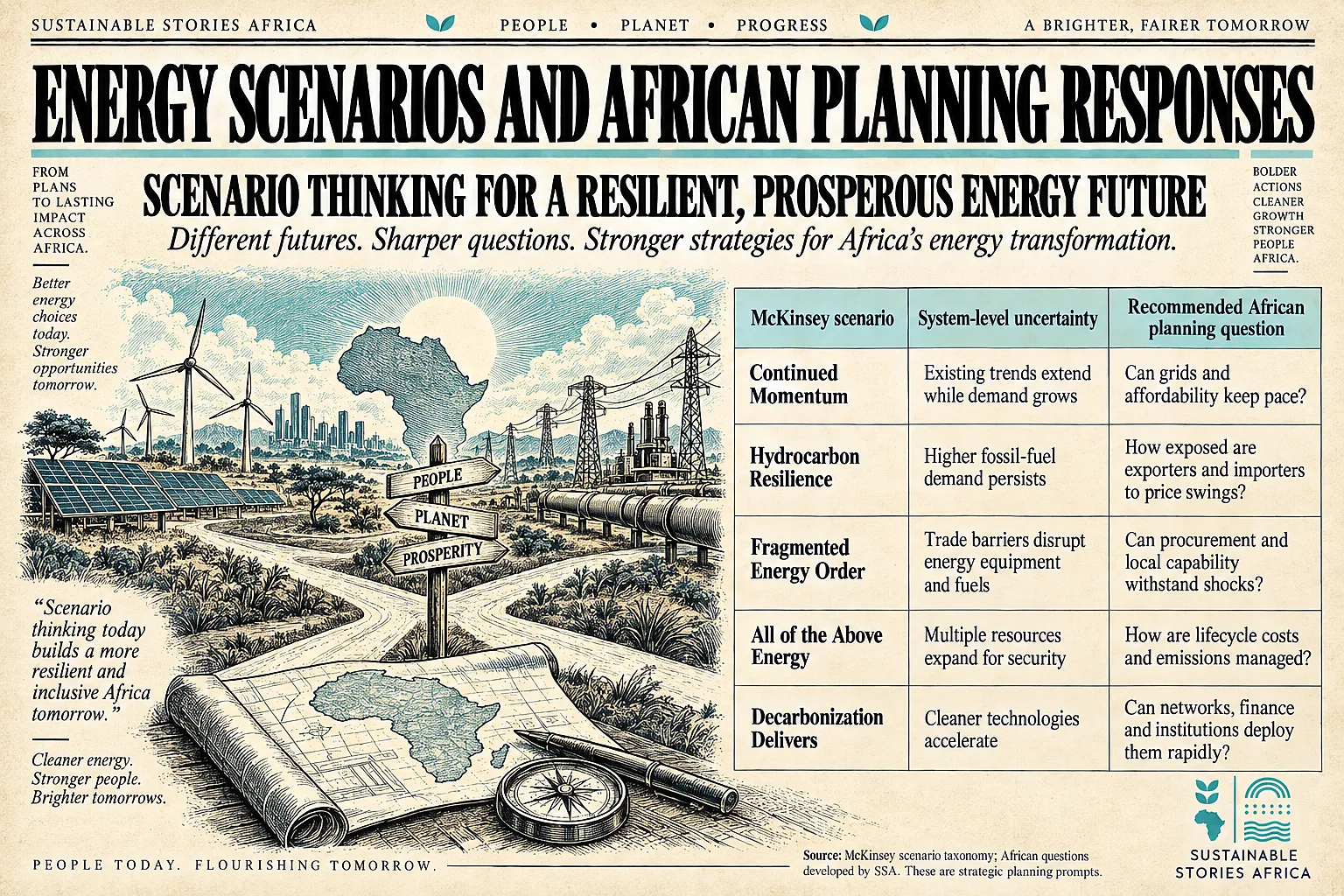
The report sets out Continued Momentum, Hydrocarbon Resilience, Fragmented Energy Order, All of the Above Energy, and Decarbonization Delivers.
- Each explores different combinations of demand growth, geopolitics, technology deployment, supply constraints and climate ambition.
McKinsey does not present any single scenario as the guaranteed future.
- In Hydrocarbon Resilience, oil demand could approach 130 million barrels a day by 2035.
- In Decarbonization Delivers, average annual net nuclear additions are modelled to rise from 18 gigawatts to 40 gigawatts through 2050.
- Even the most optimistic decarbonisation scenario described in the key takeaways misses the Paris-aligned 1.5°C pathway by a projected 0.8°C, underscoring how deeply present investment choices matter.
Africa's position is distinctive.
- Many countries need first-time or more reliable access to energy, while some also depend on hydrocarbon exports, critical minerals or imported technologies.
- Energy planning must address industrial development, household affordability, balance-of-payments exposure and emissions simultaneously.
- Neither blanket fossil-fuel expansion nor indiscriminate technology substitution resolves these competing objectives.
The acceleration of artificial intelligence adds uncertainty.
- McKinsey highlights data centres as a fast-growing electricity load in OECD markets, while acknowledging that computing efficiency could materially alter demand beyond 2030.
African governments considering data-centre or AI industrial policies should test whether commercial customers can afford firm power without shifting disproportionate costs onto households.
Integrated Systems Can Expand Inclusive Access
A balanced energy strategy could support productive industrial loads, distributed access for underserved communities and lower-carbon growth.
- However, success requires a realistic accounting of whole-system costs: generation, grid connections, storage, dispatchable supply, reserve margins and customer affordability.
Grid modernisation can be socially transformative.
- Reduced outages may improve factory output, hospital care, refrigeration and education.
- Distributed renewable systems can offer alternatives in locations where extending central networks is uneconomic, provided service quality and long-term maintenance are addressed.
- Regional power trade may also reduce dependence on a single national generation mix, where interconnections and regulatory arrangements make such trade viable.
The report’s uncertainty argues for preserving options.
- Financing a new power station without assessing future fuel costs or network demand creates stranded-asset risk.
- Equally, announcing ambitious renewable capacity without investing in transmission and grid stability can postpone actual delivery.
- Assess climate policy and energy security as a portfolio of interacting assets rather than a competition between technologies.
Plan Whole Systems, Not Technology Headlines
African utilities, regulators and financiers should develop resource plans that compare system costs under multiple plausible scenarios.
- These plans need stress tests for currency movements, fuel imports, equipment delays, drought exposure, demand growth and climate constraints.
- Procurement should assess grid equipment and technical skills as strategically as generation contracts.
Policymakers should track outcomes including reliable hours of supply, new connections, effective electricity tariffs, industrial power costs, investment in grid maintenance and emissions.
Financial institutions should insist that project claims about low-cost generation include credible transmission and firming requirements.
- Greater local workforce capability and transparent contracts can also reduce exposure to equipment shortages and opaque procurement.
System planning must also link energy policy to industrial strategy.
- Electrifying transport, expanding mineral processing and attracting digital infrastructure all change both the size and shape of electricity demand.
- A grid built solely around historical consumption will struggle if large industrial clusters emerge in new locations.
- Integrated plans should identify where transmission investment can support economic diversification and where distributed solutions can serve communities more efficiently.
Equity remains central.
- Recovery through uniform tariffs: without considering income and consumption, vulnerable households may face increased energy insecurity from the costs of upgrading a power system.
Tariff design, targeted protections and the sequencing of investment therefore belong in the same policy conversation as technology choice.
Path Forward – Put Reliable Electricity Before Easy Narratives
The global energy transition is no longer described as a simple contest between fuels.
Africa needs strategies that expand dependable energy, protect affordability and remain credible under different technology and climate outcomes.
Investment discipline should start with networks, system integration and transparent scenario analysis.
Measuring success depends on the electricity people and businesses can actually use, not capacity that exists on paper.