
Least developed economies are looking beyond manufacturing towards logistics, technology, tourism, finance and business services.
However, designing a hub is easier than creating a productive regional economy around it.
UNCTAD’s Least Developed Countries Report 2025 finds that logistics and technology dominate services-hub strategies.
For Africa, the development test is whether investments generate productive employment, reliable exports and linkages with local firms.
The Services Economy Needs Deeper Foundations
A new port terminal may shorten a shipping route, but its value is limited if inland roads remain unreliable, border procedures are slow or local businesses cannot use the facility.
A technology park may attract buildings and branding while generating few stable jobs without reliable electricity, broadband and technical talent.
Chapter IV of UNCTAD’s The Least Developed Countries Report 2025, titled Services Sector Development: Expectations Versus Realities, examines a growing policy interest in services as a route to structural transformation.
- Its case studies look at regional hub ambitions in logistics, business process services, financial services, tourism, technology and transport.
For African least developed countries, the findings matter because services can raise productivity and integrate economies into trade networks.
However, growing a services sector does not guarantee structural transformation when much employment remains low-paid, informal or disconnected from domestic production.
Logistics Leads The Services Hub Race
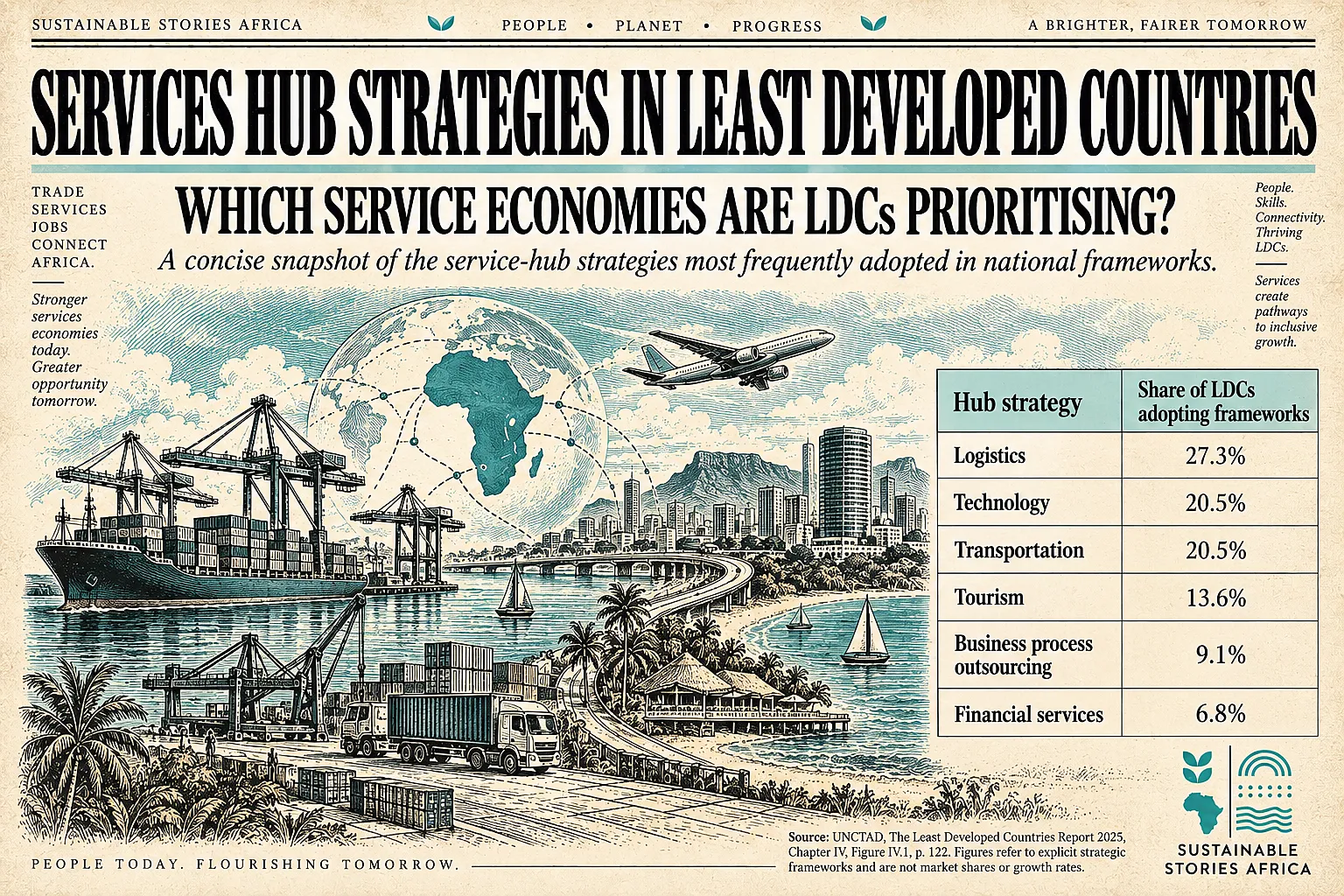
UNCTAD's Figure IV.1 shows the share of least developed countries adopting explicit services-hub strategies across selected categories.
- Logistics leads at 27.3%, followed by technology and transportation at 20.5% each.
- Tourism accounts for 13.6%, business process outsourcing 9.1%, and financial services 6.8%.
These adoption rates come from national development plans and policy documents, not measures of trade performance, completed infrastructure or realised employment.
- A strategy declaration indicates government ambition.
- Its success requires evidence on investment delivered, competitiveness, jobs and domestic spillovers.
The prominence of logistics reflects the role of corridors and ports in lowering transaction costs for goods and services.
- Technology hubs attract policymakers seeking digital enterprise and youth employment.
- Tourism and finance feature less prominently as explicit hub strategies in the report's comparative review.
Hub Strategies Need Stronger Economic Linkages
The report examines how transport corridors, digital capability, business services and investment regulation may combine to produce growth centres.
- Ports linked to modern customs systems can serve manufacturers and farmers; business service firms can help smaller enterprises obtain professional support; tourist economies can create markets for local food, crafts and transportation.
However, hub development also exposes fiscal and competitive weaknesses.
- Multiple countries may invest heavily in facilities aimed at the same regional market without sufficient demand to sustain them all.
- Public debt can increase before user charges, exports or jobs materialise.
UNCTAD warns that pursuing several overlapping hubs creates risks of overcapacity and a fallacy of composition:
- A strategy cannot succeed everywhere simply because it has worked in a few competitive locations.
- A meaningful hub should support productive relationships with its surrounding economy.
- A logistics corridor that bypasses domestic suppliers may improve transit revenue while offering limited industrial upgrading.
- A financial centre that attracts international registration activity without strengthening local firms’ credit opportunities could produce uneven benefits.
- A digital cluster that trains workers but cannot create stable paid opportunities may struggle to retain talent.
The regional African Continental Free Trade Area provides a policy reason to improve cross-border services.
- However, regulatory interoperability, trade facilitation and firm-level capacity must accompany infrastructure investment; market access alone does not create services exports.
African governments should therefore assess demand for regional services and how their own firms could compete, rather than reproducing identical hub projects across neighbouring countries.
Services Growth Can Support Industrial Upgrading
Well-designed services investment can reinforce manufacturing and agriculture rather than replace them.
- Cold chains and efficient transport help food producers reduce losses.
- Business process and professional services can support manufacturers, exporters and hospitals.
- Telecommunications and digital payments can lower transaction costs, improve record-keeping and extend markets to smaller enterprises.
The social benefits become more tangible when new businesses create formal opportunities, invest in training and link to domestic suppliers.
- Young people may find employment in engineering support, logistics management, software services, hospitality and customer operations.
- Women-owned and rural firms can potentially gain access to larger markets when digital and physical infrastructure is usable and affordable.
None of these outcomes is automatic.
- Skills mismatches, imported talent, weak procurement links and unreliable utilities can limit local participation.
- Large hubs may also concentrate opportunities in capital cities while diverting resources from smaller towns.
Inclusive policy must therefore assess the distribution of gains alongside the volume of investment and exports.
Shift From Hub Branding To Results
African policymakers should require each hub proposal to justify its target market, comparative advantage, financing model, demand assumptions and linkages with local enterprises.
- Rather than pursue every fashionable sector, governments can prioritise those where geography, skills, regional demand and existing industries offer a realistic basis for competitiveness.

- Investment incentives should be transparent and time-bound, with publicly evaluated performance.
Governments also need interoperable standards, workable licensing and dispute processes for services trade.
Development finance should support training and participation of smaller suppliers alongside flagship infrastructure.
- Transparent performance reviews can help abandon underperforming proposals before further public spending deepens exposure.
In practical terms, a services-hub proposal should begin with identified firms and markets.
- Which exporters need refrigerated transport?
- Which regional companies will purchase accounting, digital or engineering services?
- Which tourism operators can source food and supplies locally?
These questions link infrastructure plans to customers, rather than assuming that customers will arrive once facilities are built.
Labour outcomes matter equally.
- Governments should distinguish total jobs announced from formal jobs actually created, and track earnings, occupational progression and access for women and young people.
A hub generating a small enclave of high-productivity services alongside widespread low-paid work cannot yet be called an inclusive structural transformation.
Path Forward – Connect Services Expansion With Productive Employment
UNCTAD’s evidence shows growing enthusiasm for logistics and technology hubs, but ambition is not transformation.
Africa will gain more from services investment when hubs are competitive, financially sustainable and embedded in domestic supply chains.
Policymakers should measure export capability, productivity and quality employment rather than counting newly announced zones.
The objective is an economy that produces and shares more value, not a map with more hubs.