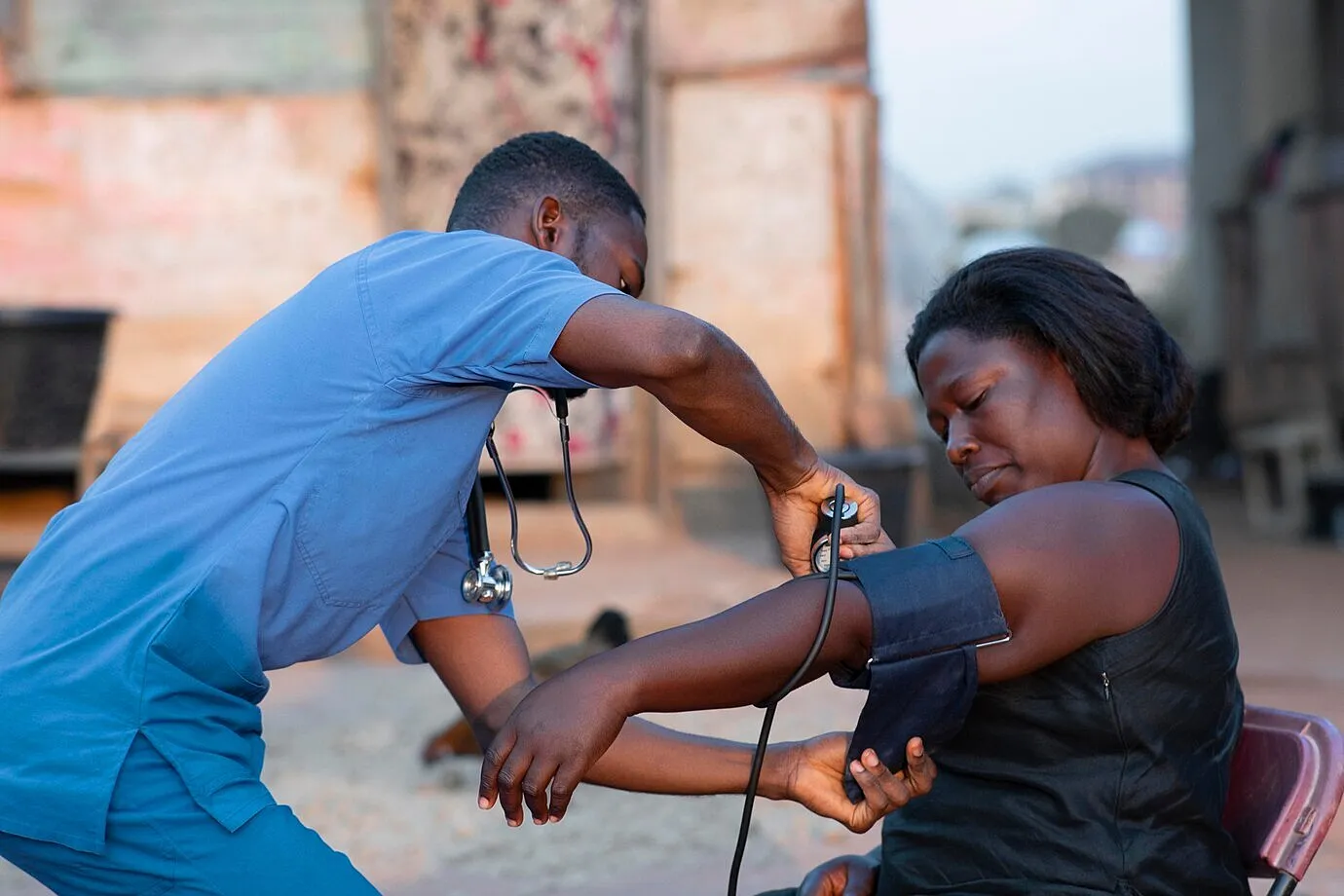
When an older adult or a person with a disability needs sustained daily assistance, families can face years of costs and lost earnings.
These pressures are rarely captured by only health insurance.
An October 2026 Brookings working paper compares European long-term care financing systems with the US.
For Africa, its relevance lies in the design principles, not in importing a European programme wholesale: broader risk sharing, caregiver recognition, predictable financing and equitable access.
Unpaid Care Carries Hidden Economic Costs
A family may afford a clinic visit but struggle when a relative needs help bathing, eating, moving safely or managing everyday life for several years.
One member reduces paid work, another covers transportation and medication, and scarce household savings gradually absorb the cost.
These arrangements provide essential support; however, their economic burden remains largely invisible.
Joan Costa-Font and Richard Frank examine that problem in the Brookings Institution working paper Pooling Risk to Pay for Long-Term Services and Supports? European Lessons for the United States, published in October 2026.
- Their focus is the United States and European care systems, including Germany, the Netherlands, Spain and Scotland.
For African policymakers, the paper offers comparative insights rather than direct evidence on African long-term care coverage.
Applying them requires attention to informal work, fiscal constraints, uneven service availability and the enormous contribution made by relatives, often women, to unpaid care.
Care Risks Extend Beyond Health Insurance
The Brookings paper notes that Medicare generally excludes most long-term services and supports (LTSS), Medicaid acts largely as a means-tested payer, and private long-term care insurance has remained marginal in the United States.
- It cites research suggesting that approximately half of Americans reaching age 65 will need some paid LTSS during the remainder of their lives, while roughly one-fifth will need care for more than five years.
These figures describe the US context and must not be used as African prevalence estimates.
- They illustrate the broader challenge of rare or unevenly distributed but potentially very expensive care episodes.
- The issue is not simply the probability of needing support; it is the difficulty of financing that support individually over an uncertain number of years.
In African contexts where coverage and professional care capacity may be fragmented, households could face overlapping vulnerabilities: direct expenses, the opportunity cost of unpaid care and distance from services.
- Policymakers considering expanded universal health coverage should therefore ask whether social protection adequately addresses functional limitations and community support beyond acute medical treatment.
European Experience Reveals Difficult Design Choices
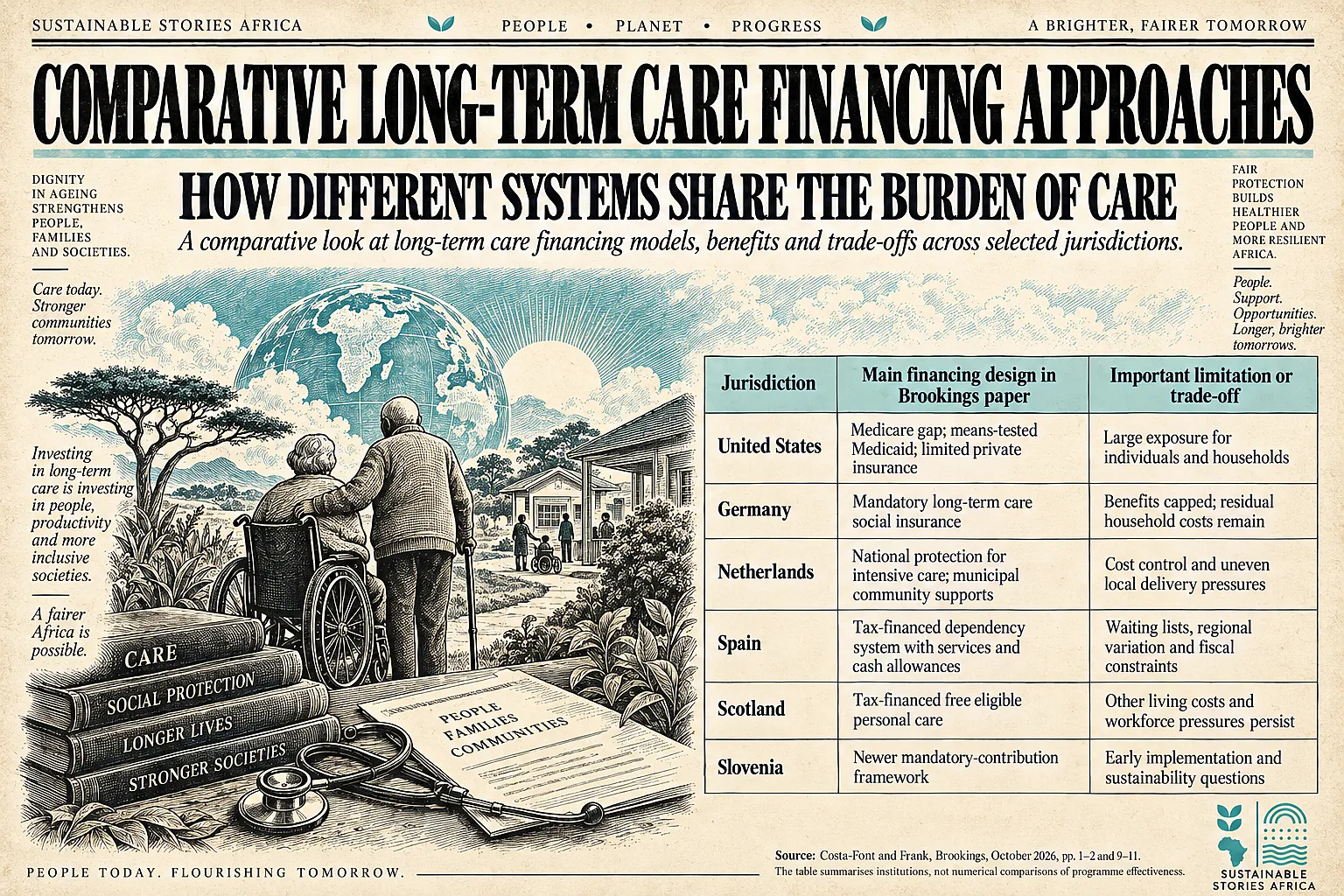
Germany pools care risk through compulsory contributions and permits households to combine cash allowances with services, while recognising informal caregivers through selected social protections.
The Netherlands maintains strong national protection for intensive needs but allocates other community-support responsibilities to municipalities.
Spain established entitlements to dependency support but has faced financing pressure, waiting lists and uneven regional provision.
Scotland's free personal care framework separates certain care needs from accommodation and other living expenses.
- The lesson is that a nominally universal entitlement can still leave families with substantial costs.
European systems must continually balance service quality, affordability, workforce supply, geographic access and the respective roles of professional and family caregivers.
For Africa, these tensions may be sharper where payroll-based contributions reach only a portion of workers.
- A model financed solely through formal-sector wages could exclude many households needing support.
- Conversely, a generous entitlement without credible revenue or sufficient carers could become a promise that local governments cannot deliver.
The Brookings paper argues against treating family support as a free residual.
- That insight is especially relevant for policies seeking women's economic participation and poverty reduction.
- Uncompensated care can reduce time available for education, employment and entrepreneurship; recognition and support can therefore serve both social and economic objectives.
Shared Risk Can Support Dignity And Employment
A carefully designed long-term support system could offer predictable help before household resources are exhausted.
- Community-based care and rehabilitation can enable people to remain at home when clinically and socially appropriate, while families receive respite and professional guidance.
- Formal training and safer employment conditions can also improve the quality of care work.
The economic case includes more than avoided medical expenditure.
- Working-age relatives who can remain economically active may sustain household income and tax contributions.
- Older adults and people with disabilities may maintain dignity, connection and greater independence.
Some services could integrate with existing primary healthcare, disability support and local social-assistance networks rather than requiring new institutions in every district.
These benefits are plausible policy objectives, not outcomes established by the Brookings paper for African countries.
- Funding must still be sustainable, and financial pooling will not remedy a shortage of trained caregivers or uneven transport access by itself.
Poorly designed cash allowances could also shift responsibility back onto women without providing meaningful support.
Adapt Care Financing To African Realities
A practical starting point is to assess local care needs, costs, informal caregiving patterns and existing social protection.
- Countries can define a basic service guarantee, identify priority populations, pilot community-based services and build independent assessment systems for eligibility and quality.
- Financing could combine tax allocations, social insurance contributions where administratively feasible and carefully structured subsidies for low-income households.
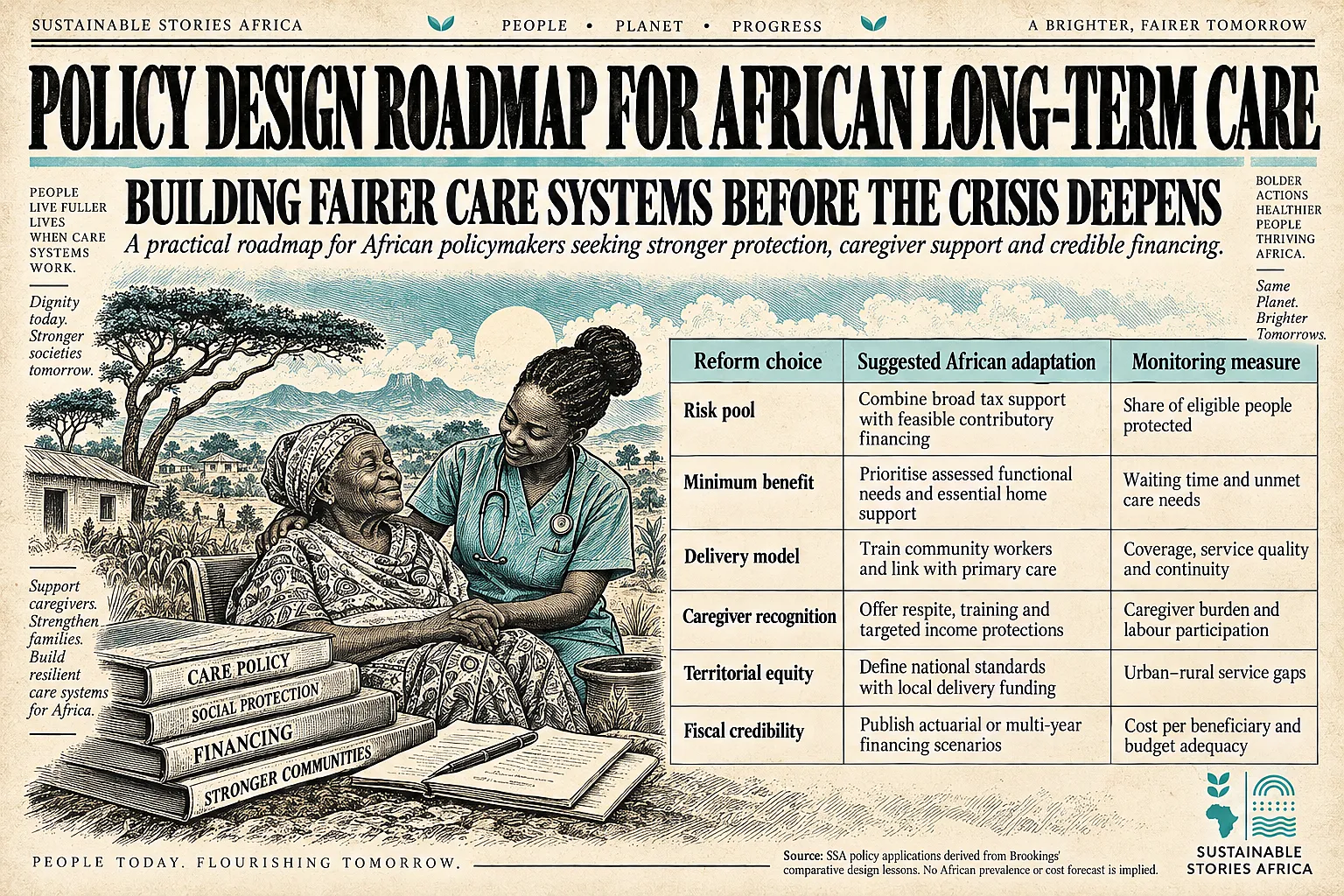
Governments should recognise people with disabilities as well as older populations, and guard against eligibility systems that make support contingent on family breakdown.
Policymakers must also respect cultural preferences while protecting carers from exploitation.
- Transparent financing and independent measurement would make it possible to scale models that achieve good outcomes without promising blanket coverage before delivery capacity exists.
A further design issue is the relationship between long-term support and conventional health spending.
Hospitals frequently manage consequences that families and community workers are poorly equipped to address at home, while medical insurance may not pay for daily assistance that prevents deterioration.
- Better coordination could improve care continuity, but policymakers should evaluate effects instead of assuming savings.
Pilots should therefore record household out-of-pocket spending, caregiver time, avoidable service interruptions, user satisfaction and workforce retention.
Independent assessments can determine whether public subsidies reach high-need households, whether people living in remote communities can access services, and whether protections remain financially realistic through demographic change.
Path Forward – Share Care Risks Without Importing Templates
European approaches show that long-term care can be treated as a shared social risk, but no country has eliminated costs, inequalities or difficult trade-offs.
For Africa, a credible route begins with needs assessment, affordable minimum protection, stronger community services and recognition of unpaid caregivers.
Sustainable care systems should protect both the people receiving support and the families who provide it.