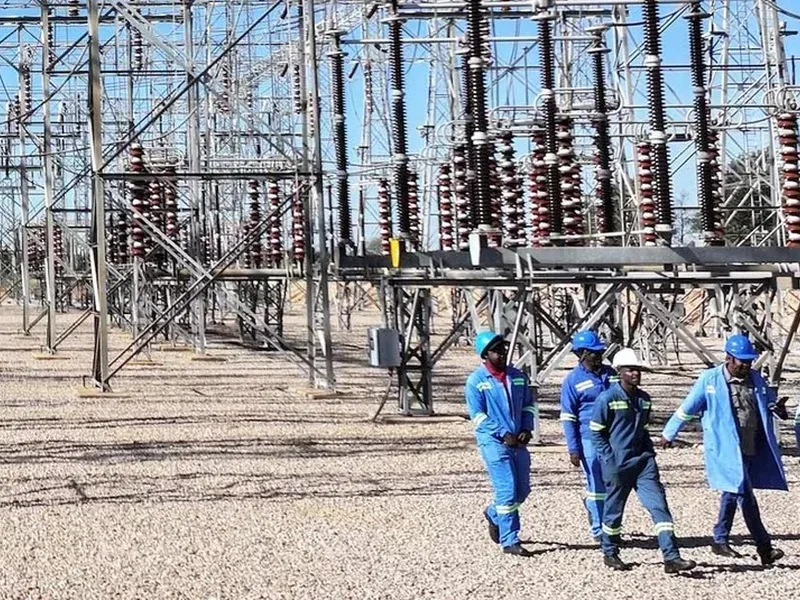
Ethiopia’s clean-power advantage and rapid electric-car adoption contrast with South Africa’s coal-heavy grid and uneven transition.
The Electrification Competitiveness Index shows why neither national ambition nor progress in one sector guarantees an economy-wide electric advantage.
For African businesses, competitiveness depends on the full package: reliable supply, affordable equipment, workable market rules and the skills to deliver investment.
Africa Needs Electricity That Enables Enterprise
Africa’s electrification opportunity is a competitiveness agenda as much as a climate agenda.
The Electrification Competitiveness Index, developed by We Mean Business Coalition with support from RMI, compares 16 countries across 52 indicators, separating existing deployment and market conditions from policies and other enabling conditions.
- Its African coverage comprises Ethiopia and South Africa, not a continent-wide assessment.
The two countries illustrate contrasting problems:
- Turning abundant clean generation into accessible services, and modernising an established but carbon-intensive electricity system while expanding new uses.
The lesson for other African markets is therefore diagnostic, not a ranking to copy.
- Businesses need to identify which constraint is binding in their operating environment and whether the planned solution addresses electricity supply, network access, equipment affordability or implementation capacity.
Electric Vehicles Cannot Substitute For Grids
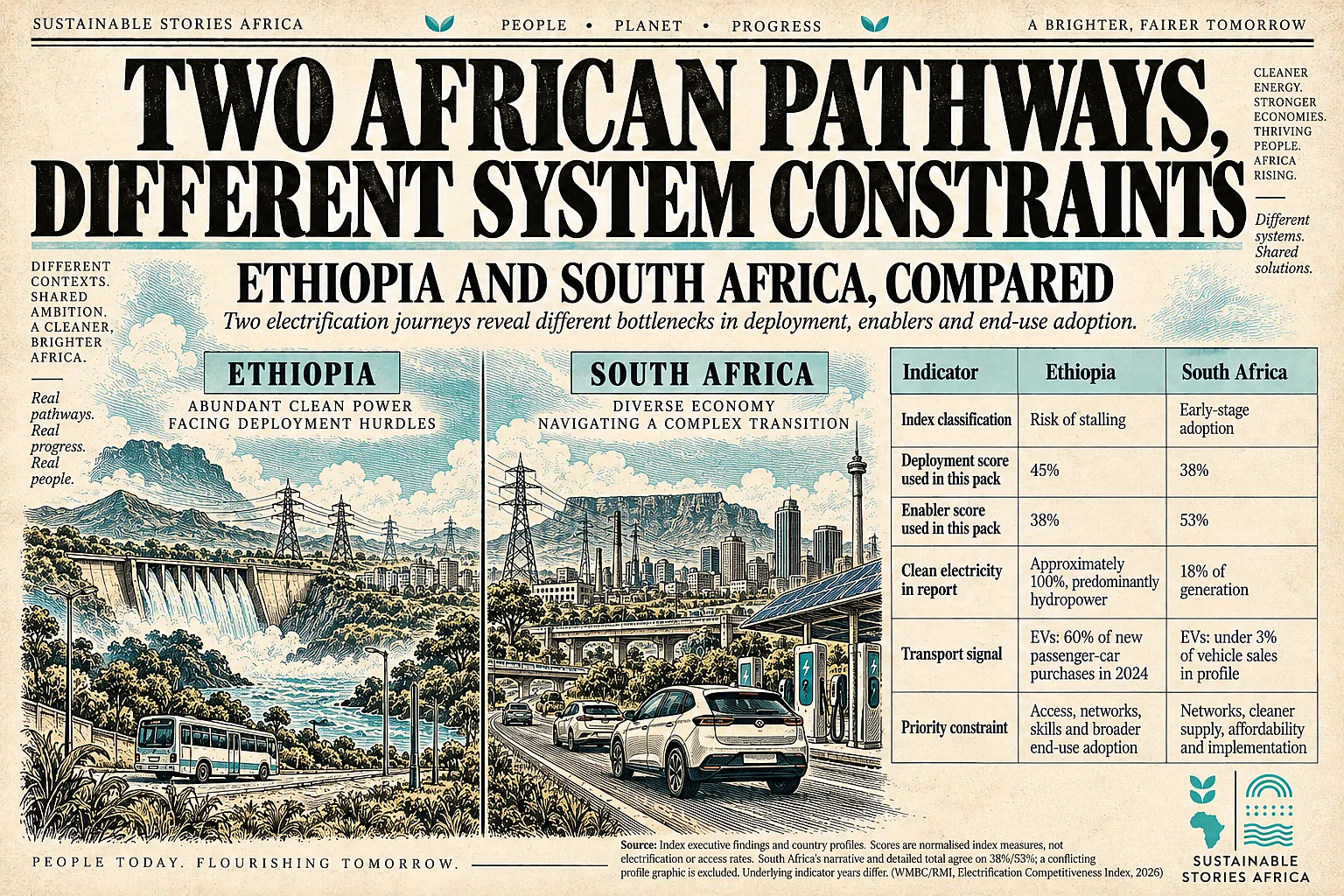
Ethiopia is the index’s clearest African contrast.
- It records a deployment score of 45% against an enabler score of 38%, supported by low-cost hydropower and rapid electric-vehicle uptake.
- However, its country profile reports electricity access of only 55% in 2023.
The report also says electric vehicles reached 60% of new passenger-car purchases in 2024, following an internal-combustion vehicle import ban and financial incentives.
- That statistic concerns new purchases; it does not mean 60% of Ethiopia’s entire vehicle fleet is electric.
These distinctions change the policy reading.
- Strong adoption in a relatively narrow market can coexist with major service gaps elsewhere.
- Clean electricity at the generating plant is not the same as dependable access for households, workshops, farms and factories.
South Africa Needs Reform And Execution
South Africa’s profile describes progress on electricity-market deregulation, distributed generation and energy efficiency, alongside persistent weaknesses in grid investment and skilled workforce availability.
- Coal-heavy generation limits the emissions benefits available from switching end uses to electricity without parallel supply reform.
The legal foundations are changing.
- The Electricity Regulation Amendment Act 38 of 2024 provides for an open market platform for competitive electricity trading and transmission-system-operator functions.
- The government records its commencement as 1 January 2025.
That is an enabling reform, not evidence that every commercial or physical barrier has been removed.
- New market rules must operate alongside viable connections, network capacity and functioning procurement.
- An investor cannot electrify a process merely because the legal framework now permits more competition.
The index identifies a related tension in transport.
- Fiscal support for domestic EV manufacturing does not automatically create an affordable domestic market.
- It recommends examining import duties, charging availability and other measures that affect the purchaser’s business case.
Its findings also caution against treating every industrial use identically.
- Electric motors, process heat and heavy-duty transport have different equipment needs, operating patterns and infrastructure requirements.
- A credible sector roadmap should distinguish them rather than rely on one national headline target.
Price comparisons require similar care.
- The index examines electricity-to-gas ratios because relative energy prices influence some switching decisions.
- However, an energy-price ratio is not a complete measure of the cost of useful output: equipment efficiency, utilisation, financing and operating requirements also matter.
African businesses should therefore test the economics of a defined application rather than infer viability from a national average alone
The report also excludes data-centre and cooling demand from its assessment scope, although both can affect electricity-system planning.
- This boundary matters when using the results for investment strategy. A favourable score on the measured end uses does not establish that every new source of electricity demand has been accommodated, nor does it substitute for a detailed network study.
Better Sequencing Can Broaden Economic Gains
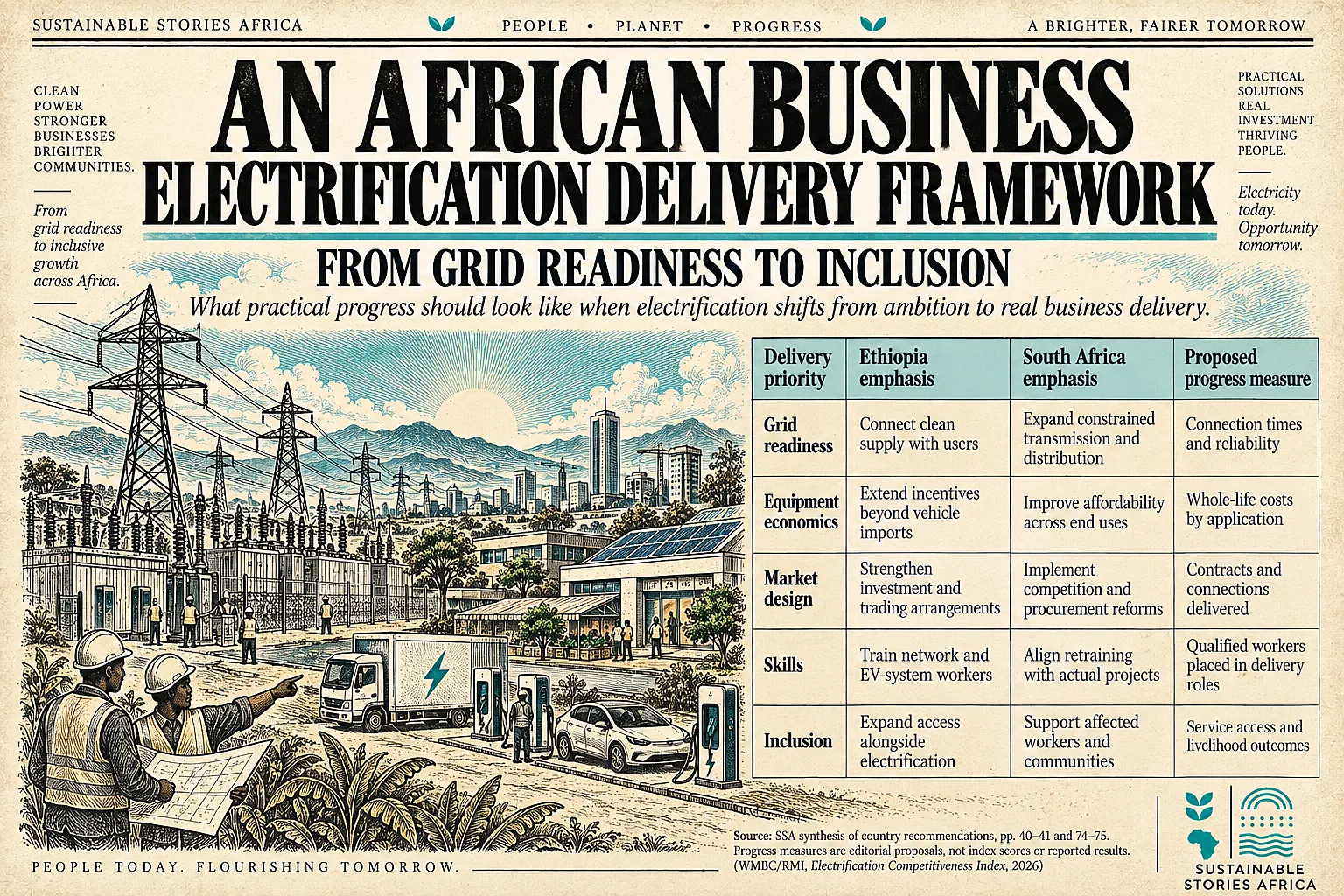
For Ethiopia, the opportunity is to use clean generation more productively while extending basic access.
- The report recommends accelerating network development and rural solutions, improving market conditions for independent producers and expanding workforce capacity.
For South Africa, the opportunity lies in joining power-market reform with transmission and distribution investment, cleaner procurement and end-use adoption.
- The index highlights existing efficiency programmes and just-transition training initiatives as foundations to build upon.
These are different starting points, but they share a commercial logic.
- An investment becomes more credible when the customer knows when electricity will be available, what it will cost and whether the required equipment can be installed and maintained.
A well-sequenced transition can also widen participation.
- Businesses with predictable vehicle routes or clearly defined process requirements may provide manageable early applications.
- Their experience can inform later deployment, provided lessons are documented rather than presented as proof that all use cases are already viable.
The distributional question should remain visible throughout that process.
- A policy package can stimulate adoption among buyers able to purchase new equipment while leaving smaller firms or unconnected households outside the opportunity.
- A practical African strategy should therefore ask who can participate, which constraints they face and whether scarce public support addresses a clearly defined barrier rather than merely subsidising purchases that would occur anyway.
Implementation capacity can itself become part of the industrial opportunity.
- Network construction, equipment installation, maintenance and digital operations require workers and service providers.
- The index’s emphasis on skills suggests that training should be coordinated with a visible project pipeline.
Counting course enrolments alone would give a weaker account of progress than tracking whether qualified workers can undertake the jobs that investment actually creates.
Put Business Constraints Before National Rankings
Governments should publish sector-specific delivery plans identifying grid dependencies, responsible institutions and implementation milestones.
- Access targets remain essential, but they answer a different question from the share of industrial, transport or household energy supplied by electricity.
Utilities and network operators should make connection processes more transparent.
- Businesses need visibility on available capacity, required upgrades and realistic timelines.
- Where flexibility can help, its value should be recognised through clear operating and payment arrangements.
Financiers should assess the complete investment rather than compare equipment prices alone.
- The relevant commercial test includes electricity costs, financing, maintenance, operating requirements and any infrastructure needed to make the asset usable.
- Subsidies can change that calculation, but uncertainty over their duration can weaken confidence.
Businesses should contribute precise evidence to policy discussions.
- A documented connection delay or unfavourable cost structure gives regulators something concrete to address.
- General demands for a faster transition are less useful when the obstacle remains undefined.
The index itself requires careful interpretation.
- Policy research was completed in September 2026, while deployment indicators often reflect earlier years.
- Scores therefore combine different time periods, and recently introduced measures may not yet appear in observed outcomes.
- Ethiopia’s profile also flags high data-quality concerns.
Those limitations do not erase the findings.
- They reinforce the correct use of the exercise: identify plausible constraints, test them with local evidence and monitor whether reforms change investment conditions.
The goal is not a higher score in isolation, but an electricity system that allows more productive activity at a competitive cost.
Path Forward – Build Electric Advantage Through Practical Delivery
African governments should connect access, grid development and end-use electrification rather than treat them as competing agendas.
Businesses need clear investment conditions, while financiers should support complete delivery packages.
Ethiopia and South Africa show different routes to the same objective: electricity that is clean enough, reliable enough and affordable enough to strengthen economic opportunity.
Progress should be measured through services and investments delivered, not policy announcements alone.