
Travellers increasingly value sustainability, but cost, convenience and unclear information still interrupt the journey from intention to booking.
Trip.com Group’s 2026 consumer report identifies a market opportunity for destinations that can make responsible choices practical.
For African tourism businesses, the findings are a product-development signal, not an Africa-specific demand forecast.
The commercial challenge is to link environmental responsibility with a better, more dependable travel experience.
Better Journeys Need More Practical Choices
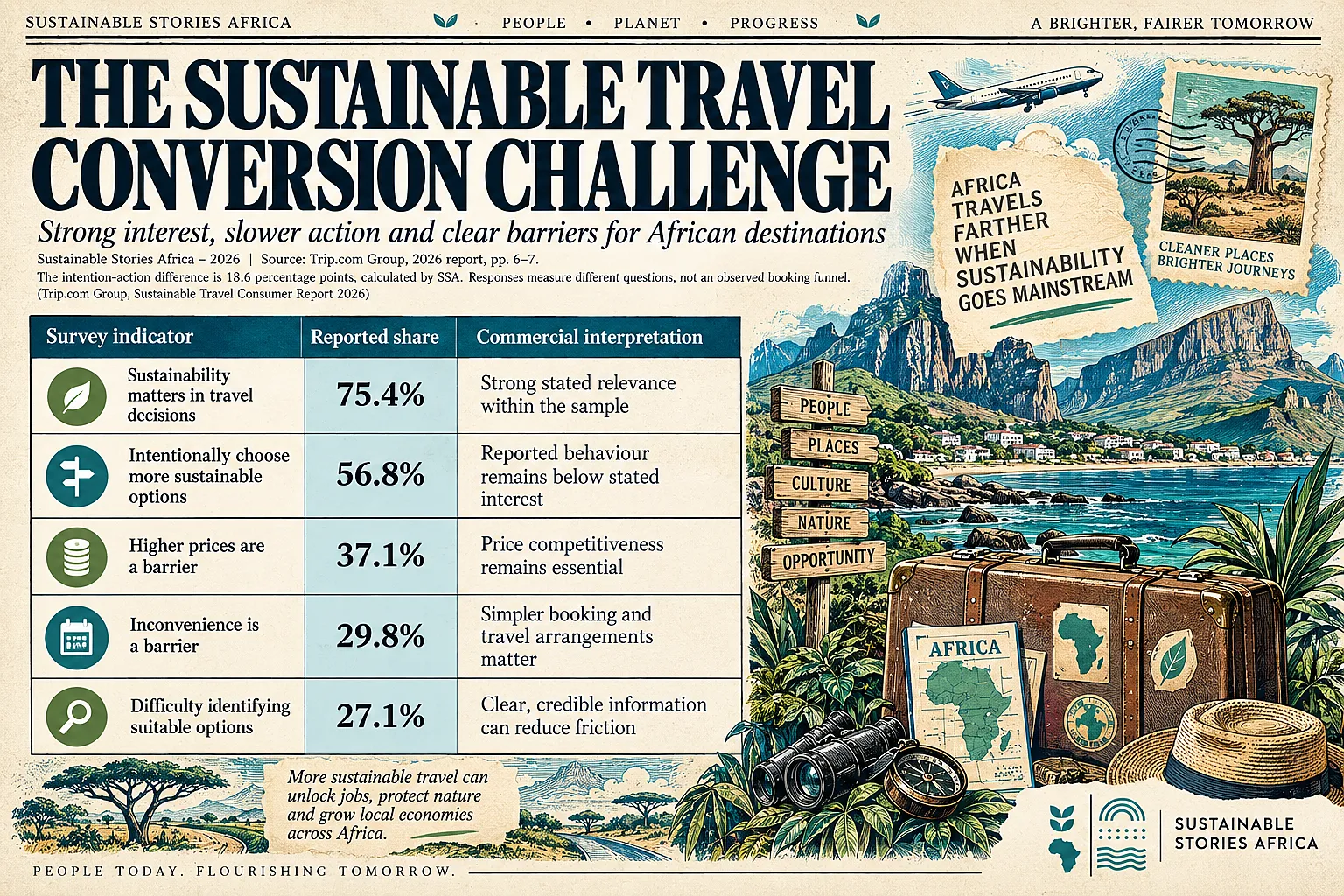
Sustainability matters to 75.4% of respondents in Trip.com Group’s Sustainable Travel Consumer Report 2026; however, only 56.8% say they intentionally choose more sustainable options.
- The 18.6-percentage-point difference places affordability and usability at the centre of the industry’s next challenge.
The report draws on 8,777 respondents across 29 markets in four regions.
- Its findings describe the surveyed sample; the document does not provide a separate African sample or country-level results that would support continent-wide consumer claims.
For African destinations, the value lies in understanding what prospective visitors say they need.
- Cleaner transport options, credible accommodation information, climate confidence and accessible pricing can be treated as product-design priorities, while operators test which preferences translate into actual bookings in their own markets.
Good Intentions Still Meet Practical Barriers
The strongest barrier is not a rejection of sustainability.
- Higher prices are cited by 37.1% of respondents, inconvenience by 29.8%, and difficulty identifying more sustainable options by 27.1%.
These constraints suggest that the industry must improve the offer, not simply intensify its messaging.
- A traveller comparing two hotels may value environmental responsibility but still lack a clear explanation of what a sustainability label covers.
- A destination may offer appealing nature experiences while leaving visitors uncertain about transfers, cancellation terms or local conditions.
These examples illustrate the report’s central tension:
- Responsibility competes within a broader purchase decision.
If choosing differently requires more money, more research and greater uncertainty, stated interest may not become action.
Climate Confidence Now Shapes Destination Appeal
Extreme weather is already associated with changes in travel planning.
- The report says 62.0% of respondents adjusted at least one aspect of a trip in response to extreme weather.
- Specific responses included delaying or rescheduling travel, changing timing and switching destinations.
These are self-reported adjustments, not a measurement of the economic losses caused by climate change.
- Nevertheless, they indicate why climate resilience is becoming part of the visitor proposition.
- Reliable information and workable alternatives can matter alongside the destination’s attractions.
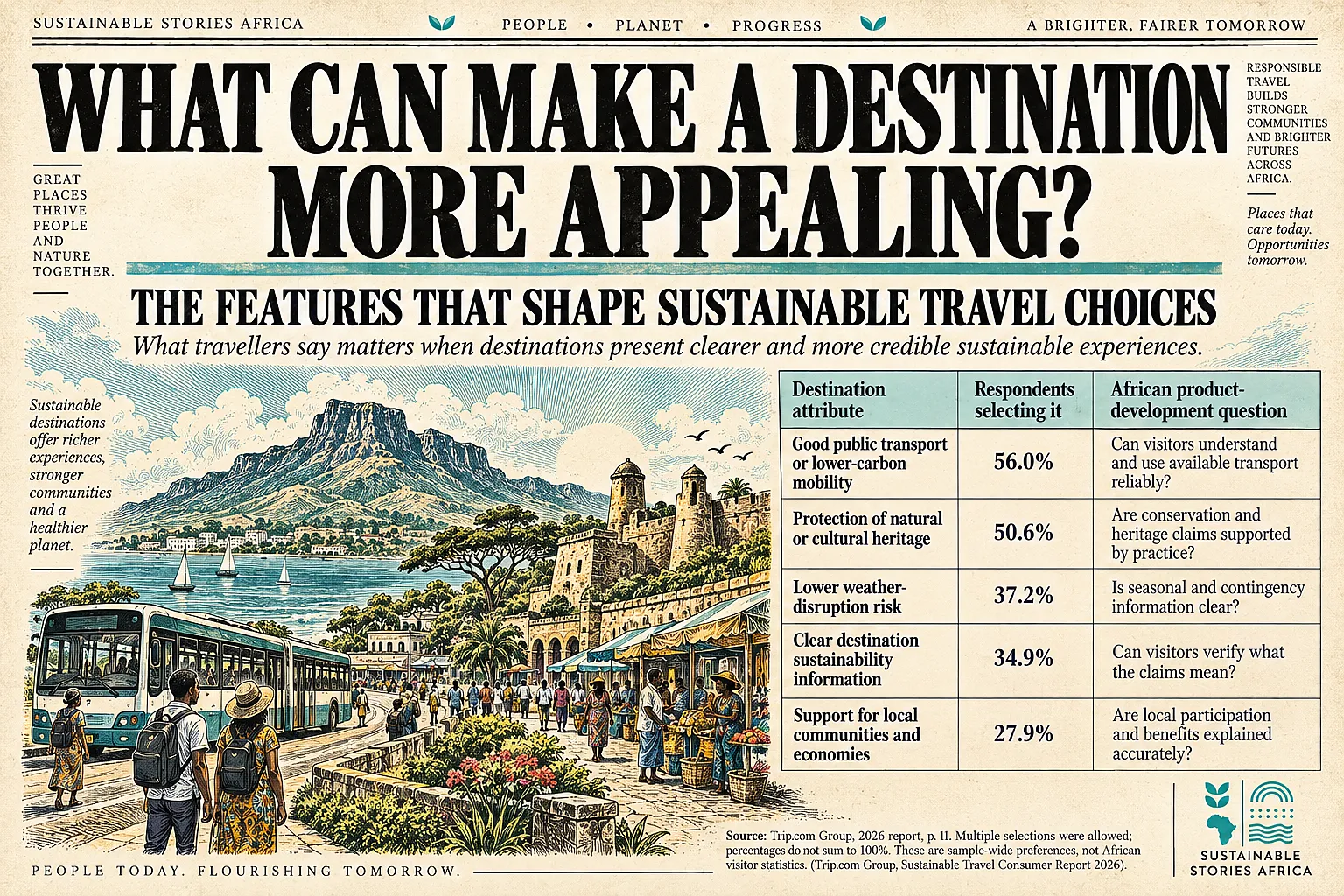
The survey also finds that 37.2% would be more interested in destinations with a lower risk of extreme-weather disruption.
- African tourism authorities can use that signal to examine what visitors need to know about seasonal conditions, access routes and contingency arrangements, without presenting any location as risk-free.
Sustainability also influences the experience itself.
- Nature and outdoor destinations appeal to 41.6% of respondents as potential experience enhancers.
- Scenic rail journeys attract 34.1%, less-crowded destinations 32.7%, and hotels with stronger sustainability practices 31.9%.
These preferences cannot be transferred unchanged into every African product.
- Rail opportunities, accommodation standards and local carrying capacity differ.
- The useful lesson is to package the attributes a destination can substantiate rather than borrow a universal definition of the ideal sustainable trip.
The generation findings offer a further segmentation lesson.
- The report says younger respondents show stronger engagement with product-led experiences, while older groups place greater value on lower-crowd and off-peak choices.
- Operators should therefore avoid designing one generic sustainable package for everyone.
Age patterns can inform testing, but they should not replace information about individual budgets, interests and accessibility requirements.
There is also an important difference between motivation and impact.
- Environmental responsibility was selected as a motivation by 52.5% of respondents, preserving destinations by 50.8%, and authentic experiences by 44.4%.
These answers explain reported preferences;
- They do not verify that the trips purchased delivered better environmental or social outcomes.
Credible destination management must keep the two questions separate.
Sustainability Can Strengthen The Visitor Experience
The Global Sustainable Tourism Council (GSTC) defines sustainable tourism as regards the economic, social and environmental impacts of all forms of tourism.
- It is not a synonym for nature tourism or an assurance that any outdoor activity automatically benefits local communities.
That distinction matters commercially and ethically.
- A nature-based holiday can still create pressure on water, waste services or cultural sites.
- Conversely, an urban hotel or business-travel operator can improve sustainability through credible management, procurement and community relationships.
African destinations therefore have an opportunity to make sustainability tangible.
- Practical examples could include clearly explained resource-management measures, dependable shared transfers, locally guided experiences and transparent information about community benefits.
- These are proposed product choices, not outcomes measured by the survey.
Price discipline remains crucial.
- Although 59.2% say they would pay some premium, willingness clusters at modest levels: 50.6% would pay up to 10% more.
The findings do not justify assuming that sustainability can support unlimited price increases.
The commercial proposition becomes stronger when benefits are specific.
- Instead of describing an entire holiday as sustainable, an operator can explain the particular practice involved, its evidence and its limits.
- That gives visitors useful information without implying that a single improvement neutralises the full footprint of travel.
- It also makes the claim easier for staff and partners to communicate consistently.
Community participation should be treated as a design issue rather than a decorative feature of the itinerary.
- Proposed products can be assessed for who delivers the experience, how local suppliers participate and whether host priorities are respected.
These questions help link the visitor’s interest in authenticity with the broader social dimensions of tourism, without assuming that local branding alone proves equitable benefits.
Make Responsible Choices Easier To Book
Tourism authorities should begin with a shared information standard.
- Visitors need concise explanations of what accommodation labels cover, what transport options actually exist and how operators manage foreseeable disruptions.
- Marketing should make those details easier to compare.
Hotels and tour operators should then audit the full customer journey.
- The relevant question is not whether a website contains a sustainability statement, but whether a traveller can identify a suitable option, understand its price and book it without additional uncertainty.
For smaller businesses, the immediate priority may be documentation rather than expensive technology.
- Accurate descriptions, consistent operating procedures and evidence of claims can improve credibility.
- Where third-party certification is used, operators should distinguish the certifying body from the organisation that sets or accredits the standard.
Platforms can support that work through clearer filters and explanations.
- Trip.com describes tools covering certified accommodation, estimated transport emissions and booking-related sustainability indicators.
These tools have different methodologies and boundaries;
- A carbon estimate should not be presented as a complete assessment of environmental or social performance.
Destination managers also need local evidence.
- Booking conversion, guest feedback, operating costs and community participation can help establish whether a proposed sustainable product works in practice.
- Segmenting that information by visitor group would be more useful than assuming the global sample represents all African demand.
Finally, environmental improvements should complement quality rather than excuse weaker service.
- The survey identifies price, comfort and convenience as major purchase considerations.
Sustainable travel will reach more customers when responsible practices support those fundamentals instead of appearing as an additional sacrifice.
Path Forward – Turn Sustainability Claims Into Better Journeys
African destinations should compete on credible experiences, dependable services and transparent value, not sustainability labels alone.
Operators need to connect environmental and community commitments with products visitors can understand and afford.
The next step is local testing: measure bookings, service quality and destination outcomes, then improve the offer.
Global survey enthusiasm becomes useful intelligence only when it informs practical decisions and is checked against actual behaviour.