Africa’s $230 Billion Imports Demand Value Addition Through Reliable Power, Logistics And Regional Markets
Excerpt
Africa imports roughly $230 billion across five essential product categories that AFC identifies as opportunities for greater domestic processing.
The figure captures more than an industrial gap: it exposes economies to foreign-exchange pressure and external supply shocks.
The solution is not indiscriminate import replacement.
It is competitive value addition built around demand, accessible resources, reliable infrastructure and credible policy.
Africa Must Capture More Productive Value
Africa’s dependence on imported processed goods has become a resilience problem.
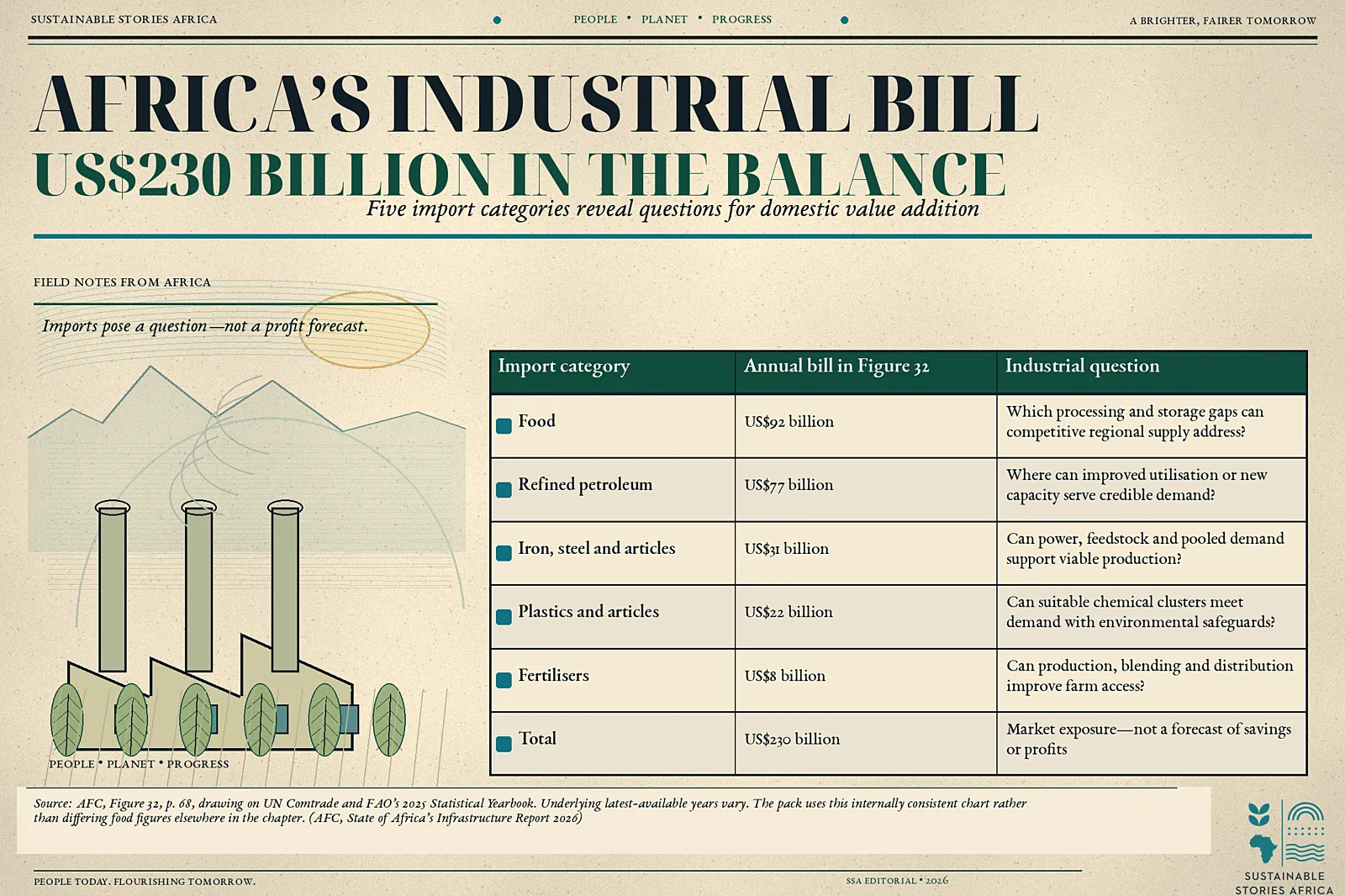
The Industry and Value Addition chapter of AFC’s State of Africa’s Infrastructure Report 2026 puts the annual import bill across food, refined petroleum, iron and steel, plastics and fertilisers at approximately $230 billion.
- The report argues that resources and demand already exist across many value chains, but fragmented power, logistics and markets prevent competitive processing.
- As a result, raw materials leave the continent while higher-value goods return with additional costs embedded in their prices.
For policymakers and investors, the central question is where domestic or regional production can genuinely compete.
- A large import bill indicates a market, not a guaranteed profit opportunity or an amount that can automatically be retained through new factories.
Import Dependence Transmits More Than Costs
AFC’s Figure 32 provides a consistent five-category breakdown: $92 billion in food, $77 billion in refined petroleum, $31 billion in iron and steel products, $22 billion in plastics and $8 billion in fertilisers.
- Together, these sum to US$230 billion.
Those categories differ in their economics, inputs and environmental impacts.
- They should not be combined into a single claim that every product can or should be manufactured locally.
- Rather, the figure helps identify areas where supply-chain exposure deserves closer investigation.
When imported inputs become more expensive or difficult to obtain, the effect spreads through firms and households.
- Transport, food production and construction can all face pressure.
Building resilient industrial capability therefore has implications beyond manufacturing output alone.
Four Conditions Explain Where Industries Scale
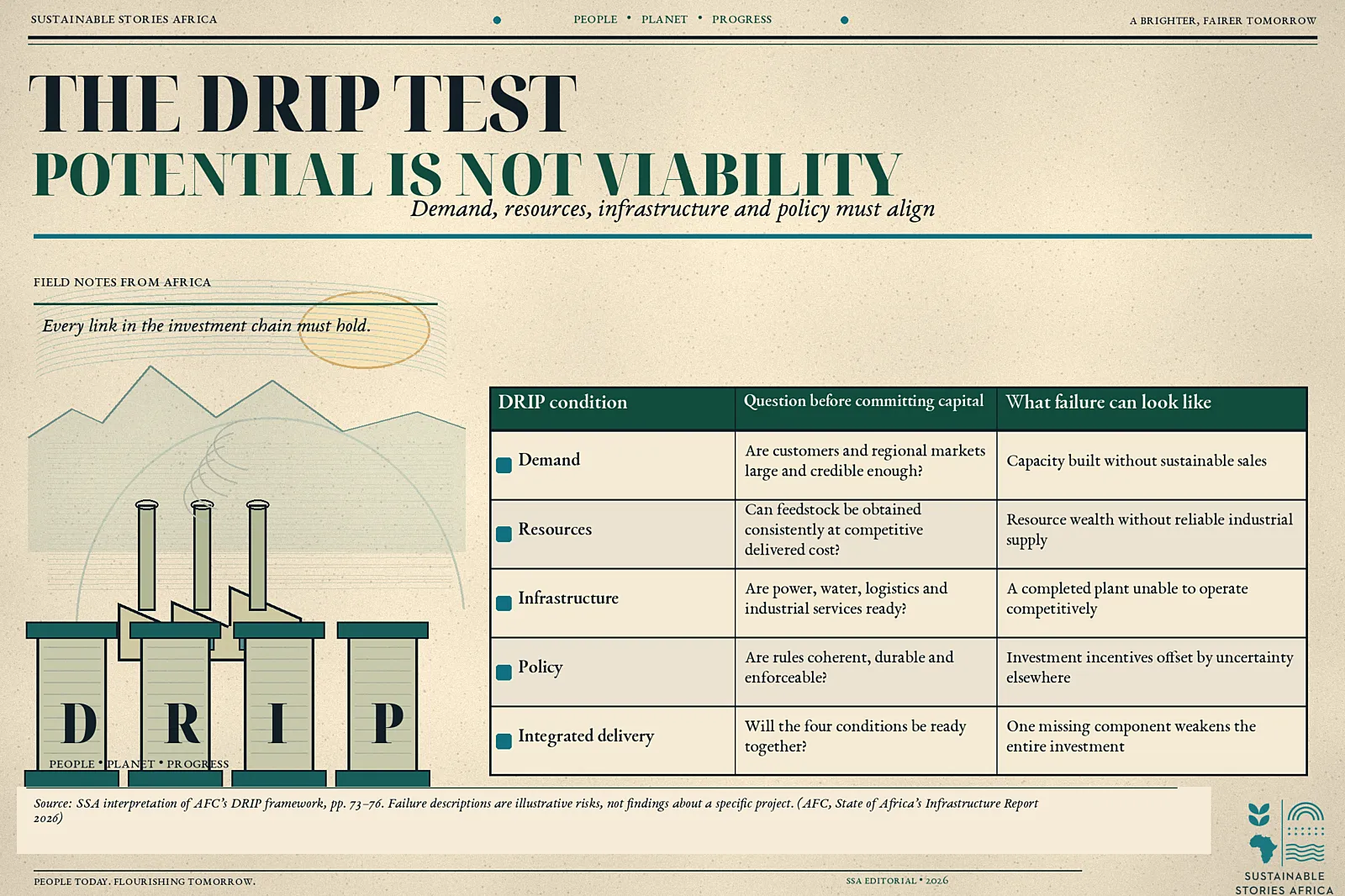
AFC applies a Demand, Resources, Infrastructure and Policy framework, or DRIP, to examine why some value chains develop while others stall.
- The framework asks whether demand can support production, resources are competitively accessible, enabling infrastructure exists and policy provides a workable investment environment.
Cement provides the report’s strongest precedent.
- Several markets have developed production around domestic construction demand, available materials and supporting infrastructure.
- Fertilisers and refining show related progress, though capacity remains concentrated in particular countries and regions.
Metals illustrate the difficulty of relying on resources alone.
- Smelting requires large volumes of dependable power, while processing and fabrication need logistics, skills and customers.
- Exporting more ore does not establish those capabilities automatically.
The framework is useful because it makes missing conditions visible.
- A country may possess the resource but lack sufficient domestic demand; another may have a market and energy but need imported feedstock.
- Regional coordination can link these complementary positions.
It should not be read as a project credit rating.
- AFC’s sector scores are analytical assessments within its framework, not probabilities of success or independently guaranteed investment returns.
- Asset-level diligence remains essential.
The report’s distinction between processing and full value-chain development is particularly useful.
- Producing an intermediate material can improve value capture without creating a complete manufacturing ecosystem.
- Policymakers should identify which subsequent activities are commercially plausible, what additional capabilities they require and whether customers exist.
- This prevents a processing milestone from being presented as the completion of industrial transformation.
Trade should remain part of the strategy.
- Regional production may improve resilience while still depending on imported machinery, specialist inputs or external markets.
- A competitive industrial system does not require eliminating every cross-border dependency.
- It requires understanding which dependencies are most consequential and building options to manage them.
Greater African value addition and constructive participation in global trade can therefore be complementary goals.
Regional Value Chains Can Broaden Economic Benefits
Fertilisers show how production and access can diverge.
- AFC reports that Africa holds about 80% of global phosphate reserves but accounts for roughly 20% of production.
- It also identifies established nitrogen-fertiliser platforms in gas-producing economies.
The development opportunity is not only to increase output.
- Distribution, product suitability and farm-level affordability determine whether additional production improves regional food systems.
- Export capacity does not automatically resolve access for nearby agricultural users.
Refining raises a similar distinction between nameplate capacity and actual throughput.
- AFC identifies rehabilitation and operational improvement as potentially efficient ways to recover output from existing facilities.
- New capacity must be evaluated against demand, logistics and future market conditions rather than justified by import dependence alone.
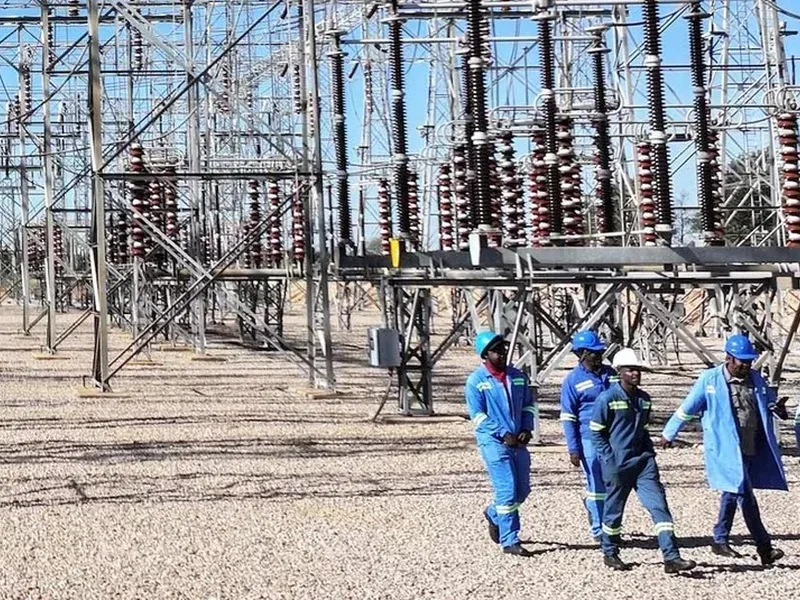
For metals, the report emphasises reliable and affordable power.
- The broader opportunity includes fabrication and manufacturing around processed inputs, but those downstream activities require their own markets and capabilities.
- More local processing is a starting point for value capture, not its final stage.
The quality of demand matters alongside its size.
- Manufacturers need to know whether customers require particular grades, specifications or delivery conditions, and whether they can meet them consistently.
- A market estimated from imports may include products that a proposed facility is not designed to produce.
- Product-level analysis is therefore essential before translating a broad import category into an investment case.
Industrial support should also recognise opportunity costs.
- Concessionary power, fiscal incentives or public guarantees allocate scarce resources and may affect other users.
- The relevant policy question is whether the expected benefits justify that support under transparent assumptions.
- Stating the trade-off clearly is more credible than describing all industrial assistance as either inherently necessary or inherently wasteful.
Build Industries Around Competitive Regional Systems
Governments should begin with value-chain analysis rather than a factory announcement.
- The objective is to establish where a country or region can compete, which inputs are missing and how demand will be served.
- Domestic processing targets should follow that assessment.
Energy and transport plans must be coordinated with industrial delivery.
- A processing facility cannot assume that a transmission line or railway will arrive on time unless those dependencies have credible financing and implementation arrangements.
- Joint planning can make risks visible earlier.
Regional bodies can help aggregate markets and align standards.
- Fragmented national demand may be insufficient for some large facilities, while a wider regional market can improve scale.
- The opportunity still depends on workable borders, product standards and predictable trade rules.
Financiers should distinguish commercial returns from wider economic benefits.
- Job creation, skills and foreign-exchange resilience matter, but they do not replace the need for a solvent operator.
- Where public support is proposed, its purpose, cost and conditions should be transparent.
The sustainability test must be explicit.
- Refining, fertiliser production and metals processing can create emissions, pollution, water demand and waste.
- Industrial resilience should therefore include environmental performance, worker protection and community safeguards, not assume that local production is automatically sustainable.
Finally, policy should encourage improvement rather than permanent insulation from competition.
- Support may help overcome a defined barrier, but firms still need incentives to become productive.
The objective is durable capability: industries that can serve customers, maintain assets and adapt as technologies and markets change.
Path Forward – Retain Value Through Competitive Industrial Systems
Africa should prioritise value chains where demand, resources, infrastructure and policy can align within credible delivery plans.
Regional coordination can help connect resource-rich areas with energy and markets.
Success means more than replacing an import line.
It requires competitive production, stronger capabilities and resilient supply chains, delivered with environmental and social safeguards.
Public support should be transparent, targeted and tied to measurable performance.