Africa’s financing debate is shifting from how much capital exists to how effectively it reaches productive investment.
AFC’s 2026 infrastructure report identifies substantial domestic savings, but weak intermediation, concentrated portfolios and limited bankable projects restrict their development impact.
The opportunity is not to treat pensions or reserves as spare money.
It is to build investable structures that protect savers while financing infrastructure and enterprise.
Africa Must Put Savings To Work
Africa holds more than $4 trillion across domestic financial pools, yet infrastructure and productive sectors remain underfunded, according to the Capital chapter of Africa Finance Corporation’s State of Africa’s Infrastructure Report 2026.
This article covers that chapter as Section 2 in the pack’s sequential mapping.
AFC argues that the binding challenge has shifted towards capital allocation and the institutions that link savings with investment.
- Pension funds, insurers and banks accumulate resources, but their portfolios remain concentrated in government securities, cash and other liquid instruments.
The implication is not that Africa can fund every development priority immediately.
- Financial assets carry liabilities, regulatory requirements and liquidity needs.
The question is how a prudent share can support well-structured long-term investment without transferring excessive risk to savers or weakening financial stability.
Large Asset Pools Are Not Cash
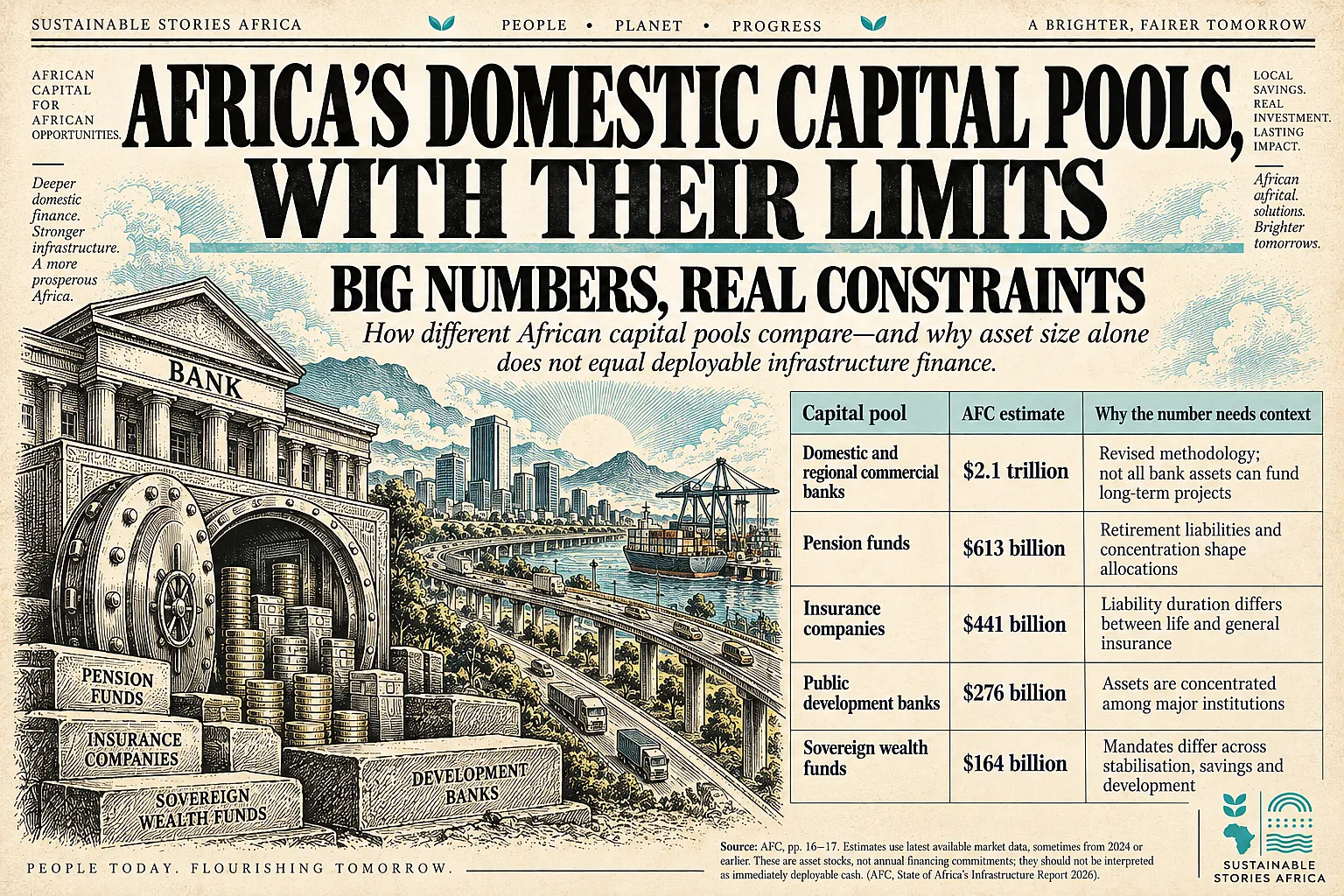
AFC estimates pension assets at $613 billion and insurance assets at $441 billion in its domestic-capital-pools breakdown.
- Together, these exceed $1 trillion, but they are unevenly distributed: South Africa accounts for 73% of pension assets and 80% of insurance assets. (AFC, State of Africa’s Infrastructure Report 2026)
That concentration matters.
- A continental total does not mean every country has a similarly deep investor base or ready access to regional savings.
- Infrastructure demand and institutional capital often sit in different jurisdictions, governed by different investment rules.
The report also revises its estimate of domestic and regional commercial-bank assets to $2.1 trillion using a harmonised bottom-up approach.
That methodological change should not be misread as evidence that the banking system lost an equivalent amount of money.
Regulation Opens Doors But Cannot Originate Projects
The report identifies progress in investment rules across several markets. Namibia has encouraged investment in unlisted domestic companies,
- Botswana has increased domestic-allocation requirements, and other countries have expanded the range of permissible assets.
South Africa’s amended Regulation 28 allows overall infrastructure exposure of up to 45% across asset classes, subject to the regulation’s definitions and exclusions.
- The amendments took effect on 3 January 2023.
- That ceiling permits investment; it does not require funds to allocate that amount or establish that they have done so.
This distinction explains why regulatory reform is necessary but insufficient.
- Trustees still need suitable investments, credible managers and a risk profile consistent with obligations to beneficiaries.
- A legal ceiling does not create a project pipeline, improve a contract or ensure reliable revenues.
AFC points to guarantees, first-loss capital and blended finance as ways to bridge some of those gaps.
- Nigeria’s InfraCredit is presented as an example of local-currency guarantees helping institutional investors participate in infrastructure bonds.
- Comparable mechanisms are emerging elsewhere.
The objective should be to allocate identifiable risks to parties best placed to manage them, not to conceal weak projects behind public support.
- Investors need clarity about what a guarantee covers, what it excludes and which institution ultimately bears a loss.
A related constraint is the sovereign–bank connection.
- AFC describes how banks’ exposure to government securities can reinforce dependence between public finances and domestic financial institutions.
- Diversification is therefore not simply a search for higher returns.
- It can be examined as a risk-management question, provided alternative assets are assessed honestly rather than assumed to be safer because they are different.
Local-currency financing also deserves attention in structuring.
- Where a project earns predominantly domestic-currency revenue, its financing arrangements should make any currency mismatch explicit.
- A domestic investor base can be useful, but the relevant test remains whether the tenor, repayment profile and risks fit the asset and the investor.
The origin of the capital does not by itself establish that fit.
Better Intermediation Can Protect And Diversify Savings
Infrastructure can potentially offer long-duration cash flows that match some pension and life-insurance liabilities.
- It may also diversify portfolios heavily exposed to sovereign debt.
- However, suitability depends on the individual asset, financing structure and investor, not the infrastructure label alone.
AFC’s strongest institutional example is Morocco’s Caisse de Dépôt et de Gestion.
- Established in 1959, CDG combines savings mobilisation with investment, project-development and financial-structuring capabilities.
- The report describes its early participation in Tanger Med and wider industrial and territorial development.
The transferable lesson is organisational rather than institutional imitation.
- Capital mobilisation, project preparation and execution need to work together.
- Establishing a new public investment body without a clear mandate, governance safeguards or coordination with existing institutions can create friction rather than solve it.
For citizens, the desired outcome is a financial system that supports retirement security while contributing to dependable services and productive employment.
- Neither goal should be assumed to follow automatically from directing more money into infrastructure.
The distinction between existing assets and new construction can help develop investable products.
- Institutional investors may have different appetites for development exposure, construction uncertainty and established operating revenues.
- A financing platform can recognise those differences instead of expecting every investor to enter at the same stage.
- That creates a more realistic conversation about who should bear early risks and when capital can be refinanced.
Performance should also be reported at the right level.
- Money raised by a fund is not the same as money deployed; committed finance is not the same as completed infrastructure; completed infrastructure is not the same as dependable service.
- A useful public reporting framework would follow those stages separately.
This would allow citizens and beneficiaries to distinguish fundraising success from actual economic delivery.
Build Investable Pipelines Without Weakening Safeguards
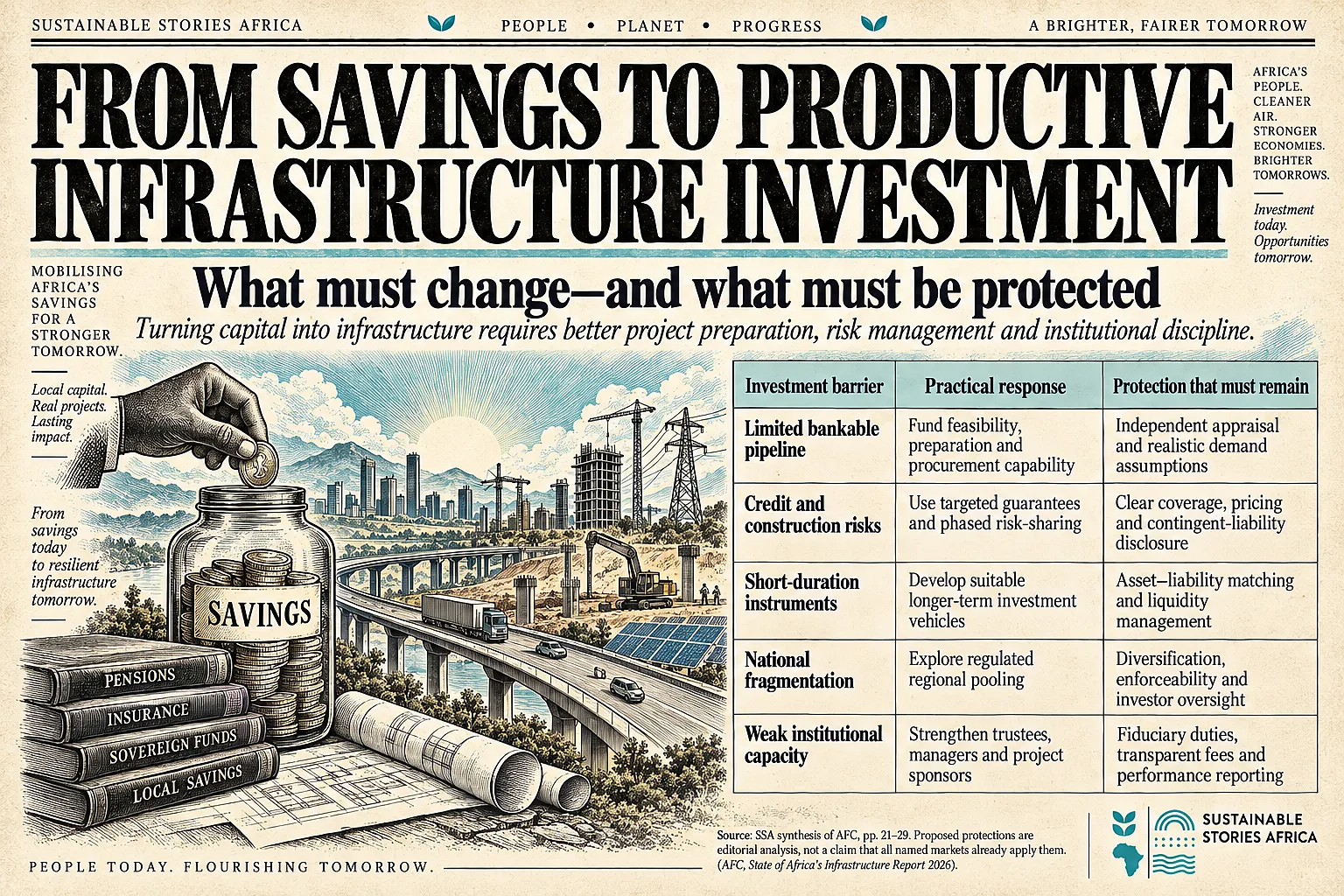
Governments should prioritise project preparation alongside fundraising.
- Infrastructure proposals need sufficiently developed technical, commercial and environmental information for investors to make disciplined decisions.
- Public announcements are not a substitute for the work required to reach that stage.
Regulators should examine whether prudential rules distinguish adequately between different risk profiles.
- An operating asset with established revenues is not identical to a project exposed to construction and demand uncertainty.
- Better classification can support prudent participation without abandoning oversight.
Development finance institutions can help standardise documentation and structure credible investment vehicles.
- Their catalytic role is especially useful where transaction costs are high relative to individual project size.
- Standardisation should improve comparability, not encourage investors to ignore asset-specific risks.
Regional institutions also need to address the mismatch between national savings pools and cross-border infrastructure.
- Power lines, transport corridors and digital networks can create benefits beyond one country.
- Financing arrangements should reflect that geography while protecting investors against unfamiliar legal and currency exposures.
Finally, expanding the savings base requires more than financial products.
- AFC highlights low contributory pension coverage, particularly in sub-Saharan Africa, and the potential to connect digital finance with structured savings.
- Regular contributions still depend on incomes, trust and accessible products.
- Formalising savings should support households rather than extract liquidity they need for daily resilience.
The measure of success is therefore dual: more productive investment and sound stewardship of the capital entrusted to institutions. Sacrificing either would undermine the model.
Path Forward – Finance Development While Protecting African Savers
Africa should strengthen the institutions that prepare projects, aggregate capital and allocate risks transparently.
Regulatory flexibility must be matched with credible investment vehicles and stronger execution capacity.
Domestic finance can become a firmer development anchor, with external capital playing a complementary role.
The priority is not compulsory exposure to infrastructure, but investable opportunities that can deliver economic value while meeting obligations to savers.