Long-term agreements help finance energy infrastructure by promising predictable revenues and supply.
They can also transfer risks that remain hidden until a disruption makes the original bargain difficult to sustain.
For African governments, utilities and investors, contract quality means more than negotiating a low price.
It means understanding who manages disruption, payment, policy and demand risks and what happens when circumstances change.
When Certainty Depends On Contract Design
A competitive energy price can hide an expensive risk allocation.
- If a long-term agreement leaves a utility paying for volumes it no longer needs, or a developer exposed to an unfinanceable disruption, the consequences can outlast the original negotiation.
Energy Unplugged episode 308, published on 29 September 2026, examines this problem through a discussion between Aurora Energy Research’s Anise Ganbold and Philip Norman, CMS partner and head of international arbitration.
- Norman describes long-term energy agreements as a rulebook for a partnership that often lasts decades.
For African power and gas markets, the relevant lesson is not that every contract should become easier to exit.
Durable investment requires explicit risk allocation, workable adjustment mechanisms and public institutions capable of managing agreements throughout their lives.
Price Alone Cannot Define Energy Value
Norman argues that contractual risk allocation can matter more than the initial sale price.
- Energy infrastructure involves substantial sunk investment, while lenders need confidence in future cash flows and buyers need confidence that supply will arrive.
- The contract links those interests.
The difficulty is that the physical assets, financing agreement and supply contract do not necessarily share the same flexibility.
- A buyer may want to reduce purchases just when a lender needs stable repayment.
- A supplier may seek relief from a disruption that leaves the buyer facing downstream obligations.
For a public utility, these tensions can become fiscal risks.
- An apparently attractive agreement may prove costly if demand projections fail, currency moves sharply, or network constraints prevent delivery.
- Evaluating the headline tariff without examining these contingencies provides an incomplete picture of value.
Our insights and data editorial conclusion is simple:
- Procurement teams should compare the full allocation of obligations, not just the price printed on the first page.
Different Risks Require Different Contractual Tools
The interview uses take-or-pay provisions to explain bankability.
- A buyer commits to take an agreed minimum quantity or pay based on the contract, giving the seller a degree of revenue certainty.
The same conversation distinguishes force majeure from ordinary commercial difficulty.
- In English-law contracting, force majeure generally depends on the agreed clause: its qualifying events, required causal connection, notice procedures and consequences.
- A less profitable transaction does not automatically create a right to relief.
Norman contrasts contractual approaches with doctrines that may apply under different legal systems.
These comparisons are necessarily broad.
- The governing law, mandatory rules, precise wording and particular facts determine the outcome; labels such as common law or civil law are not enough to predict a dispute.
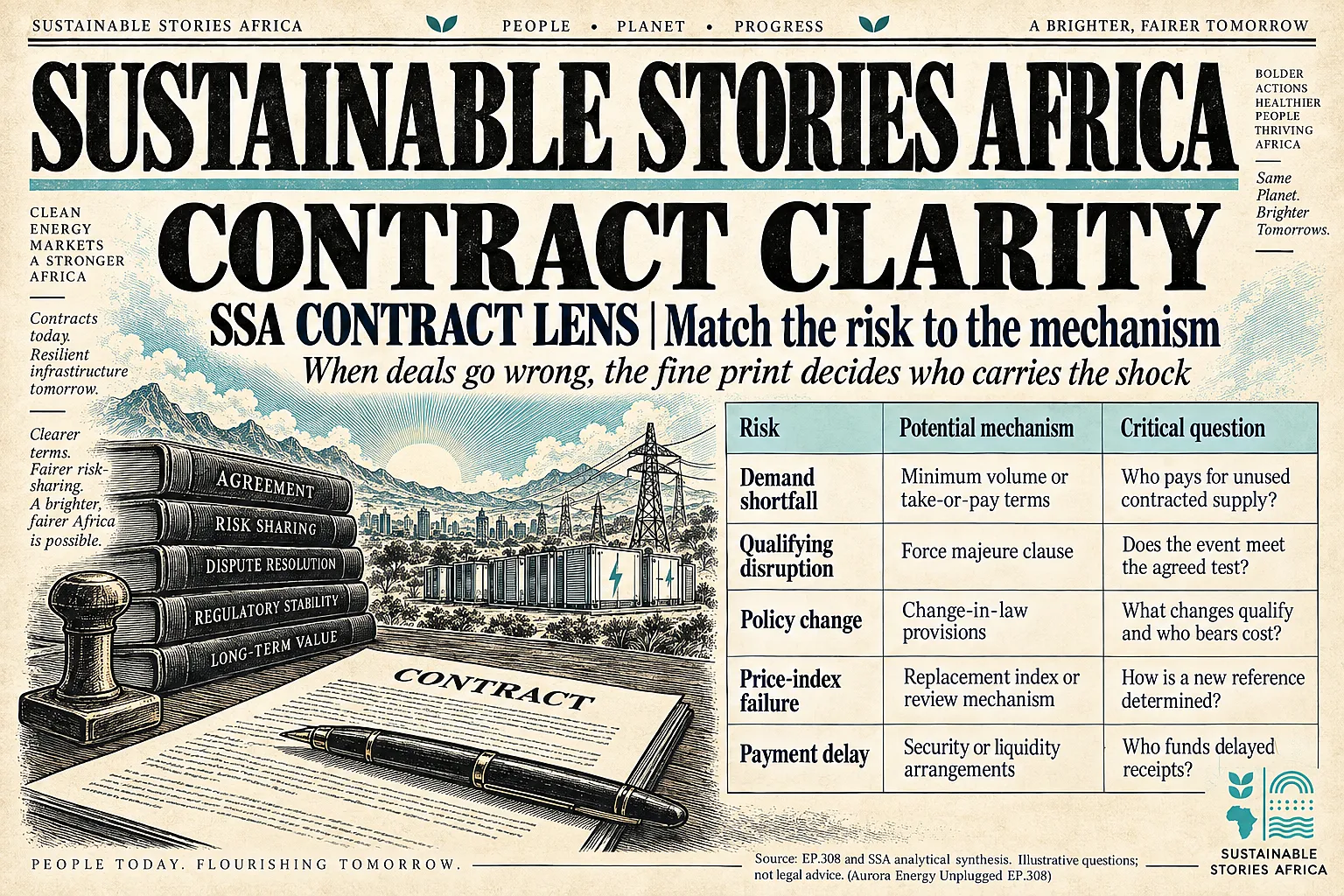
For project teams, the practical task is to separate risks before drafting remedies.
- Physical inability to deliver, a tax change, a breakdown in a pricing index, and lower customer demand are different problems.
- A single general disruption clause may leave important gaps.
A robust agreement therefore needs a risk matrix showing the event, the responsible party, the evidence required and the available response.
- That is a governance tool as much as a legal one.
Notice and mitigation requirements deserve particular attention.
- The existence of a listed disruption does not mean a party can simply stop performing without following the agreement.
- Norman’s discussion stresses the importance of the wording and of procedural behaviour when a contract comes under pressure.
A project team should therefore know what records to keep, when to notify the counterparty and what alternatives must be explored.
- These responsibilities should be understood by operational staff as well as lawyers, because the first evidence of a problem often arises at a plant, port or construction site.
Review mechanisms should also distinguish temporary relief from a permanent change in obligations.
- Extra time to complete a facility, a revised delivery route, and termination address different circumstances. Each can affect the financing arrangements behind the project.
For public buyers, the strongest negotiating position is an informed one.
- Understanding the risks a supplier genuinely cannot control helps avoid both excessive guarantees and unrealistic transfers of responsibility.
- A contract that allocates every problem to the weaker party may appear protective while remaining difficult to finance or perform.
Flexibility Can Preserve Rather Than Weaken Bankability
Norman says energy contracts have become more flexible as parties pay closer attention to geopolitical, climate and technological risks.
- He points to price-review triggers, alternative index arrangements and provisions responding to transport disruption.
- Flexibility can support continuity when the original assumptions no longer hold.
That does not mean unlimited renegotiation.
- If every adverse market movement reopens the bargain, lenders cannot assess repayment and buyers cannot plan their costs.
- Useful flexibility identifies a bounded trigger, an orderly process and a defined consequence.
For an African renewable project, a change-in-law mechanism might address a specified regulatory change, while payment security addresses delayed utility payments.
- These protections serve different purposes.
- Combining them loosely under a broad promise to protect investors can create obligations that public institutions struggle to understand or fund.
Communities also have an interest in contract resilience.
- A dispute that freezes construction, interrupts supply or redirects public money can undermine the development benefits promised at approval.
- Sound contracts should support continued safe operation and transparent decision-making while disagreements are resolved.
The opportunity is therefore a better-managed partnership: enough certainty to finance infrastructure, enough adaptability to survive defined shocks, and enough disclosure for public institutions to remain accountable.
Build Contract Management Into Public Institutions
Norman highlights the additional complexity of state-linked transactions.
- Public entities answer to more than shareholders: commercial decisions may also involve regulatory, political and public-service responsibilities.
- Authority to approve changes and the prospect of later public audit can affect how officials respond to disruption.
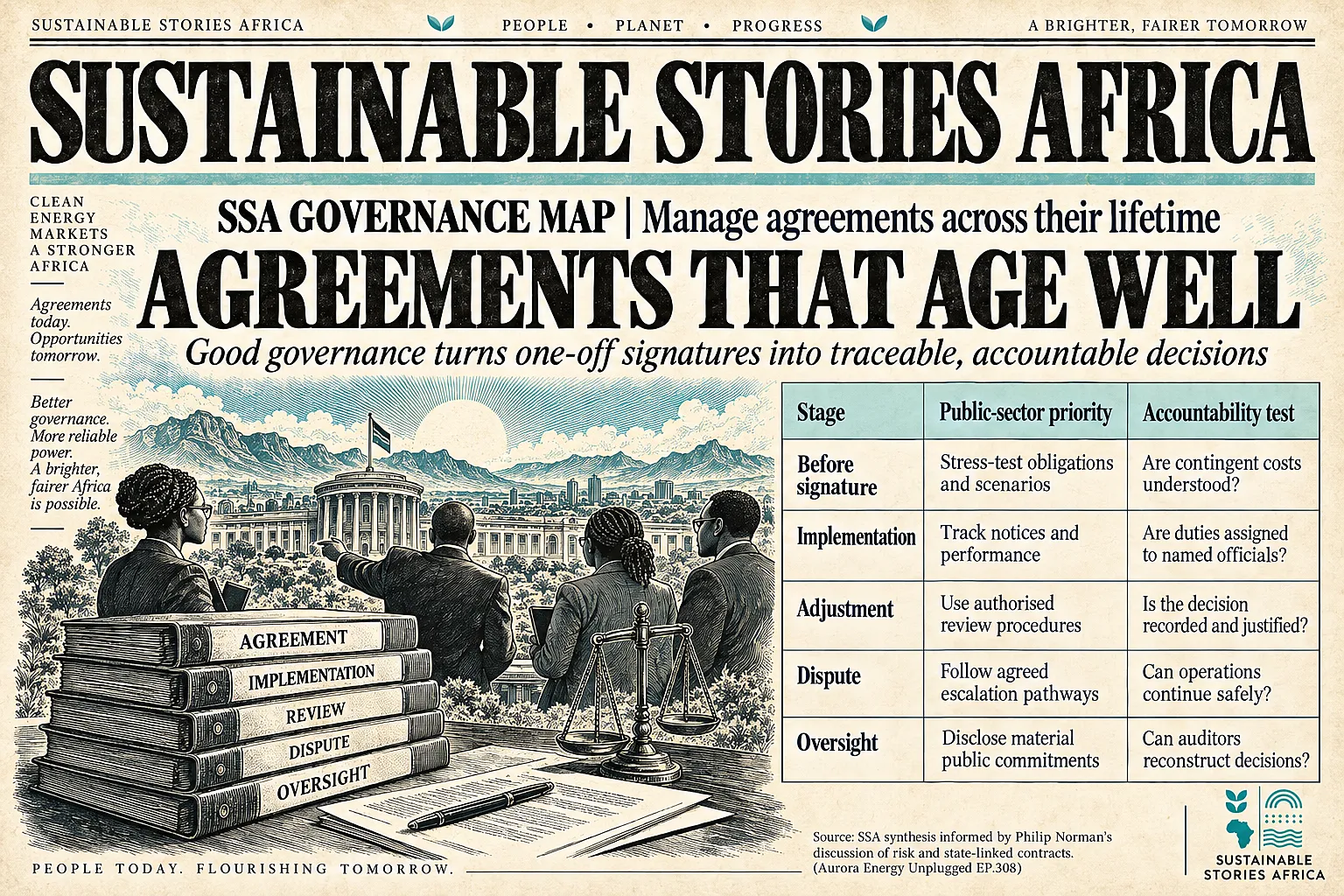
Governments should therefore establish contract-management arrangements before signature.
- Each agreement needs an accountable owner, a record of approval authority, a calendar of notices and reviews, and a process for recording decisions.
- A missed notice or unauthorised variation can undermine an otherwise sensible commercial response.
Procurement teams should stress-test demand, currency exposure, delivery routes and payment delays.
- They should identify which risks are insurable, which require a guarantee, and which should remain with the party best able to manage them.
- Public guarantees should be assessed as potential fiscal obligations, not treated as costless reassurance.
Dispute provisions also need careful treatment.
- The forum, governing law, escalation process and enforceability of remedies affect the value of contractual rights.
- State immunity questions are jurisdiction-specific and require specialist advice; an arbitration clause alone does not guarantee practical recovery.
Finally, public-interest transparency should be designed into the process, subject to legitimate confidentiality.
- Citizens need to understand the duration of commitments, allocation of major risks and conditions under which public payments can rise.
- Commercial complexity should not become a reason to remove scrutiny.
The best moment to address uncertainty is before capital is committed.
- Once disruption arrives, institutional discipline and contemporaneous records can matter as much as the quality of the original drafting.
Path Forward – Allocate Risks Before They Become Disputes
African energy buyers and investors should assess price alongside demand commitments, payment security, disruption clauses and adjustment mechanisms.
Public entities also need authorised contract managers and transparent records.
The aim is not to eliminate uncertainty or guarantee every commercial expectation. It is to build agreements that remain financeable, adaptable and accountable when defined risks materialise.