Ethiopia’s expanding generation fleet has not yet translated into dependable electricity for much of its population.
The IEA’s 2026 policy review puts basic-service access at around 35% in 2024, leaving roughly 85 million people without sufficient access.
Closing that gap requires more than new power stations: stronger distribution networks, affordable connections, credible utility reform and investment plans linked to productive demand.
More Generation Must Become Better Service
Ethiopia’s next power-sector challenge is converting generation growth into reliable, affordable services.
The International Energy Agency’s Ethiopia 2026 Energy Policy Review finds that weak networks, financial constraints and institutional fragmentation limit the development impact of an almost entirely renewable electricity system.
This article draws principally on the Power sector chapter, pages 36–56, while connecting it to the review’s general policy, renewables, electricity-access and clean-cooking analysis.
The wider context matters because transport, industry and household cooking are all expected to create new demands on the same system.
The review estimates electricity access at around 35% in 2024 under the IEA basic-service definition.
- This excludes very small solar lanterns and some multi-light systems included in other access measures.
- The figure should therefore not be presented as interchangeable with every national or international electrification series.
Network Weaknesses Dilute The Generation Dividend
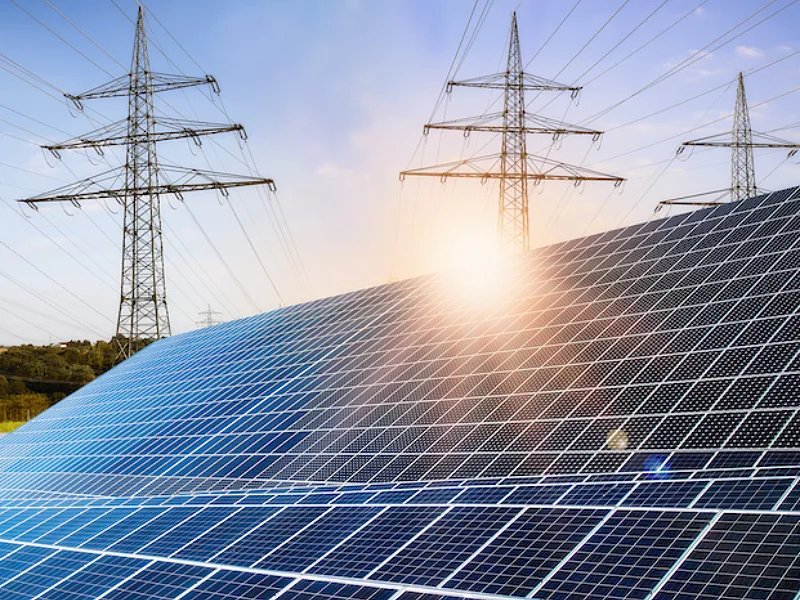
The IEA describes frequent interruptions and high network losses, with weaknesses concentrated in distribution.
- Ageing infrastructure, maintenance constraints and inadequate control and protection systems reduce the quality of electricity reaching users.
Adding generation does not remove those local bottlenecks.
- For a small enterprise, reliability determines whether an electric machine is a productive investment or an additional risk.
- For a household, repeated outages and voltage problems can discourage appliance purchases and keep consumption low even after connection.
The report links these service problems to weaker utility revenues and limited reinvestment capacity.
- This creates a damaging cycle: poor service suppresses demand, weak demand and losses constrain finances, and constrained finances delay improvements.
- Connection targets remain important, but counting new meters alone cannot show whether this cycle is being broken.
The policy priority is to identify the network investments that unlock dependable service and useful consumption, rather than assume that every additional megawatt at the generation level has the same developmental effect.
Utility Reform Must Balance Cost And Affordability
Ethiopian Electric Power generates and transmits electricity, while Ethiopian Electric Utility handles distribution and retail supply.
The Petroleum and Energy Authority regulates key activities.
- The review argues for clearer responsibilities, transparent market arrangements and stronger regulatory capacity.
The single-buyer model makes EEP central to independent power producers’ prospects: investors depend on its payment credibility as well as the contractual and regulatory framework.
- Financial ring-fencing and clearer business-unit responsibilities could improve accountability without implying that a competitive wholesale market already exists.
Tariff reform began a phased adjustment in September 2024, with quarterly changes over four years.
- The review also describes targeted support for smaller consumers during the transition. These arrangements aim to improve cost recovery while limiting social harm, but their effectiveness depends on implementation and actual service quality.
Higher tariffs alone cannot repair a weak distribution system.
- Conversely, persistently inadequate revenue can undermine maintenance and expansion.
- Reform therefore needs a credible service bargain: transparent costs, targeted protection and demonstrable improvements.
The report’s different loss figures also require care.
- Transmission, distribution, technical and commercial losses are not automatically additive because denominators and accounting coverage can differ.
- This article uses the broad finding of high losses rather than constructing an unsupported combined percentage.

Productive Demand Can Strengthen Public Utilities
The IEA recommends targeted grid upgrades in areas where reliable service can unlock substantial residential and productive demand.
- This approach links electrification to income generation and potentially stronger utility finances, rather than treating every connection as an isolated endpoint.
Agricultural processing, refrigeration and small industrial activity can create more sustained electricity use when equipment finance and markets are available.
- The opportunity is not to manufacture demand artificially; it is to remove supply constraints that prevent economically useful activity.
Affordability starts before the first bill.
- The review puts the national average residential grid-connection fee at around $100, with a typical range of $24 – $190, while noting that internal wiring can add substantial expense.
- These are report estimates, not universal quotes for every customer
Spreading connection payments or providing targeted support can help households use nearby infrastructure.
- The programme must still account for fiscal costs, verification and service quality delivered.
- A subsidised connection that remains unreliable offers limited developmental value.
Clean cooking reinforces the need for integrated planning.
- Electric cooking can reduce dependence on traditional fuels, but households need affordable appliances and dependable power.
- A cooking roadmap that assumes reliable electricity without funding network improvements risks shifting the implementation problem from one ministry to another.
Geography offers a further clue to priorities.
- The review’s geospatial analysis finds that about 64% of the population lives within five kilometres of existing grid infrastructure.
- Proximity is not a connection, but it suggests that densification, last-mile investment and affordability measures may be important alongside long-distance extension.
The appropriate approach still depends on local conditions.
- A nearby line may lack capacity or reliable service, while a settlement’s income and demand profile can affect the viability of either grid or off-grid delivery.
- Geospatial planning needs to incorporate those factors rather than measure distance alone.
This also clarifies the relationship between access and development finance.
- A relatively modest service connection can be transformative when the upstream network is dependable; the same expenditure can disappoint if outages remain frequent.
- Project appraisal should examine the whole chain from generation to the customer’s usable service.
Publishing local reliability and connection outcomes would help identify where investment is succeeding.
- It would also make the national access target more meaningful by showing whether newly served users are moving beyond minimal consumption.
Finance The System Rather Than Isolated Assets
Ethiopia’s National Energy Compact targets 75% electricity access by 2030, while NEP 3.0 aims for universal access by 2035.
- The review estimates electricity-sector investment needs of $9.6 billion to 2030 and $18 billion to 2035 to meet these ambitions.
- These are different planning horizons and should not be added.
Mobilising capital requires more than a project list.
- The IEA identifies currency exposure, payment risk, lengthy approvals and limited commercial finance as barriers.
- It recommends clearer licensing, stronger risk mitigation and more systematic investment planning. (IEA, Ethiopia 2026, supplied policy review)
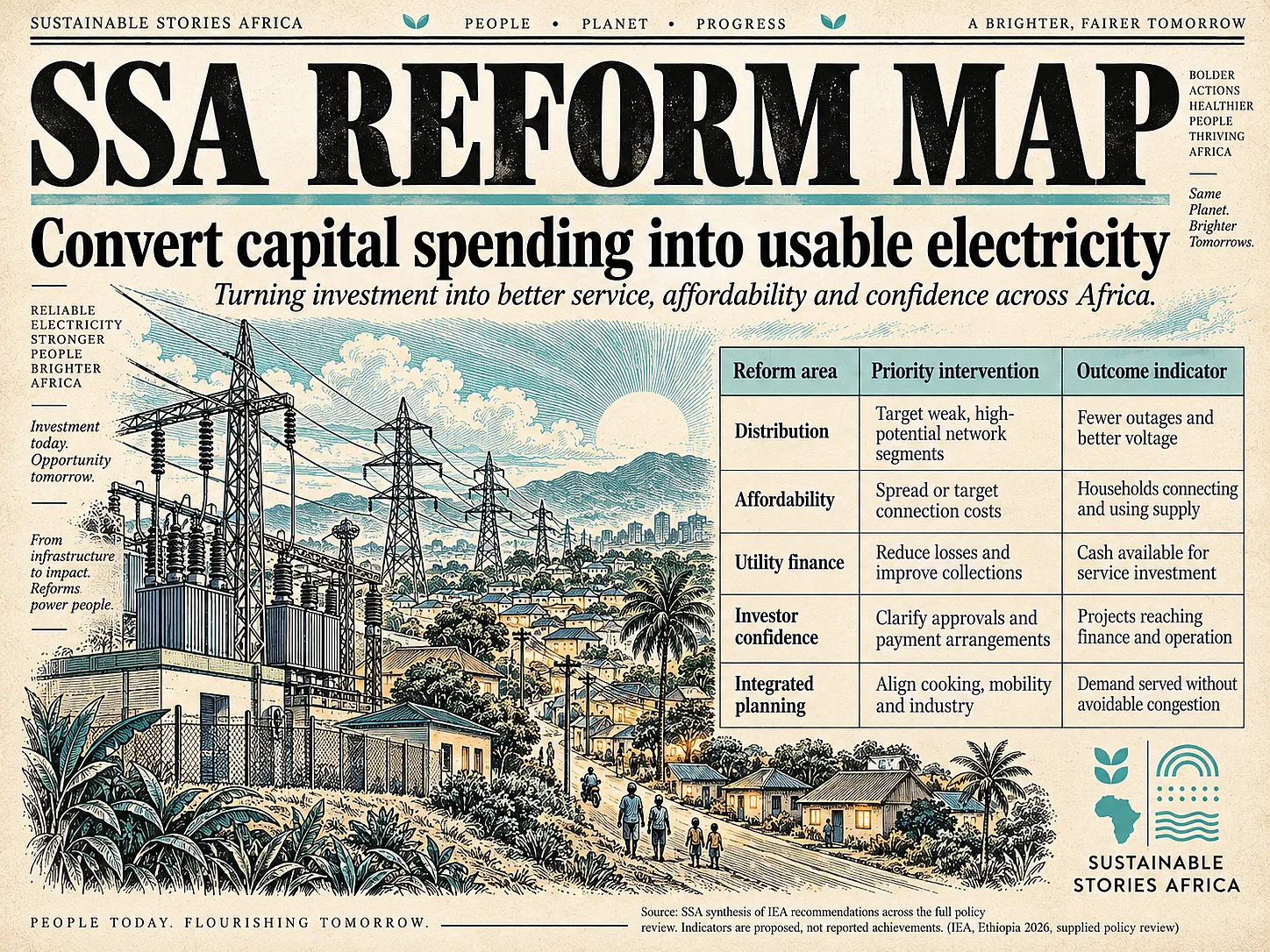
The government should publish an integrated plan connecting generation, transmission, distribution and demand from industry, mobility and cooking.
- Utility performance reporting should track outages, voltage quality, collections, losses and new connections.
- Measure improvements locally, where users experience the service.
Regional electricity trade can support the financial picture.
- The review reports export receipts of $118.1 million in FY2024/25, exceeding 20% of EEP revenue.
- It also distinguishes interconnector technical capacity from the smaller flows currently operationally available.
- Export potential is therefore not identical to deliverable trade.
Domestic access and regional exports need not be opposing goals, but their relationship should be explicit.
- Foreign-exchange earnings can support imported equipment and maintenance, while domestic network bottlenecks may remain binding even when generation is available.
- Transparent planning can show how both objectives are served.
The central reform test is whether financing arrangements strengthen the full service chain.
- A generation project, transmission line or digital meter should be judged by its contribution to reliable and inclusive electricity, not by asset completion alone.
Path Forward – Put Reliable Access At Reform’s Centre
Ethiopia should combine utility reform with targeted network modernisation, affordable connections and integrated demand planning.
Private investment needs clearer rules and credible risk allocation, while tariff changes require visible service improvements and targeted protection.
Generation expansion becomes development when households and businesses can use dependable electricity.
That should be the organising principle linking the country’s access, industrial and regional-power ambitions.