Nigeria could recover economic value from gas currently wasted through flaring, venting and leaks.
An APRI brief proposes treating that loss as a mitigation opportunity, with energy access and employment as potential co-benefits.
However, its headline revenue and jobs figures are projections.
Real value depends on measured emissions, site-level economics, credible buyers and rules that prevent recovery programmes from justifying new fossil expansion.
Methane Recovery Needs Evidence Before Optimism
Nigeria’s methane challenge combines climate damage, lost gas value and unmet energy needs.
- Capturing emissions from existing operations could address part of that problem; however, it must establish commercial opportunity through measurement, not a national headline.
Mahmoud Ibrahim Mahmoud’s APRI policy brief, From waste to wealth: A national strategy for methane mitigation and commodification in Nigeria, published on 1 April 2026, proposes a coordinated recovery and utilisation programme.
- It explicitly distinguishes mitigation at existing and legacy infrastructure from incentives for additional upstream development.
That boundary is essential.
- For communities near oil and gas operations, success should mean lower verified emissions, less harmful pollution and useful services, not merely a new commercial label for gas that would otherwise remain unaccounted for.
Wasted Gas Is Not Automatically Revenue
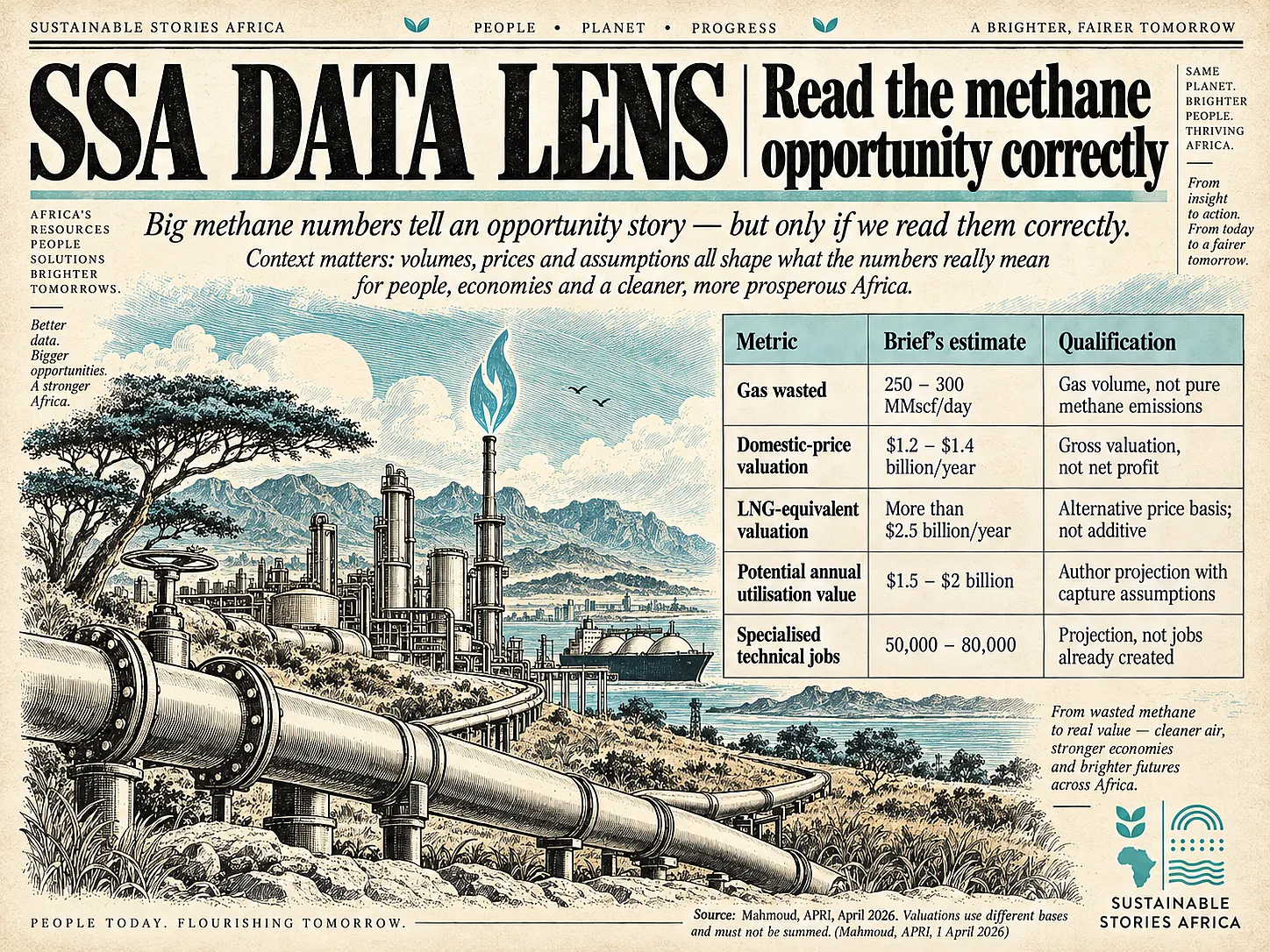
The brief cites an estimated 250 – 300 million standard cubic feet per day of gas wasted through flaring and leakage, attributing the estimate to Nigeria’s upstream regulator.
- It values that gas at $1.2 – $1.4 billion annually using domestic prices, or more than $2.5 billion at an LNG-equivalent valuation.
These are alternative valuation bases, not amounts that can be added together.
- They also do not represent profit.
- Recovery equipment, processing, transport, operating expenditure and financing can materially change project economics.
Gas streams differ in location, composition and scale.
- A dispersed leak and a concentrated flare stream require different interventions.
- A commercially attractive buyer may be distant from the source, while a nearby community may lack the network needed to use recovered gas safely.
The first policy question is therefore not how much national income a programme could claim.
- It is which sources can be reduced, at what cost, and with what verified climate and public-service outcome.
Measurement Must Separate Gas And Emissions
Flaring, venting, and fugitive leakage are related but distinct.
- Flaring burns gas and produces carbon dioxide, while incomplete combustion can release unburnt methane.
- Venting releases gas without combustion, and fugitive emissions escape through equipment or infrastructure.
The brief identifies all three as important sources.
- Consequently, the volume of gas flared does not equate to the volume emitted as methane.
- A credible emissions inventory must account for source conditions and combustion performance.
- Recovery also does not eliminate all climate impacts if the gas is subsequently burned.
The brief describes methane as a powerful short-lived pollutant and argues that reducing it can deliver near-term climate benefits.
- It recommends satellite and ground-based measurement, reporting and verification, with independent checks.
MRV should establish a defensible baseline, document interventions and track residual emissions.
- If a project seeks carbon revenue, it must separately satisfy the eligibility and crediting rules; the presence of a methane reduction does not automatically produce a saleable credit.
This is especially important where data serves multiple purposes.
- Operational compliance, commercial gas sales and carbon accounting need compatible records, but they are not interchangeable.
- Strong governance reconciles them without double counting the same benefit more than once.
Site selection should separate technically recoverable gas from gas that is commercially and environmentally sensible to use.
- A recovery proposal needs a clear operating boundary: the equipment covered, the baseline period, expected utilisation and arrangements for downtime.
- Otherwise, measured reductions can be confused with lower production or temporary operational changes.
Financing should also be tested without assuming the highest possible carbon-credit price or full-time demand from a proposed customer.
- If the core project depends on uncertain supplementary revenue, that exposure needs to be explicit.
- Climate finance can help overcome barriers, but it cannot substitute for a credible operating model.
The brief’s emphasis on existing and legacy infrastructure offers a useful eligibility principle.
- Support should reward reductions against a defensible baseline rather than creating a new emissions stream that is then partially captured.
- Independent verification can help demonstrate that the intervention changes outcomes beyond the commercial relabelling of gas.
A transparent project register could make these distinctions visible by showing location, intervention, financing status and verified performance.
- Communities and financiers can then assess delivery against the same core facts.
Recovery Can Support Energy And Livelihoods
Mahmoud proposes gas-to-power, compressed natural gas, micro-LNG and industrial applications as potential uses for recovered methane.
- These are options to assess, not an instruction that every source should serve the same market.
- The brief also identifies digital-economy uses, including data centres and computing.
Public policy should compare these options against emissions reduction, reliable demand, local access and value for money.
- A profitable buyer is relevant to bankability, but it does not by itself establish the strongest public benefit.
- Projects serving energy-poor communities may require different infrastructure and financing support.
The brief projects $1.5 – $2 billion in annual value if at least half of currently wasted methane is captured and commercialised across multiple applications.
- It also suggests 50,000 – 80,000 specialised technical jobs.
- These are author estimates, not audited outcomes or demonstrated net revenues.
The projections should not be mechanically reconciled with the earlier gross gas valuations.
- They tend towards wider utilisation pathways and depend on assumptions that need project-level validation.
- Presenting them as assured earnings would overstate the available evidence.
For host communities, a stronger promise would connect recovered gas to measurable improvements: verified source reductions, documented local procurement, transparent employment conditions and reliable services.
That creates a basis for accountability beyond an aggregate national opportunity figure.
Coordinate Regulators Without Delaying Basic Repairs
The brief identifies fragmented responsibilities across petroleum regulation, environmental oversight, fiscal administration and climate policy.
- It proposes a Methane Governance Council and clearer institutional coordination.
- These are recommendations, not evidence that a new council is already operating.
Institutional reform should support immediate practical work.
- Leak detection and repair, improved equipment management and suitable flare-recovery projects should be measured for abatement potential and implementation readiness.
- A national strategy should not be used to postpone available source reductions.
Regulators should require consistent reporting formats and clarify who validates emissions data, enforces compliance and authorises commercial use.
Developers need access rights, a credible offtaker and transparent terms for recovered gas.
Financiers need evidence that the project remains viable under conservative price and utilisation assumptions.
Community consultation should begin before selecting a utilisation model.
- Local users should understand expected benefits, safety arrangements, land requirements and grievance procedures.
- Workforce plans should distinguish temporary construction roles from ongoing technical employment.
The brief proposes initial pilots and MRV deployment in 2026, expansion during 2027–2029, and longer-term integration from 2030 onwards.
- That is its proposed sequence, not an implementation record.
- Routine-flaring commitments should not be interpreted as postponed simply because a strategy describes later commercialisation phases.
Finally, eligibility for support should be tied to mitigation from existing or legacy sources, with safeguards against induced production.
- Capturing gas already being wasted and expanding the fossil supply base are different interventions.
Keeping that distinction visible protects the credibility of both climate finance and Nigeria’s transition strategy.
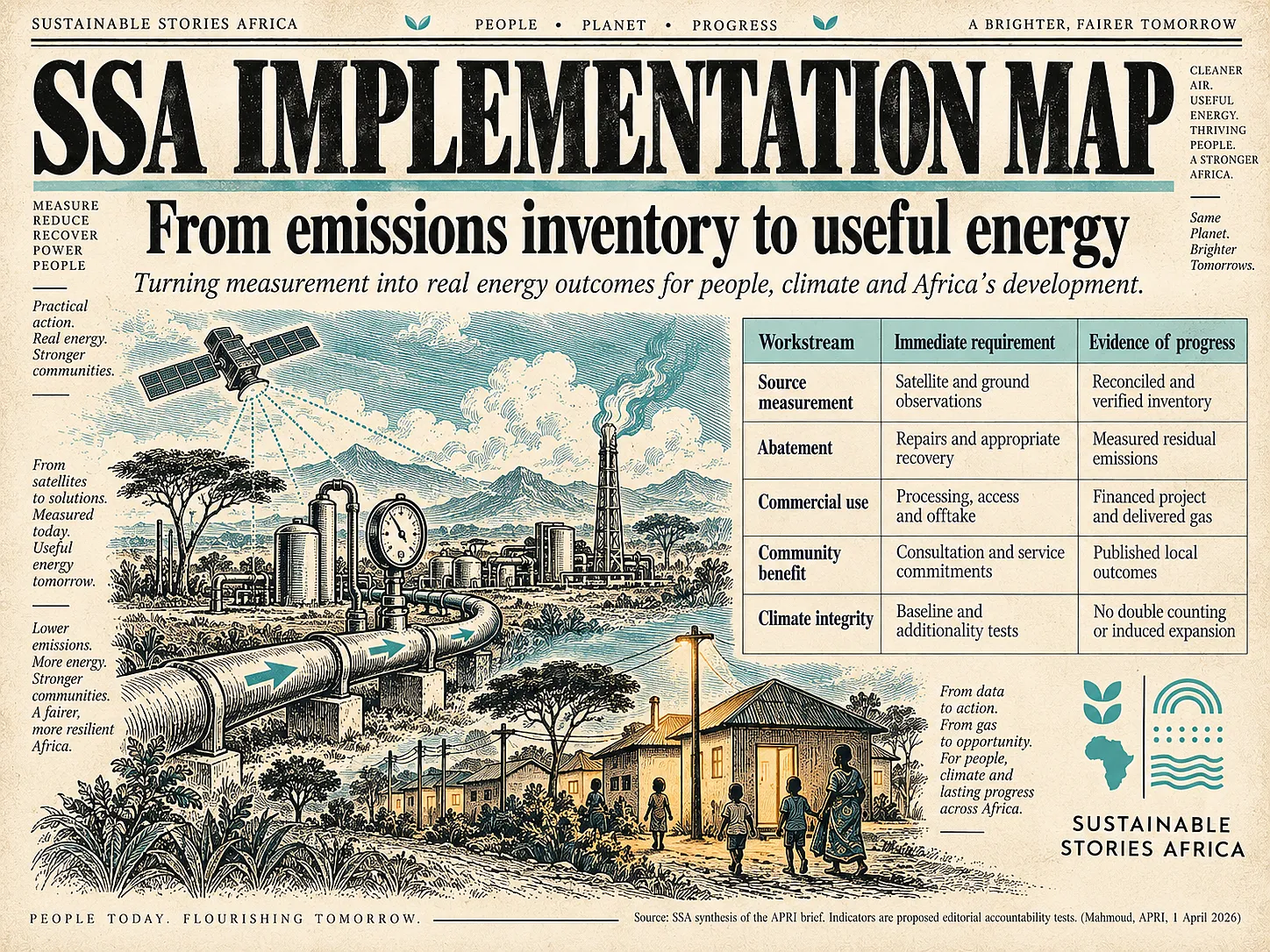
Path Forward – Recover Value Only With Verified Abatement
Nigeria should prioritise measured source reductions, bankable recovery projects and transparent institutional responsibilities.
Public support must be linked to verified emissions benefits and credible energy or industrial demand.
Revenue and employment projections need independent scrutiny before they shape spending commitments.
Methane recovery should reduce waste from existing infrastructure, improve community outcomes and avoid creating incentives for additional fossil-fuel dependence.