Building renewable capacity is only part of the energy transition.
Electricity systems must also coordinate batteries, appliances and smaller generators, changing how power is produced and consumed.
A discussion with Elexon chair Sara Vaughan shows why data, settlement and market rules now deserve as much attention as new infrastructure, and why African reforms must keep inclusion at their centre.
The Next Challenge Is Coordinating Demand
Electricity systems risk turning flexibility into a bottleneck if market rules cannot coordinate growing numbers of smaller assets.
- The challenge is increasingly institutional: knowing what resources exist, valuing their contribution and paying participants correctly.
That is the central theme of Energy Unplugged episode 312, published on 27 October 2026.
Aurora Energy Research’s global research director Richard Howard speaks with Sara Vaughan, chair of Elexon, the organisation responsible for key balancing and settlement functions in Great Britain’s electricity market.
For African utilities, the discussion offers a framework rather than a ready-made blueprint.
- Rooftop solar, batteries and productive-use equipment can change electricity demand before conventional planning systems recognise them.
Capturing their value requires proportionate data systems, credible commercial rules and protections for customers who cannot easily shift consumption.
Flexibility Must Complement New Renewable Capacity
Flexibility means changing when electricity is generated, stored or consumed in response to system conditions. In the interview,
- Vaughan describes a wide field spanning storage, behind-the-meter generation and consumers increasing or reducing demand.
- Howard argues that unresolved flexibility constraints could eventually obstruct further renewable integration.
The problem is not that every device needs a central instruction.
- Millions of decentralised decisions must remain compatible with a secure system.
- An electric vehicle charging later, a battery discharging at a constrained location and a business rescheduling a process can provide different forms of value.
African application should start with identifiable local needs.
- A utility may need to relieve an overloaded feeder, accommodate daytime solar or manage a steep evening demand increase
- Describing the constraint precisely is more useful than importing a broad flexibility target from another market.
Settlement Turns Meter Data Into Incentives
Vaughan draws an important institutional distinction.
The National Energy System Operator, NESO, manages physical balancing, while Elexon handles the financial reconciliation of differences between market participants’ scheduled and actual positions.
- Settlement determines who owes what; it is not the same activity as operating the grid.
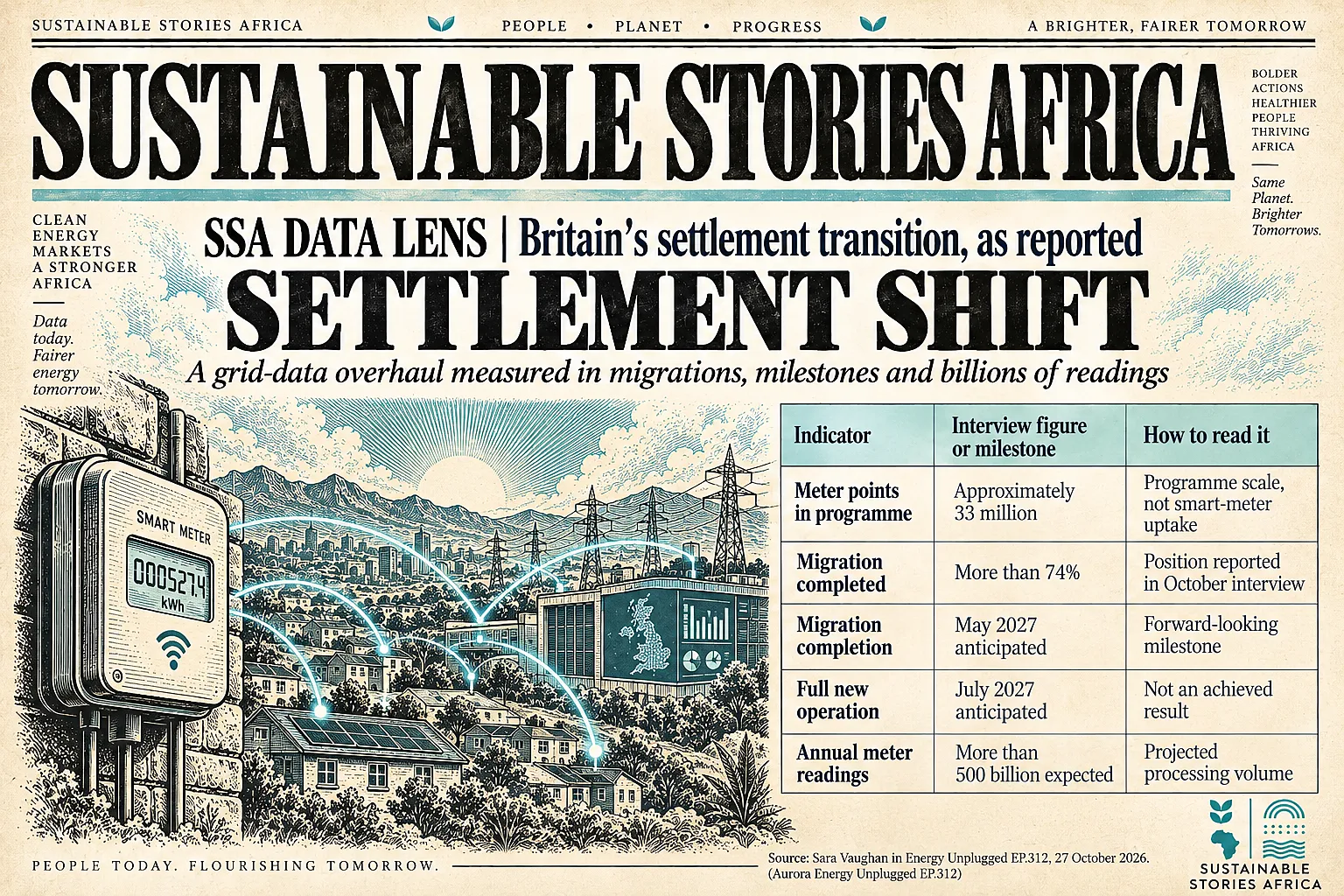
Britain’s market-wide half-hourly settlement programme is intended to align settlement more closely with actual consumption patterns.
- Vaughan says more than 74% of approximately 33 million meter points had migrated at the time of the interview.
- She anticipates completing migration by May 2027 and full operation under the new process by July 2027.
- These are interview-reported milestones, not completed outcomes.
She also says the resulting system would process more than 500 billion meter readings annually.
- The scale illustrates the importance of digital infrastructure, but volume alone does not establish data quality, cybersecurity or useful market participation.
Half-hourly settlement is also distinct from requiring every household to accept a dynamic retail tariff.
- Better wholesale and settlement information can support new products; these products depend on tariff design, consent and consumer protection.
- This distinction is especially important where households have limited control over essential electricity use.
Distributed Assets Can Support Shared Benefits
Vaughan questions whether the system operator should seek ever deeper direct visibility of individual assets or work more closely with distribution system operators.
- Her proposed middle ground is a coordinated whole-system approach that combines information held at different network levels rather than assuming one institution must control everything.
This matters for African electricity reform because distributed resources often emerge through customer investment.
- A factory’s battery may primarily protect production, but under suitable arrangements it could also provide a network service.
- The utility needs verified availability and clear operating boundaries, not unrestricted access to the factory’s commercial data.
The interview also discusses consistent products, revenue stacking and primacy rules.
- Revenue stacking allows an asset to earn from more than one compatible service; primacy rules determine which commitment takes priority if requests conflict.
- Without these arrangements, the same flexibility can be promised more than once.
The potential benefit is a system that uses existing infrastructure more effectively and rewards customers for useful participation.
- However, demand response must be distinguished from involuntary deprivation.
- Asking a well-equipped business to shift a discretionary process is not equivalent to asking an energy-poor household to forgo cooking or refrigeration.
The design test is therefore both economic and social:
- Does flexibility reduce avoidable system expenditure, and can its benefits reach people without expensive controllable equipment?
The interview’s electric-vehicle example illustrates both the opportunity and the limits of transferring headline savings.
- Vaughan cites an estimated annual saving of around £330 from smart rather than conventional charging.
This figure concerns the British context discussed; it is not an African tariff benchmark or a promise to every vehicle owner.
The transferable principle is that customers need an understandable reason to change behaviour.
- A utility cannot assume participation simply because a system-wide saving is modelled.
- The customer must see a credible benefit after accounting for equipment, inconvenience, contractual restrictions and any risk to essential use.
Where automated controls are involved, performance arrangements should also clarify what happens during communications failure or an equipment fault.
- A flexibility product should not leave the customer unable to meet a core operational need because responsibilities were poorly specified.
For regulators, the useful comparison is therefore between delivered outcomes and a transparent counterfactual:
- What would the network have spent, or how would it have operated, without the service?
That makes it possible to judge whether flexibility genuinely avoids costs rather than merely shifting payments between participants.
Design Digital Markets Around Public Trust
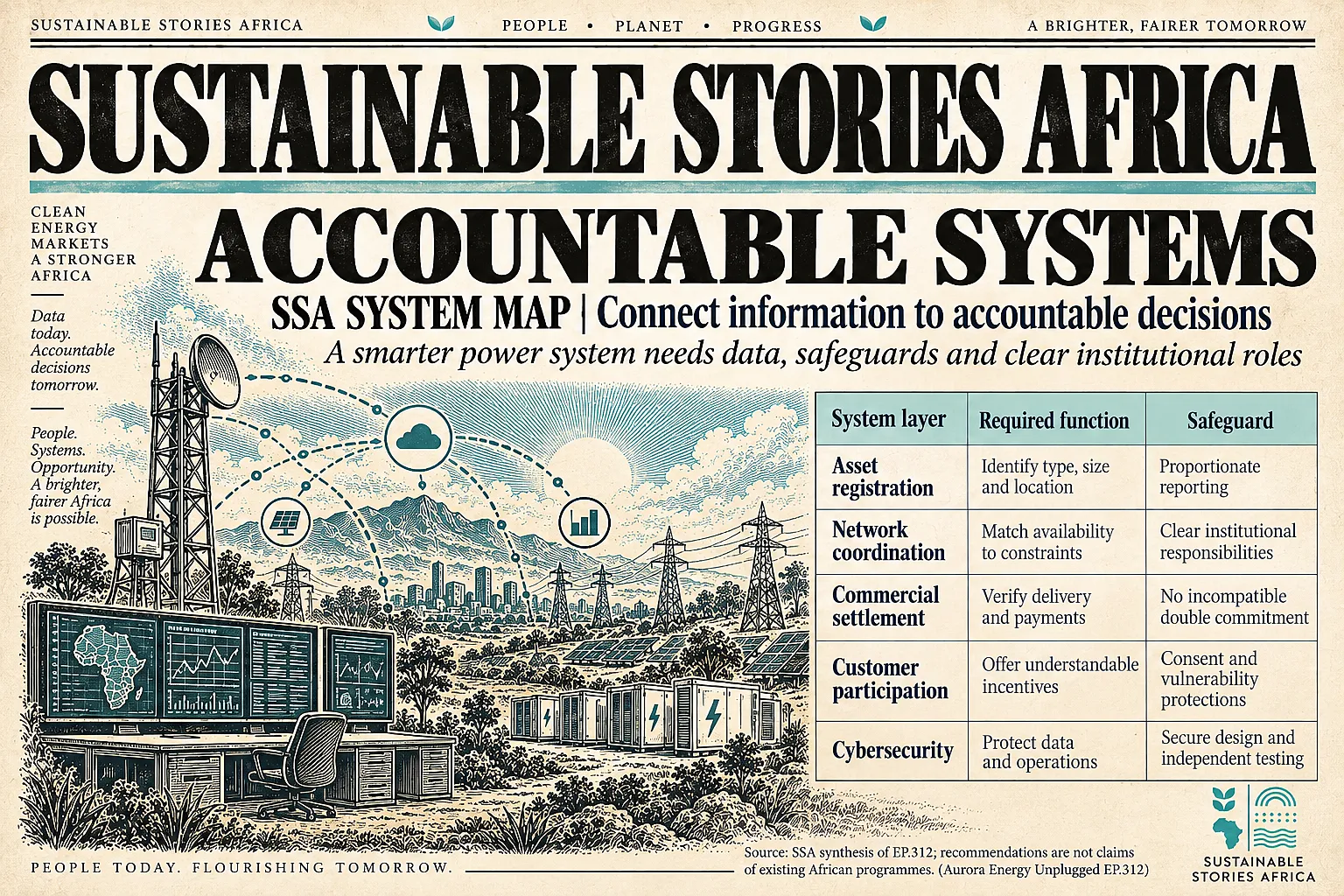
African regulators should begin with interoperable asset registers and proportionate reporting requirements.
Utilities need basic information on resource type, location, capacity and connection status.
- Collect granular operational data when it serves a defined purpose and under clear access rules.
Vaughan discusses Britain’s flexibility market asset register and broader work to improve visibility of small connected assets.
- She also stresses secure-by-design systems and independent cybersecurity testing.
- These safeguards are part of infrastructure development, not optional additions after a platform is operating.
A practical reform sequence would start with pilots on specific network constraints, agreed measurement methods and transparent settlement.
- Participation rules should prevent duplicate payment for the same undeliverable service while allowing genuinely compatible revenue streams.
- Regulators should publish performance results before expanding schemes.
Consumer safeguards deserve equal attention.
- Participants need simple contracts, predictable exit arrangements and clarity on who controls equipment.
- Customers who opt out, or lack smart appliances, should not automatically carry an unfair share of network costs.
- Vulnerable users need protection against inappropriate exposure to volatile prices.
Finally, utilities should distinguish better forecasting from stronger surveillance.
- Collecting every possible data point can increase cost and risk without improving decisions.
- The aim is sufficient, reliable information distributed among accountable institutions.
A smaller, well-governed system that settles payments correctly may deliver more value than a sophisticated platform that customers and developers cannot trust.
Path Forward – Coordinate Assets Without Excluding Vulnerable Consumers
African power-sector reforms should connect metering, asset registration, network planning and settlement around clear service needs.
Start with measurable pilots, compatible market rules and secure data governance.
Flexibility should reward useful participation without penalising households that cannot shift demand.
The transition advances when digital coordination improves reliability and affordability, not when utilities collect more information.