
UK banking records show differences in financial functioning up to three years before customers disclosed a mental health condition.
The findings point to opportunities for earlier support, while leaving diagnosis and causation unresolved.
For African financial institutions, the question is how to make assistance more accessible without turning financial difficulty into a mental health label or a basis for exclusion.
Financial Difficulty Often Precedes Seeking Support
People who disclosed mental health conditions to a major UK bank showed differences in income, credit use, savings and banking activity long before the disclosure, according to research published in JAMA Network Open on October 29.
- The study suggests that existing customer interactions may offer opportunities to provide practical support before difficulties deepen.
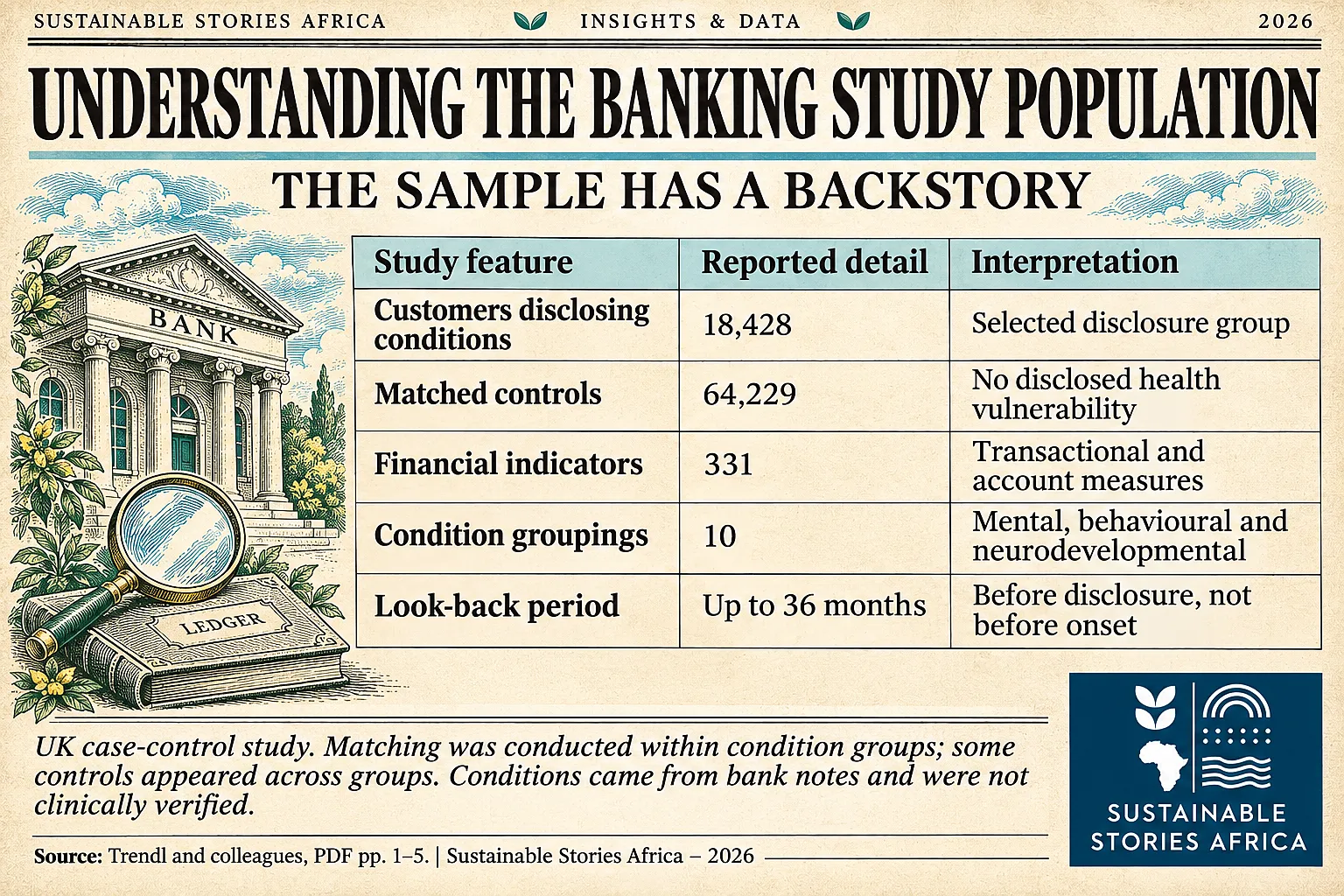
Anna Trendl and colleagues compared de-identified records from 18,428 customers who disclosed a condition with 64,229 matched controls.
- Across 331 financial indicators, differences were visible up to 36 months before disclosure and were broadly similar across the conditions examined.
The findings bring financial inclusion into the mental health conversation.
- They also establish an essential boundary: a disclosure date is not the date a condition began, and banking behaviour cannot establish a diagnosis.
For African banks and fintechs, the study offers questions for service design rather than a ready-made prediction system.
Disclosure Arrived After Financial Differences Emerged
The customers who disclosed conditions had lower credit scores, greater overdraft use and more frequent contact with the bank.
- Differences generally grew nearer to disclosure.
- Among 34 indicators selected for temporal analysis, 21 reached their largest absolute difference in the immediately preceding month.
That pattern may partly reflect how disclosure happens.
- Customers experiencing difficulty may contact their bank more often, creating more opportunities to mention a health condition.
- Those who do disclose may differ substantially from people who remain silent, including in support needs, confidence and awareness of available help.
The study therefore cannot show that every customer with similar transactions has a mental health condition.
- Nor does it show a three-year countdown to illness.
It describes differences between selected groups before an administrative event recorded by a bank.
Shared Patterns Reveal Strain Across Conditions
The research covered conditions including anxiety, depression, bipolar disorder, ADHD and autism.
- Bank staff recorded customer disclosures as free-text notes with explicit oral consent, and researchers mapped those notes into diagnostic groupings.
- The process enables analysis at scale but introduces possible ambiguity and misclassification.
The largest differences included welfare-related income, financial distress and bank interaction.
- Customers in the disclosure group were more likely to receive disability-related benefits, used overdrafts more and had lower credit scores.
- They also showed higher cash use and lower spending on some self-care and recreational activities.
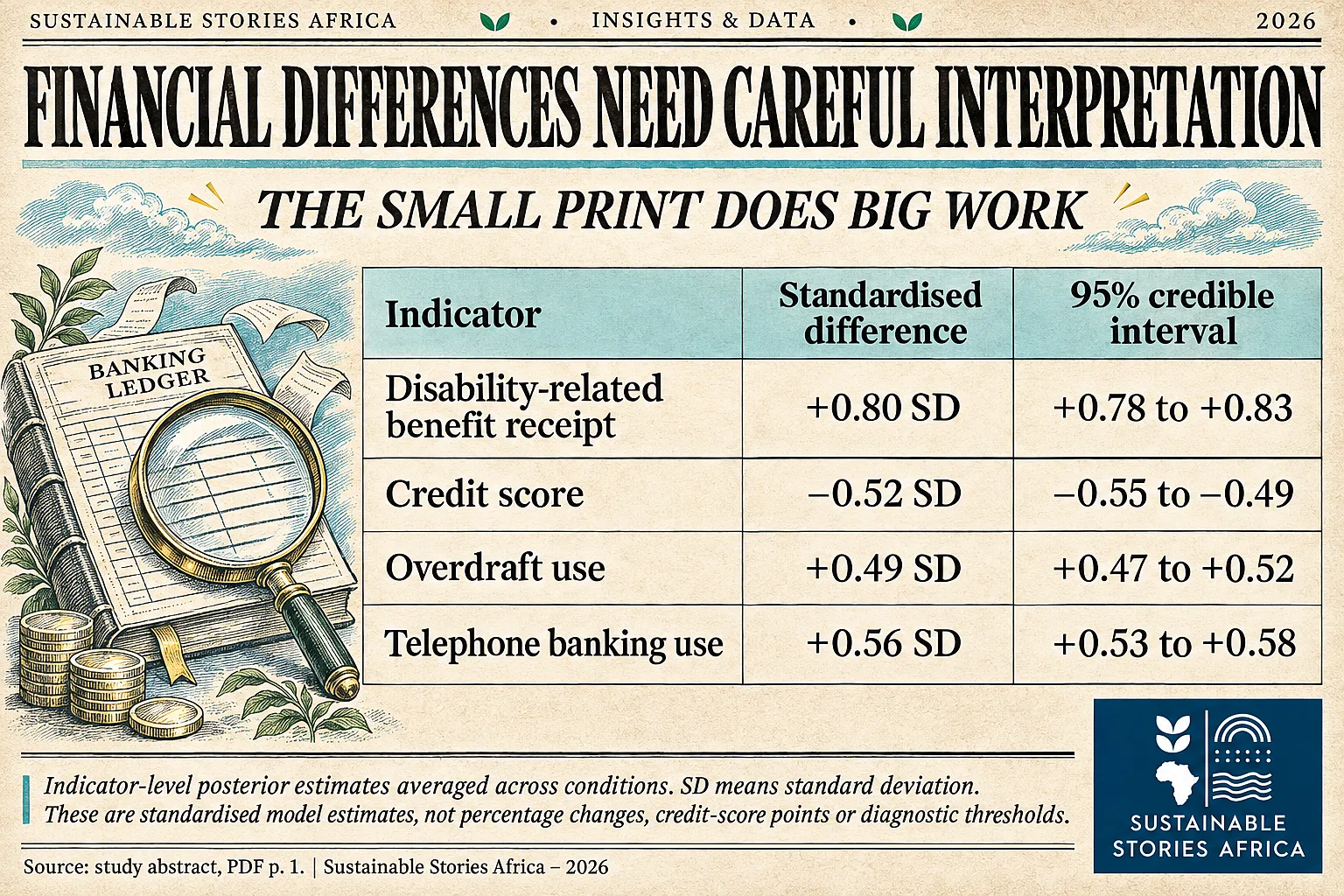
These are measures of circumstances and observed activity.
- They do not establish why someone withdrew cash, reduced leisure spending or needed help over the telephone.
- Cash may help a customer control spending; lower recreational expenditure may reflect limited income.
- An analytical signal should not replace the customer's own explanation.
The authors found that most variation in the modelled differences was associated with the financial indicators themselves, rather than the condition grouping.
- This supports a focus on common support needs, while cautioning against attempts to infer specific conditions from transactional patterns.
The results also depend on what one institution can observe.
- Accounts at other banks, household resources and informal help were not captured
African institutions considering similar research would need to examine how their own data omit parts of customers' financial lives, rather than assume that the UK patterns transfer directly.
Support Can Start With Financial Needs
The practical opportunity is to respond to difficulty without requiring a clinical explanation.
- A customer struggling with payments may benefit from a clear conversation, accessible information or a review of available assistance.
- These services can be designed around financial needs and customer choice.
Better support could reduce the effort required to navigate a bank during a difficult period.
- The study's finding of more frequent human contact makes telephone and branch services relevant alongside digital design.
Accessibility should include clear explanations, manageable processes and a route to staff who can respond appropriately.
Design Assistance With Customers And Safeguards
Banks can review the journey from the first sign of payment difficulty to an effective offer of assistance.
- Customer-facing teams need clear options, language that avoids assumptions, and escalation routes for situations requiring specialist support.
- A customer should be able to explain what help is useful without accepting an inferred diagnosis.
Institutions should involve people with lived experience when designing those services.
- The study supports combining financial measures with customers' accounts of their circumstances.
- Co-design can reveal why a process that appears efficient internally becomes difficult for someone dealing with stress, disability or disrupted income.
Any use of transaction data needs a defined purpose.
- Models require evaluation for accuracy, unequal error rates and privacy, with clear routes for customers to challenge decisions.
- Exploratory associations cannot justify diagnostic claims.
For African regulators and financial service providers, a useful starting point is a bounded support pilot.
- Participation and data use should be understandable, while assistance remains accessible to people who do not disclose a condition.
- Outcomes might include successful resolution of payment problems, customer-reported ease of access and whether repeat distress decreases.
Researchers should test the patterns across institutions and financial environments.
- Differences in welfare systems, payment channels and account use make local validation essential. UK indicators cannot define support needs elsewhere.
Oversight should examine how analytics change customer treatment and whether customers retain control.
- Evaluating systems only on collections or product sales could push an inclusion project away from welfare.
Pilots should instead test whether assistance improves financial functioning and access.
Path Forward – For Supportive Financial Services
Financial institutions should make practical assistance easier to access and evaluate it with customers.
The UK findings support research into financial functioning, while offering no basis for diagnosing people from their transactions.
African pilots should establish local relevance, protect customer choice and measure improvements in financial wellbeing. Service outcomes should guide expansion.