An October consultation paper finds deep scepticism about global sustainability outcomes alongside renewed confidence in practical levers such as taxation, supply chains and regulation.
It argues that visible risks require changes to how markets operate.
For African businesses and policymakers, the challenge is to strengthen delivery and accountability while ensuring tougher rules do not shift transition costs onto vulnerable communities and suppliers.
Visible Risks Test The Sustainability Playbook
Sustainability leaders are losing confidence that existing approaches will deliver global goals, even as they identify stronger tools for changing markets.
That tension sits at the centre of Gray Rhino Territory, an October 2026 green paper led by John Elkington through the Routes to Transformation collaboration involving Volans, GlobeScan and ERM.
Drawing on a survey of 610 experts in 57 countries, conducted from June 9 to August 9, the paper argues that the next phase of sustainability will depend more on prices, enforceable requirements and operational decisions.
- It describes a world where highly visible risks are repeatedly neglected until disruption forces action.
The document is a consultation paper, not a settled forecast.
- Its value for African markets lies in the questions it raises about investment, institutional capacity and who pays for delayed adjustment
- Its projections about the 2030s remain the author's interpretation rather than measured future outcomes.
Confidence In Global Goals Remains Weak
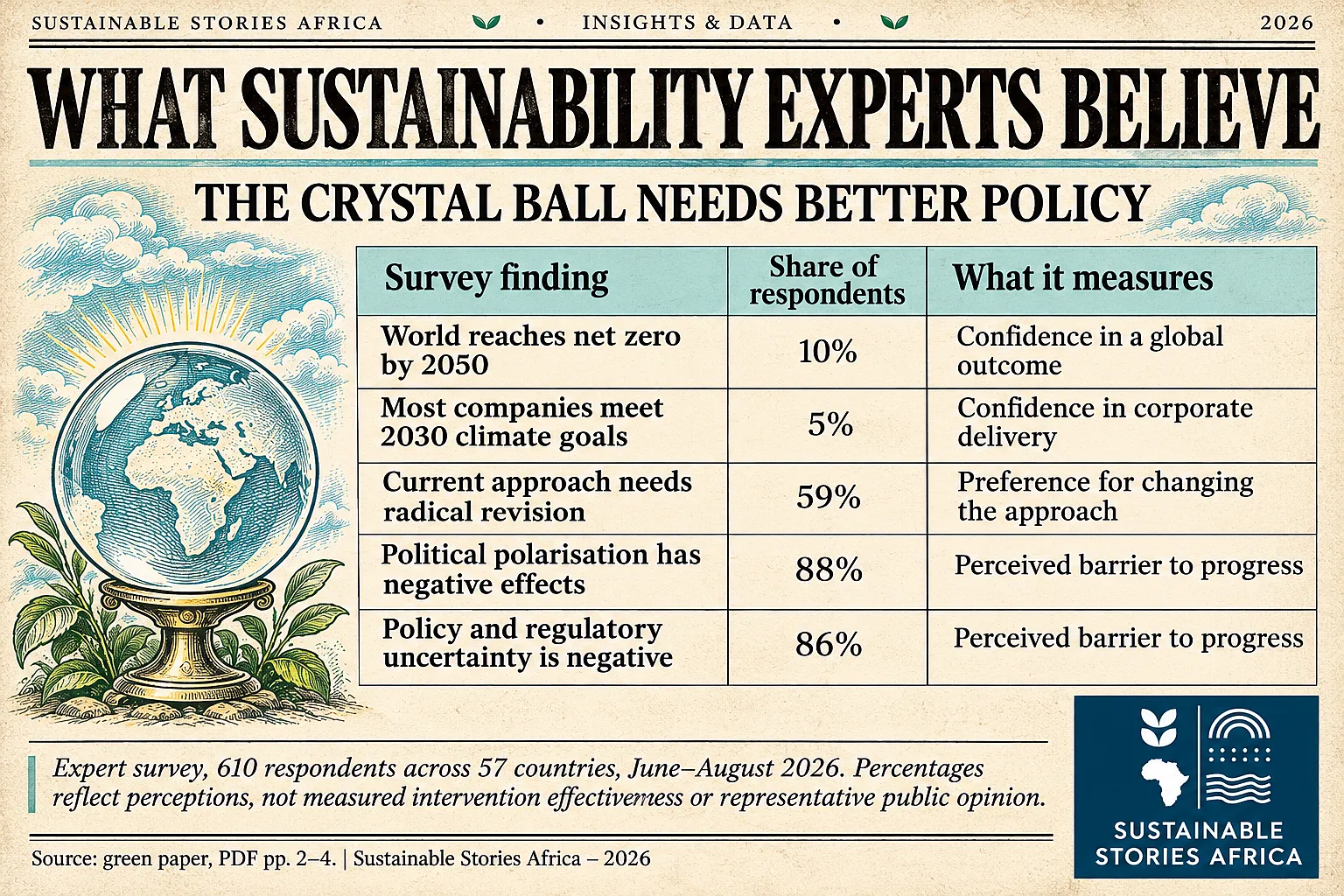
Only 10% of surveyed experts believed the world would reach net zero by 2050, and 5% believed most companies would meet their 2030 climate goals.
Meanwhile, 59% want the current sustainability approach radically revised.
- These are expert opinions about likely outcomes, not calculated probabilities of success.
The external environment helps explain the mood.
- Political polarisation tops the list and is viewed negatively by 88% of respondents
- Policy and regulatory uncertainty by 86%
- Authoritarianism and geopolitical tension each by 83%.
The respondents see sustainability operating within political and economic conditions that can obstruct delivery.
The paper's central proposition is that this pressure may change the tools leaders use.
However, crisis is not automatically productive.
- The same disruption that prompts innovation can damage institutions, household security and the capacity to invest.
This makes preparation quality as important as ambition.
Markets Respond To Costs And Consequences
According to the paper’
- Subsidy reform and taxation received the highest potential-impact rating, at 77%.
- Carbon pricing and supply chain engagement each scored 69%.
- Trade policy scored 68%.
- Voluntary corporate reporting was at 15%.
The ratings describe how experts assessed the tools, not the percentage reduction in emissions that any tool would produce.
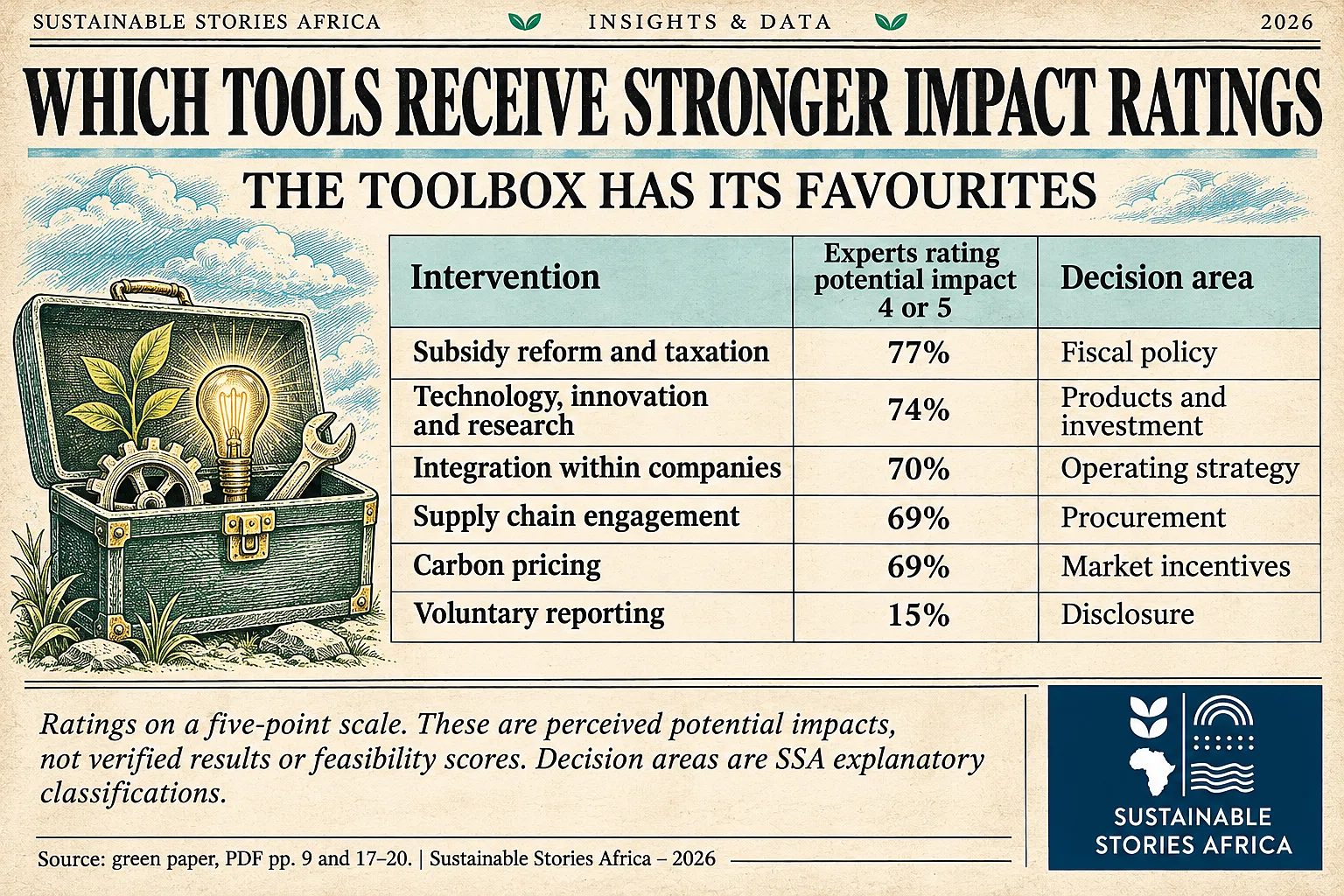
The interpretation is that disclosure alone cannot change the economic conditions under which companies compete.
- A supplier may understand its environmental impact yet lack an affordable financing route to improve it.
- A company may publish ambitious plans while procurement continues to reward only the lowest immediate price.
For African economies, this argument points towards the relationship between rules and delivery capacity.
- Requirements become more useful when firms can obtain reliable services, technical assistance and capital.
- Otherwise, a transition standard can function as a barrier to participation rather than a route to better performance.
The paper also shifts attention across corporate functions.
- Treasury influences financing, procurement shapes supplier incentives, product teams choose materials, and legal teams interpret obligations.
- Assigning every sustainability issue to one specialist department can leave those decisive choices untouched.
Rising expert confidence does not establish that firms are adopting tougher accountability.
The proposed shift remains uneven and contested, as the paper's counterarguments acknowledge.
Stronger Delivery Must Include Fairer Outcomes
An effective transition would connect better environmental performance with investment and opportunity.
- Public purchasing could create demand for improved products; financing could support enabling infrastructure; and supply contracts could reward demonstrable progress.
- These are potential applications of the paper's argument, not programmes it confirms are already in place.
The social test is whether stricter rules reduce harm without simply exporting costs.
- A large buyer can demand extensive supplier documentation while refusing to support the investment needed to meet it.
- A government can change prices while overlooking households unable to absorb the adjustment.
Both approaches risk weakening legitimacy.
For sustainability professionals, the opportunity is therefore broader than reporting less or enforcing more.
- It is to connect operational decisions, public interests and evidence of outcomes.
Reliable disclosure remains useful when it helps decision-makers identify whether the underlying change has occurred.
Move Accountability Into Budgets And Operations
Boards can begin by identifying their most material exposures and the decisions that shape them.
- Each priority should have an accountable executive, resources, a delivery timetable and a measure of progress.
- The question is whether procurement, financing and investment choices support the stated objective.
Governments should examine whether incentives support their development goals, accounting for affordability and implementation capacity.
- The survey did not establish a universal policy package for African jurisdictions.
Financiers should assess enabling investments alongside individual labelled products.
- Grids, storage, water security and resilient infrastructure can change what entire markets can do.
- Evaluating these investments requires clear assumptions about demand, delivery risks and who will use the resulting services.
Companies should involve suppliers and affected communities before fixing costs and deadlines.
Transition plans need to explain how smaller participants can obtain the skills, information and financing required to comply.
Measurement should combine compliance with real outcomes.
A completed report or signed contract shows a process; it does not establish reduced pollution, restored ecosystems or improved working conditions.
- Independent scrutiny and accessible grievance channels can help reveal gaps between formal requirements and experience.
Leaders should use the gray rhino metaphor to prepare for visible risks while acknowledging uncertainty about timing and disruption.
- Resilient institutions will be essential to delivering transition plans.
Path Forward – For Accountable Market Reform
African institutions should link sustainability goals with budgets, procurement and investment decisions.
Policy changes need credible enforcement and practical support for those expected to comply.
Judge progress by reduced harm and improved resilience, with transition costs made visible.
The consultation paper's scenarios should inform preparation while remaining distinct from established findings.