Africa’s development ambitions increasingly depend on the quality of its data.
A continental road map from the Economic Commission for Africa sets out how official statistics can become more digital, resilient, user-focused and trusted by 2030.
The core question is whether governments will treat statistics as infrastructure, rather than paperwork, and fund the systems needed to measure progress, target policy, and leave no one behind.
Africa’s Data Systems Face Defining Test
Africa’s next development breakthrough may depend less on grand policy declarations and more on something quieter: whether governments can produce timely, trusted and usable statistics.
The Road map for the transformation and modernization of official statistics in Africa, 2023–2030, prepared by the Economic Commission for Africa, argues that national statistical systems must become more agile, digital and demand-driven if they are to support the 2030 Agenda, Agenda 2063 and national development plans.
For citizens, the issue is practical. If poverty is mismeasured, resources miss the right communities. If climate shocks are poorly tracked, adaptation plans weaken.
If jobs, gender, cities, and public services are counted late or inaccurately, governments are forced to make decisions in the dark.
Data Gaps Are Now Development Risks
Africa has made progress in modernising official statistics, including through electronic censuses, civil registration systems, statistical capacity programmes and digital tools.
However, the road map warns that the continent still faces a structural challenge: official statistics must keep pace with fast-changing data ecosystems, rising user expectations and expanding digital sources.
The urgency is clear. Public data gaps remain persistent across Africa’s monitoring of the Sustainable Development Goals and Agenda 2063.
The road map notes that data are insufficient for almost 120 SDG indicators, with significant gaps in areas such as gender equality, sustainable cities, responsible consumption and production, life below water, peace and institutions, and partnerships.
That is not merely a technical weakness. It is a governance risk.
- A finance minister deciding where to allocate scarce public funds needs reliable numbers. A city mayor planning flood-resilient drainage needs local data.
- A health worker tracking maternal outcomes needs records that are timely and interoperable.
- An investor assessing emerging markets needs credible national indicators. Without trusted statistics, development becomes more expensive, less accountable and less targeted.
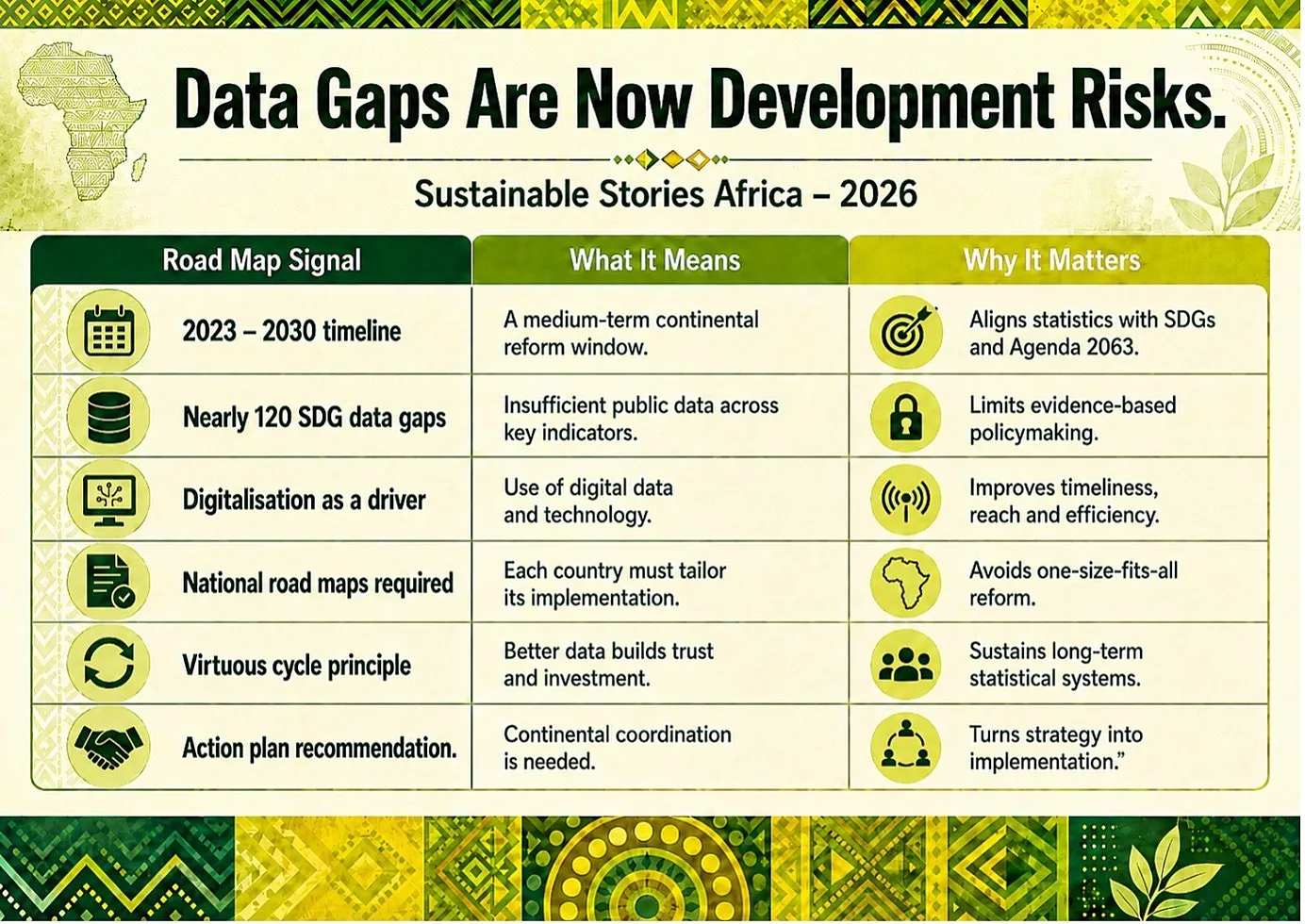
The road map’s message is direct: transformation cannot be reduced to buying software or digitising old processes. It requires leadership, financing, legal reform, human capital, infrastructure, user engagement and continuous improvement.
From Surveys To Modern Data Ecosystems
Traditional surveys and censuses remain essential, but they are no longer sufficient. A new statistical road map argues that national systems must now operate within broader data ecosystems, integrating administrative data, geospatial information, mobile data, satellite imagery, private-sector datasets and civil society sources into coherent, decision-ready intelligence.
COVID-19 accelerated the shift. When traditional surveys were disrupted, policymakers needed fast, reliable information on health, mobility and livelihoods. The pandemic exposed a critical gap: statistical systems that are resilient, agile and digitally capable are not optional infrastructure; they are governance necessities.
Three African examples illustrate the opportunity.
- Rwanda's National Institute of Statistics hosts a regional data science hub connecting government, universities, private companies and regional partners.
- Tanzania combined household surveys with satellite imagery to produce poverty estimates across 169 districts, against a previous resolution of just 20 mainland regions, fundamentally changing where interventions are directed.
- Senegal used earth observation and georeferenced crop data to map agricultural production through multi-institutional partnerships.
The lesson across all three is consistent: better data resolution changes the policymaking conversation, helping governments see where deprivation is concentrated and where investment will matter most.
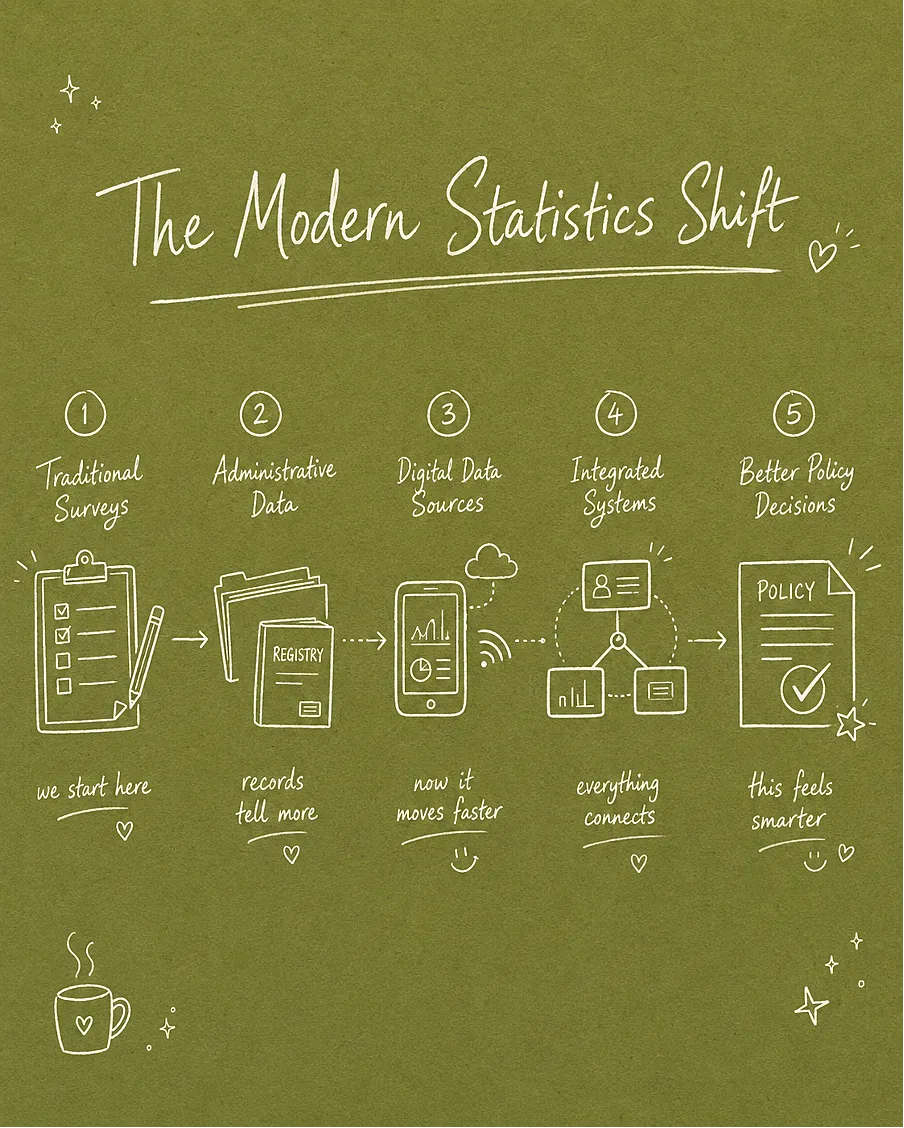
The road map is careful not to present digitalisation as a cure-all
- It says modernisation should be tailored to national circumstances and cost-benefit realities.
- In some countries, the immediate priority may be reliable electricity, internet connectivity, computers, transport, staffing and legal authority.
- In others, it may be advanced data science, interoperability or integrated national data systems.
Better Statistics Can Strengthen Public Trust
The road map’s strongest idea is the “virtuous cycle” of official statistics. When statistics are produced well, users trust them. When policymakers and citizens trust them, governments invest more. Better investment improves quality, timeliness and usefulness, which further strengthens trust.
Many African countries are still fighting the opposite cycle: weak institutions, poor funding, low statistical literacy, limited coordination and low-quality data that reinforce low demand. Breaking that cycle requires national statistical offices to become more visible, more responsive and more connected to real policy needs.
This is why the road map places user needs at the centre. Official statistics should not be produced only because international frameworks demand them. They should answer national questions: where are children out of school, which districts face water stress, which businesses are creating jobs, which communities are most vulnerable to climate shocks, and which public investments are producing results?
The roadmap also stresses the need for a national consensus on official statistics. That means governments, statistical offices, ministries, researchers, civil society, private data holders and development partners must agree on the role, value and funding of statistics in national life.
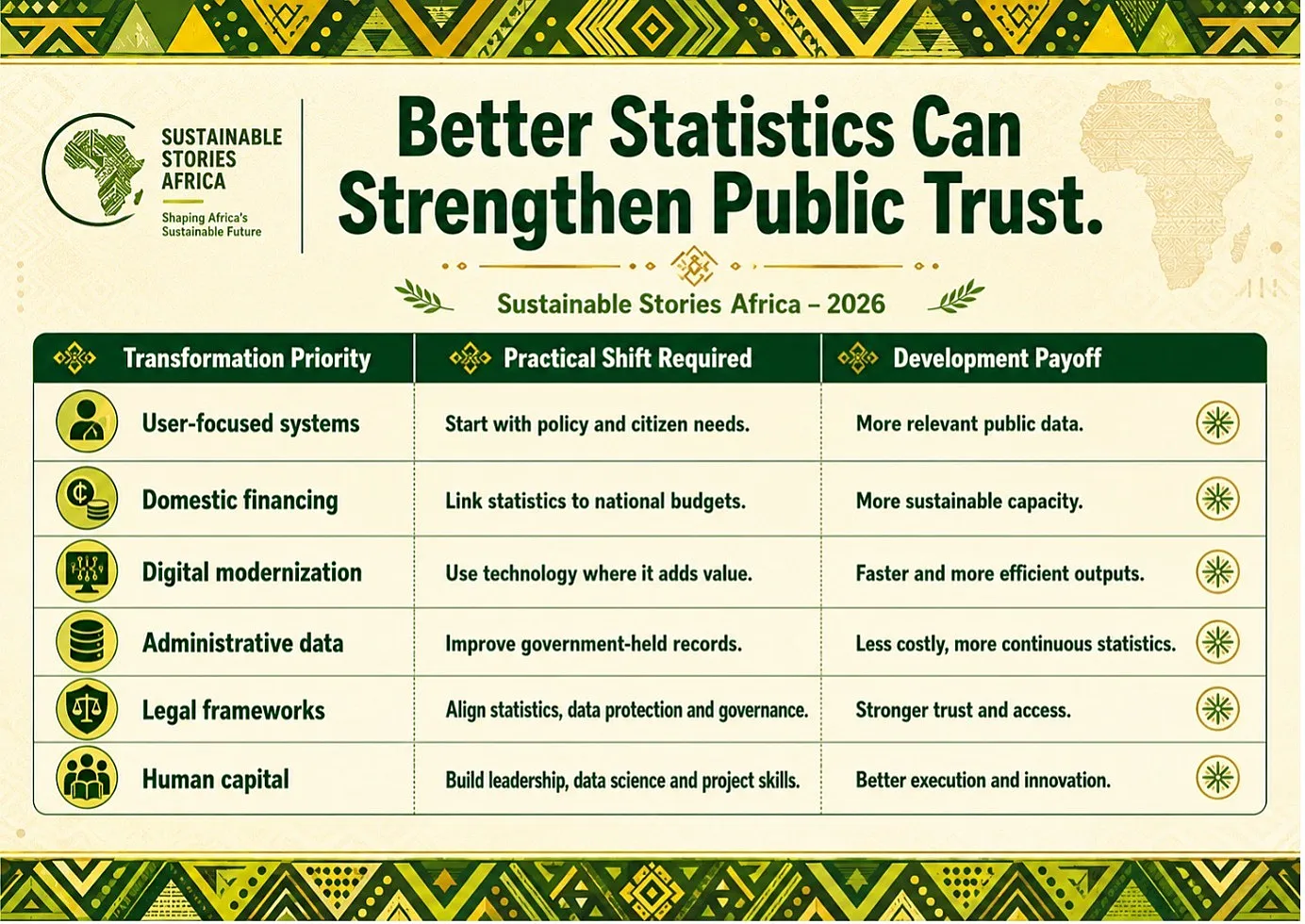
The opportunity is powerful. Better statistics can improve targeting of social protection, infrastructure, climate finance, health planning, industrial policy and local government delivery. For ESG and sustainability, stronger national data systems can improve disclosure, track climate adaptation, monitor inequality and strengthen accountability.
Governments Must Fund Data Transformation Properly
Official statistics must be treated as core development infrastructure.
The road map is unambiguous: national strategies for statistical development should become the primary vehicle for modernisation, supported by annual and multi-year work plans directly connected to ministries of finance, planning and sector agencies.
Results frameworks for national development plans must be explicitly linked to the data systems needed to monitor them, closing the persistent gap between policy ambition and measurement capacity.
Funding is where that ambition most frequently collapses. African countries have often succeeded in designing national statistical strategies but have been less successful in fully financing them. Sustainable transformation requires domestic investment matched to national priorities, not perpetual dependence on international support.
Legal reform reinforces the architecture. Statistical laws must protect professional independence, govern data access and confidentiality, and align with data protection and digital government frameworks.
The road map draws a critical distinction between strategic and technical actions. Technical projects, including new survey tools, administrative data systems, and sectoral statistics, can improve specific outputs. But they rarely transform institutions.
Weak coordination, poor funding, inadequate staff retention and low public trust require strategic, cross-cutting interventions that build institutional capacity to keep improving.
South-to-South learning accelerates that transformation.
Rwanda's data science hub, Cameroon's integration of statistics into national development planning and Ghana's high-level political support for statistical reform are continental lessons that do not require external importation.
Path Forward – Build The Systems That Count Everyone
Africa’s data transformation must move from strategy to funded delivery. Governments should strengthen national statistical offices, modernise legal frameworks, invest in digital and human capacity, and link statistics directly to national development plans.
The aim is simple but profound: build data systems that count everyone, guide policy honestly and support sustainable development. Better statistics are not just numbers. They are public trust, accountability and delivery infrastructure.