Methane regulation is becoming a test of whether climate promises can survive contact with oil and gas operations.
A new regulatory blueprint argues that countries need immediate equipment rules, verified emissions reporting and enforcement that grows stronger with better data.
For African producers, the prize is not only lower emissions. Credible rules can also protect export access, reduce financing risk and convert wasted gas into economic value.
Methane Rules Must Deliver Verified Cuts
Methane is often discussed as a global climate problem, but its control is intensely local. It depends on whether a regulator can identify a leaking valve, require an operator to repair it, verify the result and impose consequences when the rules are ignored.
That practical chain is the central message of the Blueprint for a Comprehensive Oil and Gas Methane Regulation, prepared by the Climate and Clean Air Coalition and Clean Air Task Force, with contributions from the United Nations Environment Programme’s International Methane Emissions Observatory.
- The document sets out a layered approach for national and subnational regulators seeking rapid cuts from oil and gas systems.
For African hydrocarbon producers, including Nigeria, the blueprint arrives at a commercially important moment. Methane performance increasingly affects climate credibility, access to capital and the ability to sell into markets that are developing import standards.
- Regulation is therefore moving from an environmental add-on to part of the infrastructure of competitiveness.
A Short-Lived Pollutant Demands Fast Regulation
The blueprint starts from an uncomfortable truth: regulators do not need perfect information before requiring obvious reductions.
- Pneumatic devices can be replaced with lower-emitting alternatives.
- Gas from compressors, dehydrators and storage tanks can be captured.
- Flares can be monitored.
- Leak detection and repair programmes can be made routine rather than exceptional.
This matters because delays allow avoidable emissions to continue while countries wait for inventories, laboratories or reporting systems to mature.
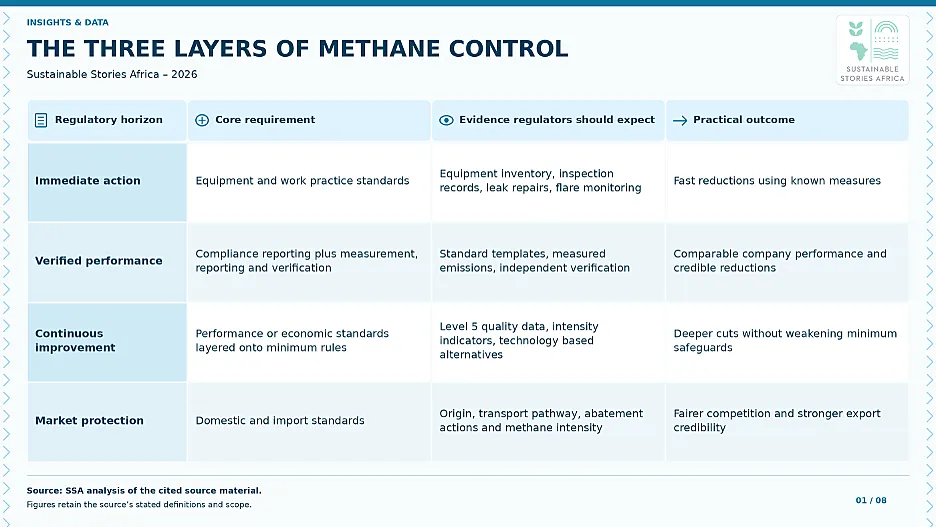
The authors recommend prescriptive equipment and work practice standards as the fastest first layer, informed by a granular inventory aligned with at least Level 3 of the Oil and Gas Methane Partnership 2.0 framework.
Nigeria is named among jurisdictions that have adopted methane standards. The challenge now is implementation quality.
- A rule on paper cannot establish whether a flare remained lit, whether a super emitter was repaired or whether reported reductions match what satellites and site measurements observe.
Three Regulatory Layers Build Lasting Methane Control
The blueprint separates the job into three connected goals.
- Immediate mitigation comes first.
- Compliance and emissions reporting follow.
- Continuous improvement then allows regulators to introduce stronger performance or economic approaches as inventories and measurement improve.
It also distinguishes two kinds of evidence that are frequently blurred.
- Compliance reporting shows whether an operator performed the required actions.
- Emissions reporting estimates or measures how much methane was released during a reporting period and explains the method and verification.
A company may complete inspections and still report weak emissions data; another may publish an inventory without proving that required repairs were done. Effective regulation requires both.
The market dimension is becoming harder to ignore.
- The European Union adopted the first methane import standard in 2024 and is moving toward disclosures covering origin, transport, producer abatement and methane intensity.
- Exporting countries that cannot produce comparable information risk having their performance defined by others.
Stronger Rules Can Protect Markets and Capital
Well-designed methane rules can create more than compliance costs.
- Captured gas can be sold or used, reducing waste and supporting domestic energy supply. Standardised information can help lenders and buyers distinguish stronger operators from laggards.
- Transparent databases can improve public trust and direct regulatory attention toward the largest sources.
The blueprint points to OGMP 2.0 Level 5 as the destination for measurement-based reporting. Reaching that standard will take time, investment and training, particularly where regulators have limited monitoring equipment or specialist staff.
However, the transition can be staged. Early rules can require proven controls while capacity building, field demonstrations and third-party verification strengthen the data layer.
For African countries, this sequencing is valuable.
- It avoids a false choice between immediate action and sophisticated measurement.
- Regulators can mandate what already works, then use better evidence to target the next tonne of methane more efficiently.
Regulators Need Data, Enforcement and Shared Capacity
The next step is institutional, not rhetorical.
- Ministries, petroleum regulators, environmental agencies and state-owned companies need defined roles.
- A national task team can align climate commitments, petroleum law, operator obligations and enforcement powers before overlapping mandates create gaps.
Operators should submit verified reports through common templates.
- Regulators should publish performance data where commercial confidentiality permits and retain a ladder of consequences, including corrective plans, inspections, penalties, fees and, for serious cases, permit suspension or revocation.
- Flexibility for new technology should be approved within clear boundaries, not used as a loophole.
Finance must also be part of the design conversation.
- Smaller operators may need structured support for measurement equipment and abatement projects, but assistance should be tied to transparent milestones.
- Development partners can support regulator training, satellite interpretation and independent verification.
- Buyers and lenders can reward measured improvement through contract terms and capital pricing.
Path Forward – Build Credibility Before Markets Tighten
African regulators should begin with enforceable equipment and work practice rules, build standardised compliance and emissions reporting, then raise ambition as measurement improves.
The objective is a system in which every claimed reduction can be traced to evidence.
That credibility will protect communities, preserve market access and turn methane governance into a source of climate and commercial value.