Europe is losing nearly one million workers from its labour force each year while skilled refugees remain underemployed.
A position paper from European Business Summits, UNHCR and Ingka Group argues that labour market integration is both an economic strategy and a protection imperative.
Its prescriptions, from language learning and skills recognition to employer incentives and local services, also offer lessons for African countries managing displacement, labour mobility and shortages of specialised skills.
Europe’s Demographic Squeeze Exposes Untapped Talent
Europe’s workforce is shrinking while employers in logistics, healthcare and hospitality struggle to fill roles. At the same time, refugees with professional experience, language skills and resilience remain blocked from work that matches their abilities.
A 2026 position paper developed through the European Demographics Summit, with expertise from UNHCR and Ingka Group, presents this mismatch as a competitiveness problem.
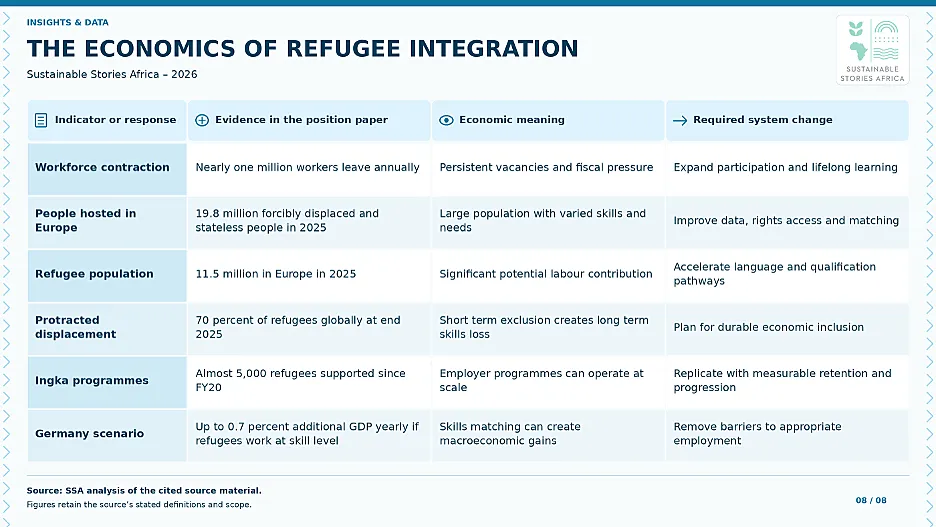
Nearly one million workers leave Europe’s labour force each year, it says, as ageing and low birth rates place pressure on businesses, public finances and social systems.
The document focuses on Europe, but the underlying lesson travels.
- Countries across Africa host displaced people, manage cross-border labour flows and face skills mismatches of their own.
- Inclusion works when legal rights, employer demand, training and local services operate as a single system.
Nearly One Million Workers Leave Annually
The demographic figure highlights the urgency of the argument.
- Labour shortages are not a temporary recruitment problem when the working population is structurally contracting.
- Employers need to improve productivity, retain existing workers and widen the pool of people able to participate.
Europe hosted 19.8 million forcibly displaced and stateless people at the end of 2025, including 11.5 million refugees and an estimated 1.5 million asylum seekers, according to UNHCR figures cited in the paper.
Although European countries grant refugees the right to work, access can be delayed by issues such as permits, documentation, language barriers and administrative procedures.
The result is more underemployment, not absence of ability.
- Qualifications are not recognised, professional networks have been lost, and training is poorly linked to available jobs.
- Single parents, people with disabilities, carers and visible minorities can face compounded exclusion.
Structural Barriers Waste Skills Europe Already Hosts
The paper organises its response around three priorities: make better use of existing skills, strengthen business and cross-sector partnerships, and invest in local integration systems. Each priority addresses a different point of failure.
- Language courses must progress from basic communication to profession-specific competence.
- Qualification recognition should include skills-first assessment, bridging courses and paid internships.
- Modular training should allow people to balance work, care and language learning.
- Digital inclusion requires devices, connectivity and the ability to use public services and learning platforms.
Fragmented labour information adds another obstacle.
- Job opportunities often sit outside the public systems refugees use, while smaller employers lack guidance on hiring and onboarding.
This creates a coordination failure even where legal rights and vacancies exist.
Better Integration Can Lift Growth and Cohesion
The benefits extend beyond filling vacancies.
- When people work at their skill level, governments collect more revenue, households gain stability, and employers retain talent.
- Workplaces gain multilingual ability, cultural knowledge and adaptability.
- Communities see displaced people as contributors rather than permanent recipients of assistance.
The paper cites a UNHCR estimate that Germany could add about 0.7% to annual gross domestic product if refugees were enabled to work at their skill level.
The estimate is country-specific; however, it captures the cost of occupational downgrading:
- A trained professional working far below qualification represents lost output for the individual and the economy.
Ingka Group’s Skills for Employment and Hiring Displaced Talent programmes have supported almost 5,000 refugees since the 2020 financial year, according to the paper.
Employer initiatives can make inclusion concrete when they combine hiring with language support, mentoring and progression.
Employers and Cities Must Build Inclusion Systems
Governments should simplify work authorisation, speed qualification recognition and fund flexible, profession-linked language training.
Labour market data should identify legal status, skills, barriers and regional demand while protecting privacy.
Employers should assess practical ability and potential instead of relying only on perfect documentation.
Wage subsidies, training grants, supported apprenticeships and onboarding assistance can help smaller firms participate.
Workplace language support and mentoring can improve retention and productivity.
Cities must connect employment with housing, health, childcare, transport and financial assistance.
- Refugees should help design and evaluate programmes.
For African policymakers, the same architecture can support internally displaced people, refugees and returning migrants, while bilateral skills partnerships should protect workers from exploitation and brain drain.
Path Forward: Treat Work as Shared Infrastructure
Labour market integration should be designed as economic infrastructure, linking legal status, skills recognition, employers, training and local services.
Europe’s demographic pressure makes the case urgent, but the principle is broader
When displaced people can use their skills safely and fairly, inclusion strengthens productivity, dignity and social cohesion.
Success will be measured by decent work with progression, rather than entry into any job.