Development knowledge once travelled mainly through conference rooms, technical reports and closed policy networks.
World Bank Live offers a different model: public events, expert questions and free replays in four languages.
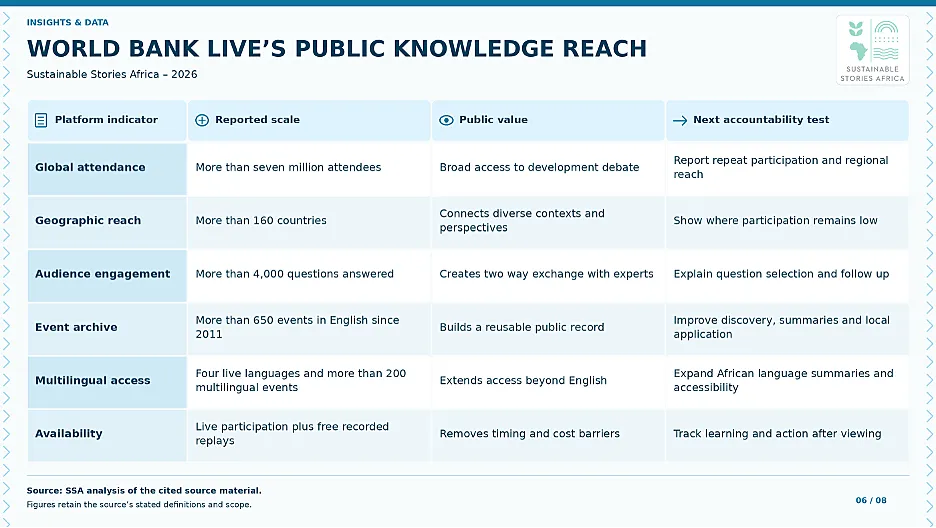
The platform reports more than seven million attendees from over 160 countries and more than 4,000 audience questions answered. Its scale shows the appetite for access, but the real test is whether viewing becomes local understanding, scrutiny and action.
Development Knowledge Moves Beyond Conference Rooms
A policy decision made in Washington, Abuja or Nairobi can affect jobs, debt, food prices and public services far from the room where it is discussed. However, the evidence and arguments behind those decisions have often remained difficult for citizens to access.
World Bank Live is designed to narrow that distance.
- The World Bank describes it as a global livestreaming platform for public discussions, report launches and expert question sessions on major development challenges. Events can be watched live or replayed for free.
The platform matters because access to development knowledge is part of accountability.
- When research is translated into public conversation, journalists, students, officials, businesses and citizens can compare expert claims with lived realities.
- Digital reach does not guarantee participation, but it lowers one important barrier.
Seven Million Attendees Signal Demand for Access
World Bank Live reports more than seven million global attendees from over 160 countries and more than 4,000 audience questions answered.
- It hosts events in English, Spanish, French and Arabic, bringing some of the world’s largest development debates to a multilingual audience.
The archive is also significant.
- Topic pages say the platform has hosted more than 650 events in English since 2011, with more than 200 available in at least one additional language.
- This turns a one-hour event into a reusable knowledge asset that can support classrooms, newsrooms and policy work long after the livestream ends.
For Africa, where travel budgets and access to global institutions remain uneven, the opportunity to hear an author of a report, a policymaker or a practitioner has a direct practical value.
- A local participant can challenge assumptions, ask how a proposal applies to an informal economy or compare regional experience without attending an international conference.
Live Events Combine Evidence, Questions and Replay
The platform combines three functions.
- It distributes evidence through report launches and expert discussion.
- It invites participation through questions and polls.
- It preserves the exchange through on-demand replay and related learning resources.
That structure helps address a weakness in development communication.
Reports may contain strong data but attract a narrow readership.
- Live conversation can surface the meaning behind a statistic, expose disagreement and show how practitioners expect an idea to work.
- Replays then allow the material to travel beyond the original audience.
Numbers alone cannot show whose voice was heard.
- Seven million attendees may include repeat visitors, and 4,000 answered questions are a small share of total participation.
- Strong public engagement therefore requires disaggregated reporting, accessible formats and transparent editorial choices.
Open Dialogue Can Strengthen Development Accountability
Used well, a livestream can make an institution more legible.
- Audiences can hear the assumptions behind a forecast, understand trade-offs in a reform and identify what evidence is missing.
- Journalists can question claims.
- Officials can learn from comparable countries.
- Civil society can use the record to follow commitments.
The archive can also support continuity.
- Development debates often reset when a conference ends or personnel change.
- Recorded sessions preserve what leaders promised and what experts advised, allowing later outcomes to be compared with earlier statements.
For students and emerging professionals, free access widens the pool of people able to learn from global expertise.
The benefit grows when videos are paired with transcripts, datasets, short summaries and links to source reports.
Access Must Become Useful Beyond the Broadcast
World Bank Live and similar platforms should publish more detailed engagement data by region, language, topic and accessibility format.
- They should make transcripts searchable, provide concise evidence notes and link each major claim to underlying data.
- Speakers should return to explain what changed after a launch.
African institutions can adapt the model.
- Ministries, development banks and regulators should stream major policy discussions, accept public questions and maintain searchable archives.
- Universities and media organisations can translate sessions into local explainers rather than merely repost links.
Citizens also need routes from information to participation.
- Event pages can point to consultations, datasets, project documents and complaint or feedback mechanisms.
- The objective is not a larger audience for its own sake.
- It is a better-informed public able to act on development choices.
Path Forward – Turn Viewing Into Local Action
World Bank Live has demonstrated global demand for open, multilingual development conversation. Its next measure of value is what audiences can do with the knowledge.
Searchable transcripts, stronger regional data, local language access and clear follow-up routes can turn a broadcast platform into durable public infrastructure for learning, scrutiny and action.