West Africa’s smaller growth companies are frequently too established for grants and too constrained for conventional finance.
Tracy Boswell, President of Pangea Global Ventures, calls this the missing middle and frames the capital gap as a question of justice.
From cashew processing in Sierra Leone to solar cooling in Ghana, her examples show how patient investment can improve productivity, reduce food loss and give women-led businesses room to scale.
Justice Means Financing Businesses Beyond Grants
A promising company can spend years moving from one grant application to another without building the balance sheet, systems or investor relationships needed for scale
In West Africa, that financing trap affects businesses that already employ people, buy from farmers and solve climate-related problems.
Tracy Boswell, President of Pangea Global Ventures, describes these firms as the missing middle. Pangea was established in 2019 and works entirely in West Africa, supporting small and medium businesses to move toward investment rather than permanent dependence on grants.
In an interview with Africa’s Green Economy Summit, Boswell said justice inspired the firm’s work. The concept is economic as well as moral: enterprises with viable products and development impact should have a fair route to capital, including in frontier markets that receive less investor attention.
West Africa’s Growth Engine Remains Capital Starved
Small and medium enterprises are commonly described as the engine of an economy; however, many cannot meet the collateral, documentation or ticket-size requirements of commercial lenders and impact investors.
Boswell said local capital is especially hard to secure, while parts of West Africa receive less impact investment than better-known markets elsewhere on the continent.
The shortage is not limited to technology start-ups. Pangea began in agriculture and now works across mobility, waste, circular economy, water and sanitation.
These are sectors where climate impact is created through ordinary operating assets: better seed, efficient processing, solar irrigation, cold storage and diversified crops.
Carbon markets can attract attention, but Boswell warned against treating them as the only form of climate finance.
- Smaller firms often lack the technical and financial resources to participate.
- Their contribution may instead appear in avoided food loss, cleaner energy, resilient farms or better water systems.
Three Enterprises Show What Patient Capital Unlocks
Boswell offered three examples.
- Nianda in Sierra Leone is a woman-led cashew processor that buys from smallholder farmers, uses multiple parts of the crop and supports surrounding communities with training and employment.
- Mariseth Farms in Ghana has grown a network of about 10,000 smallholder farmers across soybean, shea nut and palm oil value chains.
- Eden Tree, a female-owned fruit and vegetable distributor in Ghana with a 30-year operating history, has used solar cooling and irrigation to support productivity and reduce food loss.
Pangea helped it secure expansion funding after showcasing the business at the summit.
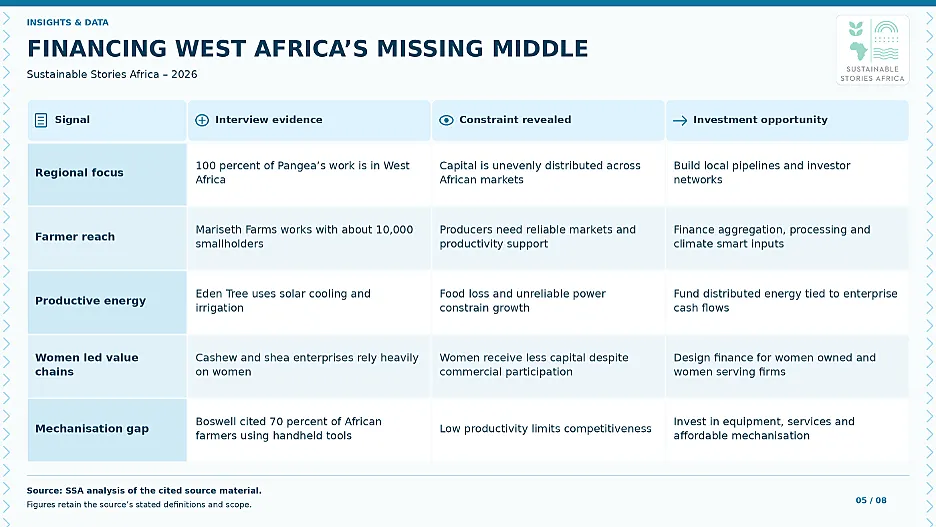
These cases show why investment readiness and capital design must develop together.
- A company may need governance, financial reporting and strategy support.
- An investor may need blended finance, guarantees or local market insight.
The missing middle is not solved by demanding that one side adapt alone.
Women-Led Investment Can Multiply Development Returns
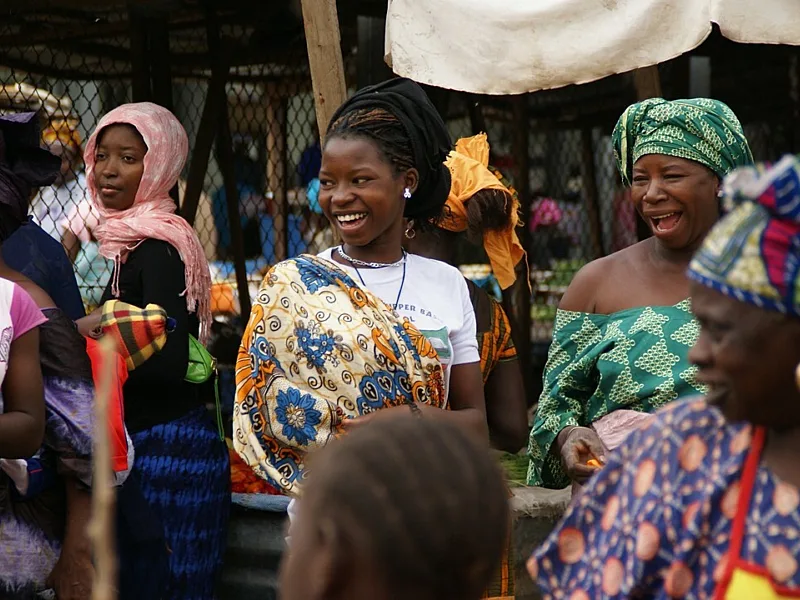
Boswell urged investors to back businesses both for women and by women.
- Products serving women can open neglected markets
- Women-led firms bring established participation in value chains such as shea and food processing into the investment pipeline.
She also cited research showing women are more likely to repay loans and investments.
The precise result varies by product and market, but the policy implication is clear: excluding women is not a prudent risk strategy.
- It can mean overlooking commercially capable borrowers and investees.
Capital directed toward productive assets can generate layered returns.
- Solar cooling reduces spoilage and emissions.
- Irrigation improves consistency.
- Processing creates local value.
- Stronger enterprises buy from more farmers, hire more workers and become better candidates for follow-on finance.
Finance Must Reach the Missing Middle Directly
Local banks should develop cash flow-based lending and sector expertise for agriculture and climate businesses, while regulators expand movable collateral systems and credit information.
Impact investors should reduce unnecessary transaction costs through shared due diligence, standard documentation and local partnerships.
Fund managers and development institutions can use guarantees or first-loss capital where risk is genuinely higher, but support should build a path toward commercial finance.
Grants remain useful for early experimentation, technical assistance and public goods. They should not become a ceiling for companies ready to invest and grow.
Platforms such as Africa’s Green Economy Summit can contribute by presenting screened businesses to investors and tracking whether introductions become closed transactions.
The Eden Tree deal suggests that visibility matters most when it is connected to preparation, capital and follow-through.
Path Forward – Build Investable Pipelines With Trust
West Africa needs financing systems that recognise established SMEs as investable development infrastructure, not perpetual grant recipients.
The practical agenda is stronger governance, local due diligence, fit-for-purpose debt and equity, and targeted risk sharing.
Capital should reach women-led firms and frontier markets where productive assets can create jobs, resilience and measurable climate value.