Africa’s green transition will be incomplete if women participate only as consumers, employees or ceremonial beneficiaries.
Yolanda Mabuto, founder and managing director of Divaine Growth Solutions, argues that women must become architects of the new economy.
Her company’s work across solar, storage and electric mobility shows how inclusion becomes tangible: through contracts, capital, procurement, technical skills and partnerships that move beyond signatures into projects with measurable impact.
Green Growth Needs More Women Building
The energy transition is often presented as a race to install technology. Yolanda Mabuto sees a broader transformation: who owns the companies, builds the infrastructure, receives the contracts and develops the skills that will shape Africa’s next industrial system.
Mabuto is the founder and managing director of Divaine Growth Solutions, a renewable energy company operating across Southern Africa.
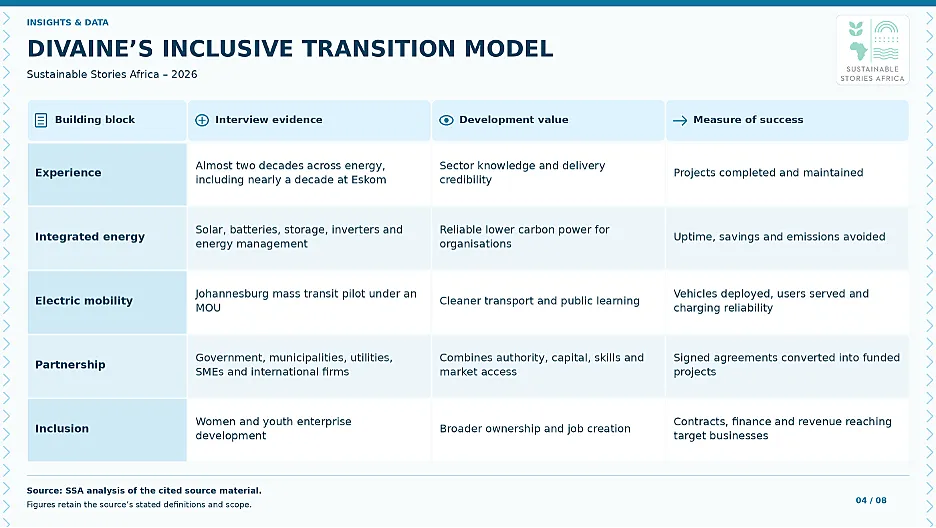
In an interview with Africa’s Green Economy Summit, she described a portfolio spanning solar photovoltaic systems, batteries, energy storage, inverters, energy management and electric mobility.
Her message is direct.
- Women should not remain beneficiaries of the green economy.
- They should design it.
That requires an ecosystem in which women and young people can access finance, procurement opportunities, technology, mentors, partners and markets.
Technology Alone Cannot Deliver a Just Transition
Mabuto has worked across energy for almost two decades, including nearly a decade at Eskom and experience with international energy organisations.
She founded Divaine to provide practical answers to the reliability and sustainability challenges that organisations in South Africa and beyond face.
The company’s approach starts with the client’s operating reality.
- A manufacturer or transport company cannot treat an energy project as a collection of solar panels
- Each site has a load profile, uptime requirement, maintenance burden and financial case.
- Transition plans must therefore combine engineering, digital monitoring and long-term asset management.
These systems also widen the meaning of a just transition.
- Cleaner power must support profitability, jobs, skills and domestic value chains.
- If equipment is imported while African businesses remain peripheral, the continent may decarbonise parts of its economy without capturing enough industrial value.
Divaine Builds Integrated Projects Across South Africa
Mabuto described work with manufacturing and automotive businesses, including a major international car rental company with sites across several South African provinces.
The assignment involves moving operations toward cleaner energy while assessing each location and supporting monitoring and maintenance.
Divaine also has a memorandum of understanding with the City of Johannesburg for an electric bus mass transit pilot, she said.
Public transport matters because it gives citizens direct experience of cleaner mobility and creates a practical setting for charging infrastructure, operational learning and public confidence.
The South African Renewable Energy Master Plan provides a policy backdrop for localisation and industrial development.
Mabuto argued that partnerships with foreign companies should be balanced by stronger collaboration among African organisations so that skills, suppliers and value chains are built on the continent.
Women-Led Enterprise Expands Transition Benefits
When women-owned businesses win credible contracts, the effect can spread through families, suppliers and communities.
Ownership creates income, decision-making power and the ability to open doors for another generation. It also changes which problems are prioritised and how products are designed.
Mabuto’s distinction between celebration and participation is important.
- Women’s Month may increase visibility, but the lasting indicators are contracts awarded, capital deployed, suppliers developed, and leaders represented in boardrooms and public institutions.
An inclusive transition can also improve competitiveness.
- South Africa needs new technical capacity as solar, storage, electric mobility and green hydrogen grow.
- Excluding capable entrepreneurs narrows the supplier base at the moment the economy needs more solutions.
Partnerships Must Produce Projects, Skills and Markets
Government should make procurement pipelines visible and accessible to qualified women- and youth-led enterprises.
Large companies should move beyond supplier registration toward paid pilots, subcontracting, mentorship and clear routes to scale.
Financial institutions need products that reflect the cash flows and asset profiles of energy service companies.
Training must connect directly to demand.
- Electric mobility programmes need technicians, charging specialists, fleet managers and data skills.
- Solar and storage projects need design, installation, maintenance and commercial expertise.
- Partnerships should publish outputs, including jobs, certifications, contracts, local content and capital mobilised.
Entrepreneurs also have agency.
- Mabuto urged women to show up, raise their hands, serve and build the record that prepares them for leadership.
Inclusion policy works best when it meets businesses that are technically credible, commercially ready and willing to collaborate.
Path Forward – Make Inclusion an Everyday System
Africa’s green economy should be measured by who builds and owns it, not only by installed megawatts or vehicles deployed.
The next step is to convert partnerships into financed projects, supplier contracts, skills and market access.
Women must have everyday routes into leadership and ownership so the transition produces cleaner infrastructure and shared prosperity together.