
Nigeria is becoming more credible to aircraft lessors just as new taxes make transactions more expensive.
The 2026 Chambers Aviation Finance and Leasing guide records stronger Cape Town Convention compliance, clearer aircraft recovery procedures and plans for a national leasing company.
It also warns that lost tax exemptions, higher capital gains tax and tighter insurance rules could weaken those gains.
The policy challenge is to make legal predictability and fiscal competitiveness reinforce each other.
Creditor Confidence Meets Tougher Aviation Taxes
Aircraft finance depends on confidence in two things:
- The airline’s ability to pay
- The legal system’s ability to protect an expensive mobile asset when it cannot.
Nigeria improved the second part in 2026; however, changes to tax and insurance rules may increase the cost of the first.
That tension runs through the Nigeria chapter of Aviation: Finance & Leasing 2026, published by Chambers Global Practice Guides and contributed by Streamsowers & Köhn.
The guide says reforms have improved creditor protections, enforcement predictability and Nigeria’s standing in the international leasing market.
At the same time, the Nigeria Tax Act 2025, which became effective on January 1, 2026, removed several historic exemptions for commercial aircraft, engines, parts and airline transport services.
- For an industry exposed to foreign exchange volatility and high operating costs, regulatory progress can be diluted quickly by transaction expenses.
Compliance Gains Improve Nigeria’s Leasing Proposition
Nigeria’s Cape Town Convention Compliance Index score rose from 70.5% to 75.5% in 2026, according to the guide.
- The improvement led to removal from the Aviation Working Group’s non-compliant watchlist and movement into a higher compliance category.
The Cape Town Convention matters because international lessors and lenders need confidence that their interests can be recorded and aircraft recovered predictably.
Nigeria’s 2024 Federal High Court Practice Directions and the Nigerian Civil Aviation Authority’s recognition of Irrevocable Deregistration and Export Request Authorisations have strengthened that framework.
Where an IDERA was filed with the lease registration, the guide says a lessor can request deregistration and export without first obtaining a court order.
This reduces uncertainty, though execution still depends on complete documentation, payment of charges and effective administration.
Tax and Insurance Reforms Reset Transaction Economics
The stronger legal environment now meets a changed fiscal one.
- The guide says previous value-added tax and customs concessions are no longer applicable to commercial aircraft and related equipment.
- Corporate capital gains tax rose from 10% to 30%, except for qualifying small companies.
- Dutiable instruments generally must be stamped within 30 days.
The Nigerian Insurance Industry Reform Act 2025 also gives aviation insurance a dedicated statutory framework.
- Local insurance and reinsurance capacity must be exhausted before risk is placed offshore, with approval available where the domestic market cannot accommodate exceptional exposure.
- The objective is stronger local capacity and oversight, but high-value aviation risk still requires access to global reinsurance.
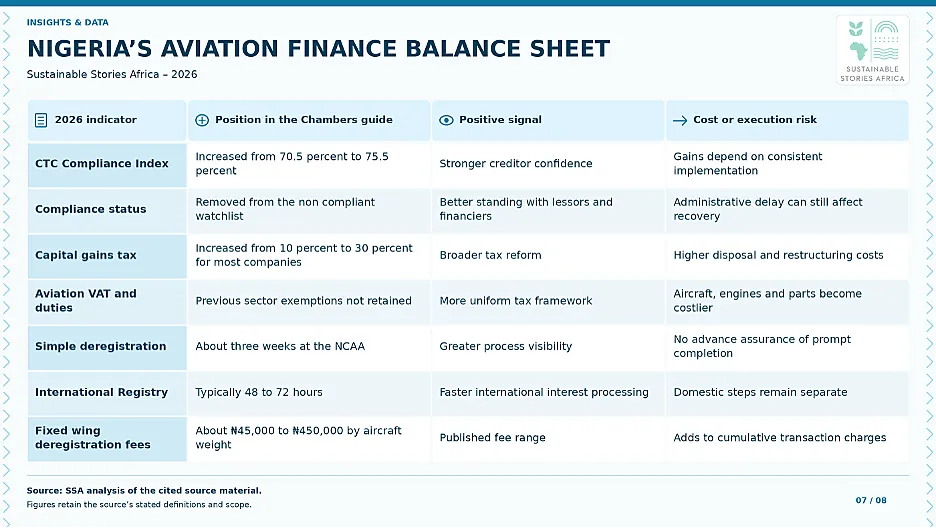
The central concern is cumulative.
- A single fee may be manageable, but VAT, import duties, insurance requirements, capital gains exposure, currency costs and legal processing can compound across a lease or acquisition.
Local Leasing Structures Could Modernise Airline Fleets
The Federal Executive Council has approved a national aircraft leasing company structured as a private sector-driven special purpose vehicle with government backing, the guide says.
A central leasing platform could give domestic airlines access to modern fleets without requiring outright purchases or separate negotiations with international lessors.
Local financing partnerships are also emerging.
- At the inaugural Nigeria Aircraft Acquisition and Investment Summit in Lagos in April 2026, a structured arrangement involving Aircraft Finance Germany and Fidelity Bank illustrated how international technical expertise and domestic capital could work together.
If these structures are credible, they can reduce fleet age, improve fuel efficiency and support safer, more reliable operations.
- The development benefit extends to tourism, trade and regional connectivity.
However, a government-backed platform must have transparent governance, commercial discipline and clear risk allocation to avoid becoming another source of contingent public liabilities.
Policy Alignment Must Protect Reform Momentum
The aviation, finance, tax and insurance authorities should assess the combined cost of the new framework rather than evaluate each measure in isolation.
- A transparent impact study can show whether lost concessions reduce aircraft availability, increase ticket prices or discourage fleet renewal.
The NCAA should publish service standards for IDERA recording, deregistration and export, together with performance data.
Courts should continue to apply practice directions consistently in the application.
Insurers and NAICOM should create predictable routes for offshore reinsurance when domestic capacity is insufficient.
The national leasing company should disclose ownership, funding, procurement, pricing, asset-recovery protections and exposure to government guarantees before committing public support.
Investors need a structure commercially robust, rather than merely nationally branded.
Path Forward – Make Predictability the Market Advantage
Nigeria has improved the legal foundation for aircraft finance. It must now prevent tax, insurance and administrative costs from eroding that credibility.
Clear service standards, coordinated fiscal review and transparent leasing structures can make predictability Nigeria’s advantage.
Reform will be judged by whether airlines can access safer aircraft at sustainable cost while creditors recover assets through reliable rules.