Nigeria’s solar market is expanding, but renewable hardware alone will not deliver reliable power to millions of customers.
In an interview with Africa’s Green Economy Summit, Ikeja Electric’s Babatunde Osadare argued that modern utilities, smart meters and stronger distribution networks remain essential. His data points show why: high metering density has improved visibility, while an intelligent data box pilot cut losses on some feeders from about 40% to 10%.
Nigeria’s Renewable Boom Meets Grid Reality
Solar panels are becoming more visible on Nigerian roofs, warehouses and business premises. However, the electricity transition will be decided as much by the wires, meters and data systems beneath them as by the panels themselves.
That is the argument made by Babatunde Osadare, Chief Legal and Regulatory Officer at Ikeja Electric, in an interview with Africa’s Green Economy Summit. He described traditional distribution utilities as the last-mile institutions that must connect a growing mix of grid power, mini-grids, and customer-owned renewable systems.
For Nigeria, the issue is urgent.
- Energy demand exceeds reliable supply; private consumers are investing in alternatives, and multilateral initiatives such as Mission 300 are seeking to expand electricity access across Africa.
- The grid cannot remain a one-way delivery system while the market around it becomes decentralised and digital.
Solar Demand Is Racing Ahead of Infrastructure
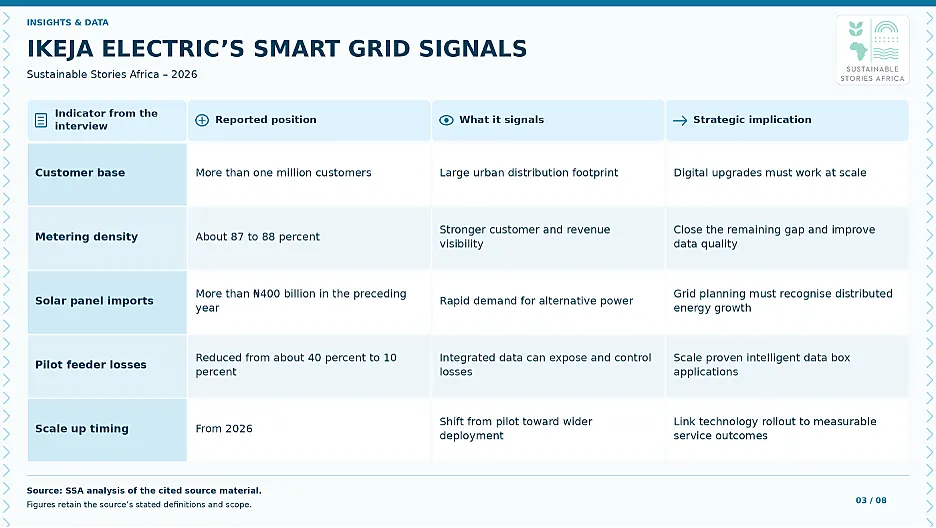
Osadare said Nigeria imported more than N400 billion worth of solar panels in 2025. The figure, presented in the interview, signals both appetite and frustration: households and businesses are spending heavily to secure power outside conventional supply.
However, disconnected systems can reproduce inequality.
- Customers able to finance solar and batteries gain resilience, while lower-income users remain dependent on weak networks.
- The distribution utility therefore has a continuing public and commercial role, particularly where renewable projects need to interconnect and deliver energy across a wider customer base.
Ikeja Electric serves more than one million customers in parts of Lagos, according to Osadare. At that scale, metering is not simply a billing project.
- It is the information layer for energy accounting, revenue assurance, loss detection and future two-way flows between customers and the grid.
Metering Data Exposes Losses and Builds Trust
Osadare said Ikeja Electric’s metering density is about 87% to 88%, and said the company hoped to close the remaining gap. Smart meters can show customers what they use and give the utility better visibility from grid injection to the final connection.
The interview also highlighted the limits of installing meters without cleaning the network and linking data across the system.
- Theft, technical losses, inaccurate customer records and weak feeder visibility can persist even where individual premises have meters.
- The operational question is whether the utility can follow each unit of energy end to end.
The intelligent data box pilot is the most consequential example.
- Osadare said it helped reduce losses on some feeders from as high as 40% to 10%.
- A 30 percentage-point reduction would materially improve revenue recovery and free energy that would otherwise disappear from the accountable system.
The claim will need continued public reporting as the programme scales.
Smart Networks Can Connect Cleaner Distributed Power
A modern distribution network can do more than collect bills.
- It can support interconnected mini-grids, identify congestion, manage variable supply and eventually allow customers to become producers.
Accurate consumption data can also help households control costs and reduce waste.
- For utilities, lower losses improve the service economics.
- For renewable developers, predictable interconnection reduces project risk.
- For regulators, feeder-level data can reveal whether investments translate into reliability.
- For customers, transparent metering can rebuild trust around the principle of paying for what is actually consumed.
The benefit is systemic.
- When fewer units are lost, more available electricity can reach productive users without waiting for an equivalent increase in generation.
Digitalisation therefore belongs inside the energy transition, not beside it.
Utilities Must Prepare for Two-Way Energy
Distribution companies should publish clearer milestones for metering coverage, loss reduction, service quality and renewable interconnection.
- Pilot results need independent validation and a transparent plan for scale, including procurement, cybersecurity, customer protection and maintenance.
Regulators should create predictable rules for isolated and interconnected mini-grids, embedded generation and customer export.
- Tariffs must recognise network services without punishing households or businesses that invest in cleaner energy.
- Data standards should allow utilities, regulators and developers to work from a consistent view of demand and capacity.
Public finance and development capital can support upgrades that produce measurable access and reliability gains.
- However, technology purchases should not become the objective.
The test is whether smarter assets reduce losses, shorten outages, improve billing confidence and connect more people to dependable power.
Path Forward: Modernise the Last Mile First
Nigeria’s renewable transition needs solar, storage and mini-grids, but it also needs utilities capable of managing them as one system.
Immediate priorities are complete metering, clean network data, transparent loss reporting and workable interconnection rules. If the last mile becomes intelligent, renewable investment can move from private backup power toward broader energy access.