Larry Fink’s 2026 annual letter argues that countries seeking energy, technology and industrial self-reliance will need more long-term capital, and more citizens sharing in the returns.
For African markets, the argument is relevant: financing infrastructure and expanding household wealth cannot depend solely on governments, banks and foreign investors.
Ownership Must Accompany National Economic Growth
In his 2026 annual chairman’s letter, BlackRock chief executive Larry Fink argues that the world is reorganising around self-reliance in energy, defence, technology and manufacturing.
He says that shift is expensive and requires deeper long-term investment through capital markets.
His central proposition is that people should be better able to “grow with” their countries by owning diversified stakes in economic progress.
The argument responds to a global concern that asset owners have captured a disproportionate share of wealth creation.
Long-Term Investing Beats Short-Term Market Noise
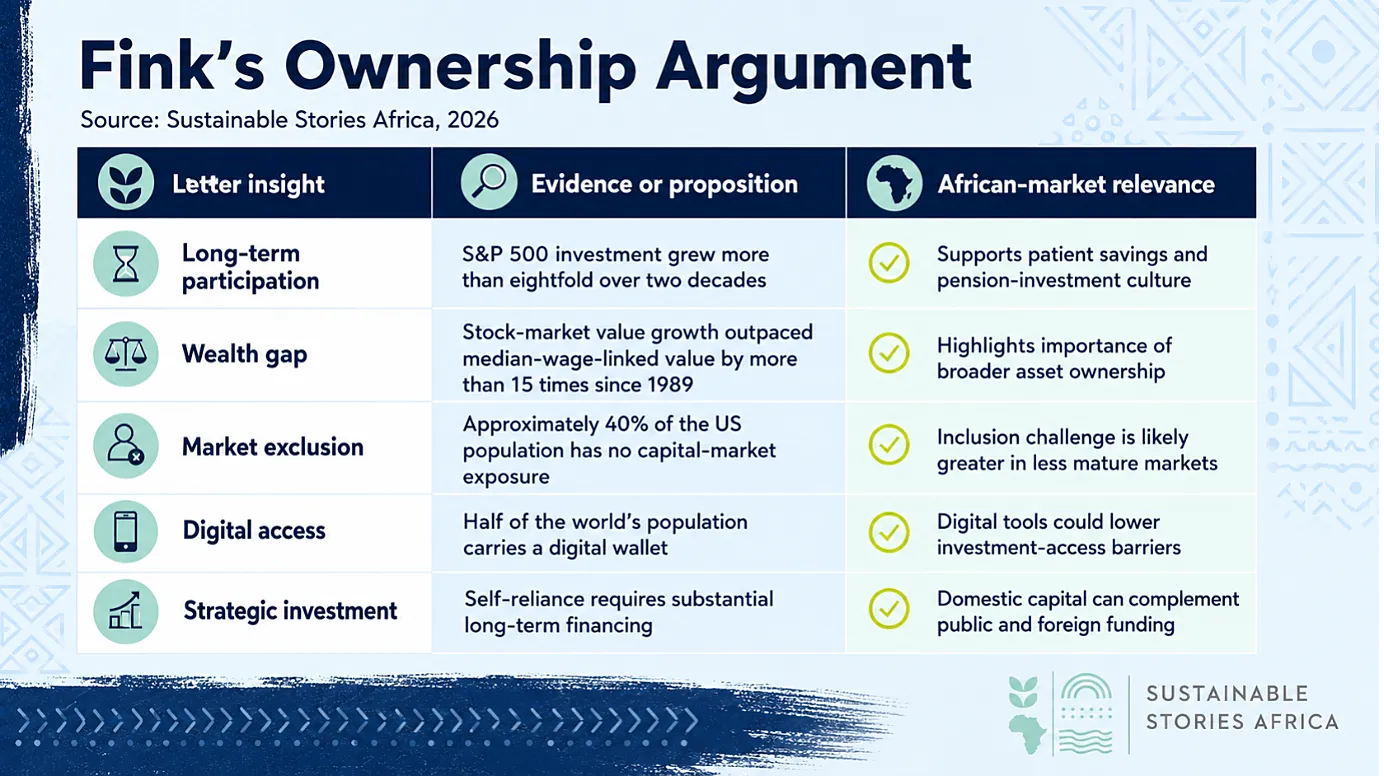
Fink notes that a dollar invested in the S&P 500 over the past two decades grew more than eightfold, while missing the market’s 10 best days would have produced less than half the return.
The point is not that markets are risk-free; rather, long-term participation can matter more than reacting to short-term volatility.
The letter also says a dollar invested in the US stock market since 1989 grew more than 15 times the value of a dollar linked to median wages.
That gap, Fink argues, helps explain why many people feel disconnected from economic growth.
Africa’s Inclusion Challenge Is Distinct
African policymakers cannot simply import the institutional models of wealthier markets.
- Household incomes are lower, informal work is widespread, pension coverage is limited and domestic exchanges can be shallow.
- However, the underlying question remains important: how can local savings help finance local productive assets while ordinary citizens benefit from growth?
The answer requires trusted institutions, low-cost investment products, financial literacy, digital access and strong consumer protection.
It also requires investable pipelines in infrastructure, renewable energy, housing, logistics and growth-oriented businesses.
Digital Finance Could Expand Participation Responsibly
Fink sees digital wallets and tokenisation as potential tools for making investment easier to access and trade.
For African markets, such innovation should be paired with regulation, clear investor disclosures, reliable identity systems and safeguards against fraud and speculative harm.
The priority should not be to turn every saver into a trader.
- It should be to create simple, diversified, affordable routes for households to invest steadily in regulated products linked to long-term economic activity.
Institutions Must Earn Savers’ Trust
Governments, exchanges, pension funds, asset managers and fintech firms should work towards deeper domestic savings and investment systems.
This includes strengthening pension coverage, improving listings and bond markets, supporting collective-investment schemes and increasing transparency around fees and risk.
Path Forward – Makes Ownership More Inclusive
Fink’s letter is a timely reminder that capital formation and economic inclusion should reinforce each other.
Countries can finance strategic investment more sustainably when citizens own part of the growth they help create.
For African markets, that goal begins with trusted financial systems that turn savings into productive domestic investment rather than short-term speculation.