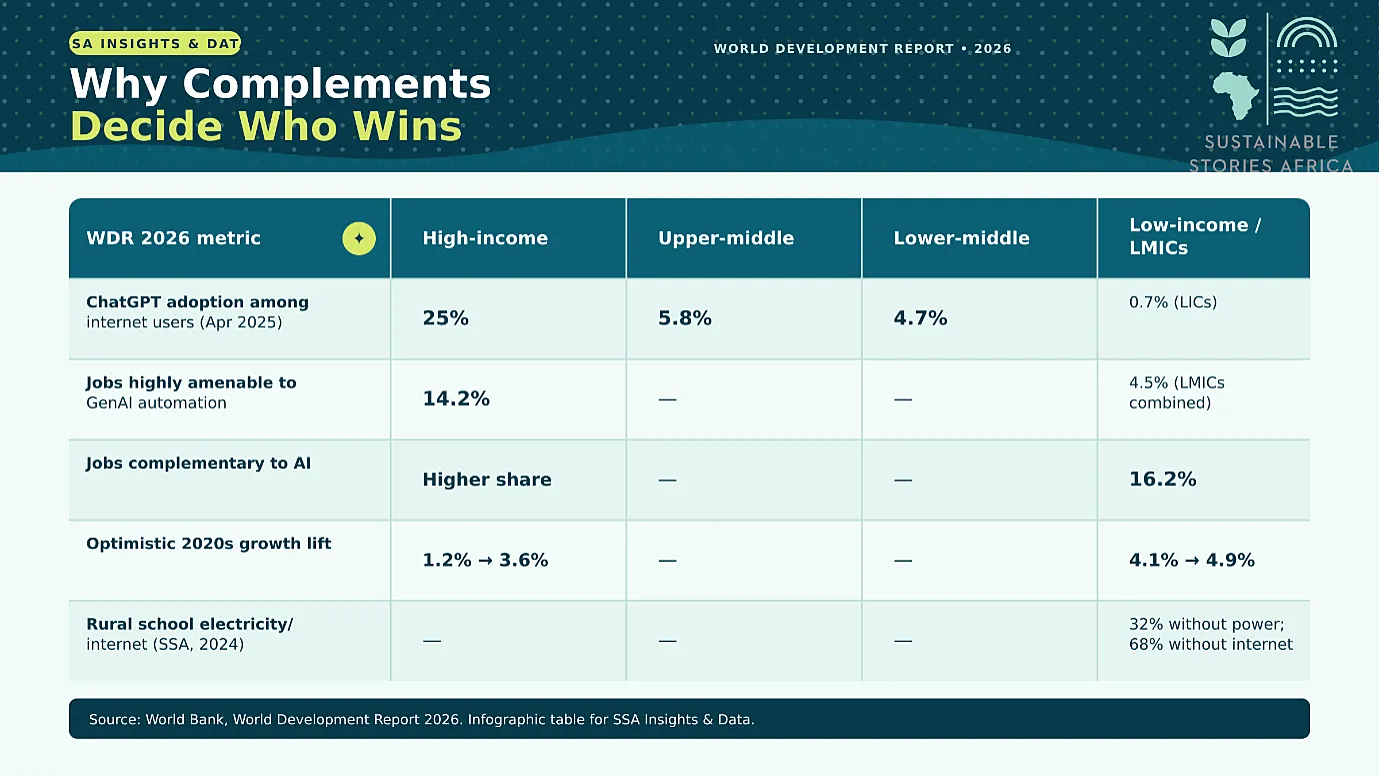
The World Bank’s World Development Report 2026 finds AI spreading faster than steam, electricity or the internet; however, only 0.7% of internet users in low-income countries had adopted ChatGPT by April 2025, compared with nearly 25% in high-income countries.
For Africa, the core question is not whether to build frontier models. It is whether governments, firms and schools can adopt and adapt “small AI” before missing complements lock in a wider productivity divide.
Promise Arrives Faster Than Power
WDR 2026 frames AI as a general-purpose technology whose benefits depend on diffusion plus analogue and digital complements: electricity, connectivity, skills, data, business climate and institutions.
Within six months of ChatGPT’s launch, middle-income countries accounted for half of traffic; by 2025, more than half of the major chatbot users were in developing countries. Intensity still lags.
US AI hyperscalers’ projected 2026 capital expenditure exceeds $750 billion. Larger than many developing-country GDPs.
Most leading listed AI firms sit in the United States or China. Africa’s realistic path is to adopt, then adapt; advancing the frontier is for a handful of well-resourced states.
Why Complements Decide Who Wins
About 4.5% of jobs in low- and middle-income countries are highly amenable to generative-AI automation, versus 14.2% in high-income countries; 16.2% could be complemented.
Displacement is narrower in Africa, but knowledge services that build the middle class are exposed, and online freelance work outsourced to developing countries fell 39% in 2025 on one major platform.
Nearly 90% of workers in low- and lower-middle-income countries are in firms with fewer than 10 people.
Chatbots can get by messaging apps already in use, yet World Bank firm surveys show better-managed, more innovative firms adopt them first.
In Sub-Saharan Africa, 32% of rural schools lacked regular electricity and 68% lacked consistent internet in 2024; 89% of 10-year-olds could not read and understand simple text.
Small AI, Tangible Public Gains
Local adaptation already shows results:
- Nuru diagnosing crop disease offline on phones
- Cough Against TB screening
- Kenya’s PROMPTS maternal chatbot
- Ghana’s Rori maths tutor delivering nearly a year of learning at about $5 per student.
- Africa’s Lelapa AI trained InkubaLM in five African languages.
Open models (Llama, Qwen, DeepSeek, Falcon) let countries customise without billion-dollar training runs.
Without complements, productivity gains could be more than twice as large in advanced economies as in developing countries, with two-thirds of that gap from slower adoption. Energy prices, cyber risk and misaligned medical or legal tools are the downside if systems are imported unadapted.
Practical Moves for African Systems
Governments should treat AI as public-service infrastructure: digitise local-language data, write AI into procurement with safety guardrails, and use AU Continental AI Strategy and AfCFTA Digital Trade Protocol where national scale is thin.
Invest first in electricity, school connectivity and foundational literacy, the binding constraints WDR names.
Firms should start with tools staff already use, then train managers to apply advice.
Educators and health systems can deploy narrow, offline-capable models rather than waiting for hyperscale data centres.
Financiers should fund compute access, start-up adaptation and cyber resilience, not only prestige model-building.
Path Forward – Africa's AI Edge: Adoption, Not Scale
Africa does not need to outspend US hyperscalers. It needs ubiquitous adoption of fit-for-purpose tools, local data and skills, and institutions that keep AI complementary to workers.
If complements move with the technology, small AI can raise farm, clinic and classroom capability. If they do not, the 2026 opportunity becomes another concentrated value chain.