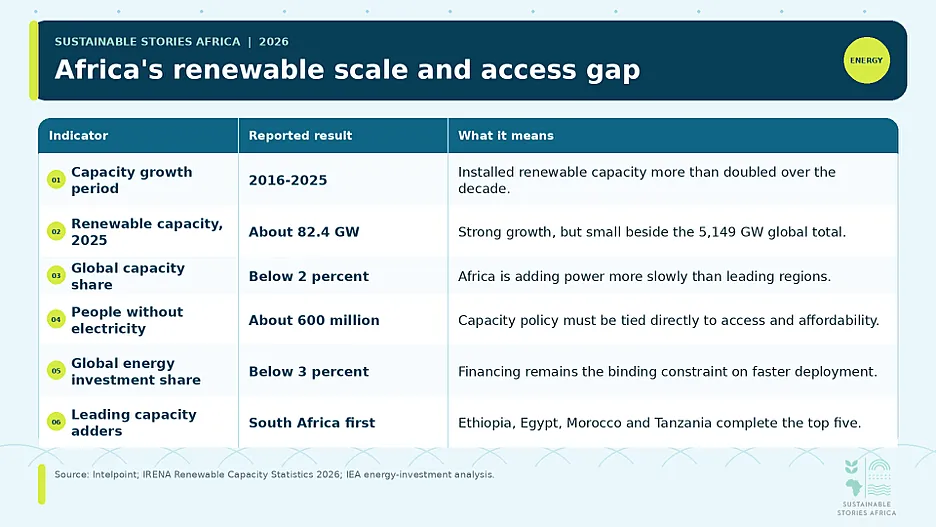
Africa more than doubled renewable power capacity between 2016 and 2025, but its share of global capacity remains below 2%.
With about 600 million Africans still without electricity and the continent receiving less than 3% of global energy investment, the central challenge is no longer proving potential. It is financing scale.
Africa's clean-energy progress remains globally marginal
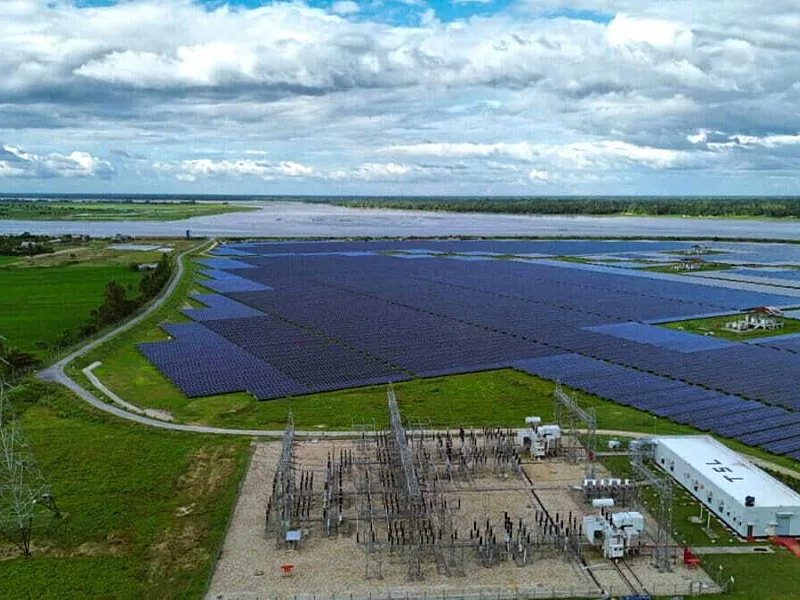
Africa's installed renewable power capacity more than doubled between 2016 and 2025, according to Intelpoint's analysis of International Renewable Energy Agency data.
IRENA's 2026 statistics place the continent's 2025 capacity at about 82.4 gigawatts after a strong annual increase.
However, the global comparison remains stark.
- Africa still holds less than 2% of worldwide renewable capacity, even though it has about one-fifth of the world's population.
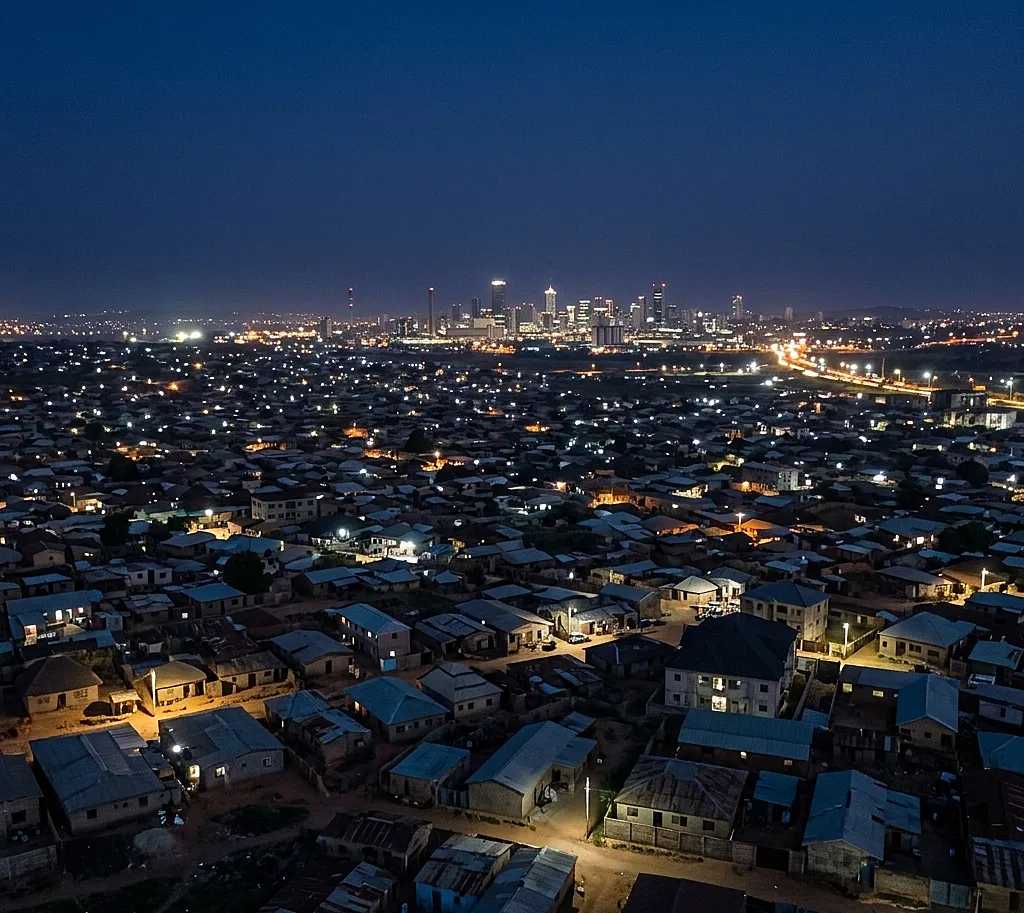
- It also receives less than 3% of global energy investment, while about 600 million Africans live without electricity.
The numbers capture a transition moving in the right direction but at the wrong relative speed. Capacity is rising, but other regions are adding vastly more.
For African governments and investors, the issue is whether scattered progress can become a bankable, grid-ready and inclusive energy system.
Capacity doubled while global distance widened
Doubling capacity in a decade is a real achievement.
- It reflects hydropower development, major solar and wind programmes, growing private procurement and a rapidly expanding distributed-energy market.
- South Africa added the most renewable capacity over 2016 - 2025, followed by Ethiopia, Egypt, Morocco and Tanzania.
However, percentage gains from a low base can mislead.
- Global renewable capacity reached 5,149 gigawatts in 2025, according to IRENA, after 692 gigawatts were added in one year.
- Africa's entire installed stock was only a fraction of that single-year global addition.
The continent is progressing, but it is not yet capturing transition investment at the scale of its population, demand or resource base.
Progress is also geographically concentrated.
- A handful of markets account for much of the continent's large-scale buildout, while many countries add capacity in small increments or depend on ageing hydropower.
- This unevenness raises questions about regional grids, shared project preparation and whether landlocked or fragile markets can access finance on workable terms.
Investment scarcity shapes uneven national progress
The leading-country list shows what enabling conditions can achieve.
- South Africa has used procurement, corporate demand and market reform to build scale.
- Ethiopia and Tanzania draw heavily on hydropower resources.
- Egypt and Morocco have combined policy direction, large projects and international financing to expand solar and wind.
Elsewhere, projects are slowed by weak grids, financially stressed utilities, currency risk, expensive capital, uncertain procurement and lengthy permitting.
- Developers may see strong demand but struggle to secure a creditworthy buyer, a viable tariff or foreign-currency protection.
- Governments, meanwhile, may face limited fiscal space for guarantees or transmission investment.
Electricity access adds another layer.
- Utility-scale generation is essential for industry and cities, but remote and low-income communities may need mini-grids, solar home systems and productive-use finance.
Capacity statistics can therefore rise without automatically delivering affordable, reliable power to the people and businesses that need it most.
The cost of capital can determine whether an excellent resource becomes a viable project.
- High interest rates, short loan tenors and currency mismatch raise tariffs before construction begins.
- Transparent contracts, credible utilities and local-currency instruments are therefore energy infrastructure in financial form: they lower risk and make more technically sound projects affordable to build.
Africa also needs better measurement.
- National statistics should capture utility-scale plants, corporate installations, mini-grids, solar home systems and storage.
- Investors and citizens should be able to see project status, connection timelines, curtailment, reliability and affordability.
- Visibility will not create megawatts by itself, but it will expose bottlenecks and make institutions accountable for delivery.
Regional power pools should be treated as investment platforms, not only technical arrangements.
- Stronger interconnectors and enforceable trading rules can help countries share reserve capacity, absorb variable renewables and create larger markets for projects.
- Cross-border planning must still protect national reliability, but fragmented systems make scale more expensive than it needs to be.
Path Forward – Convert renewable momentum into universal power
Africa has proved that renewable capacity can grow. The next test is whether governments and financiers can build grids, storage, credible markets and local-currency funding quickly enough to turn growth into access.
Success should be measured by reliable connections, productive jobs and lower energy vulnerability, not installed capacity alone.
Scaling investment around those outcomes can move the continent from a small global share to a transition shaped by African demand.