Former ING and UBS chief executive Ralph Hamers argues that transformation succeeds when purpose, culture, strategy and technology operate as one system owned by the chief executive.
His lesson for finance is timely: AI and sustainability cannot remain side programmes.
Both must be measurable, connected to risk and the balance sheet, and governed by human accountability.
AI is testing finance's leadership architecture
Artificial intelligence is arriving in finance while institutions are still managing digital transformation, climate commitments, regulatory scrutiny and public distrust. Ralph Hamers, former group chief executive of ING and UBS, says leaders make a mistake when they treat those pressures as separate programmes.
In an August 2026 OneStop ESG interview, Hamers described transformation as aligning purpose, strategy, customer promise and culture, sustained over years and owned at chief-executive level.
- Technology changes rapidly, he argued, but the reason an institution exists should provide continuity.
That view matters for African and emerging-market financial institutions.
- They face intense pressure to digitise and use AI, while widening access, protecting customers and financing economic transition.
- The leadership challenge is not only adoption.
- It is deciding what technology should achieve, what it must never be allowed to do and who remains accountable when systems fail.
Transformation fails when purpose becomes decoration
Hamers' central message is simple: transformation is not mainly a technology project.
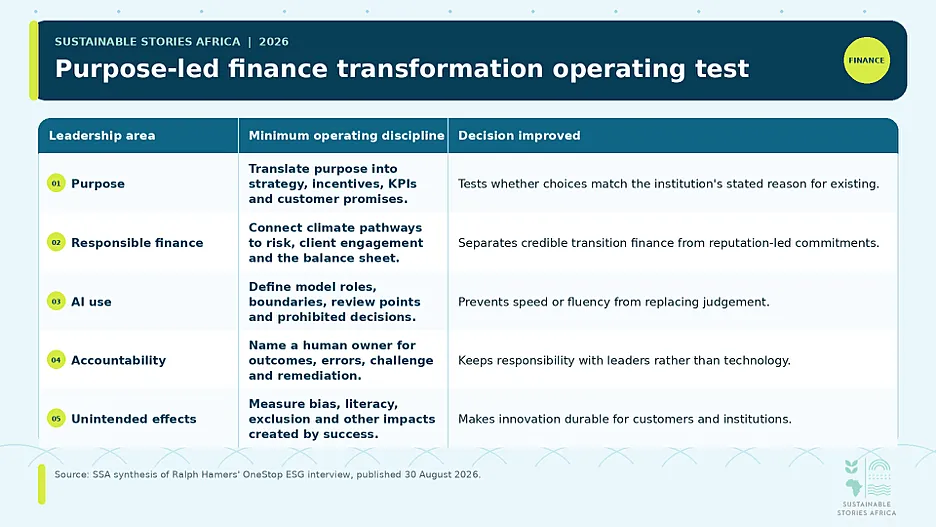
- At ING, purpose was translated into strategy, performance indicators, operating plans and expected behaviours.
- The test was whether incentives and decisions matched the promise made to customers, especially when short-term earnings pressure made consistency expensive.
This is an important governance distinction.
- A purpose statement that sits in communications material has little operational value.
- A purpose that influences credit appetite, product design, executive incentives, data use and customer treatment becomes a decision framework.
- It gives boards a basis for challenging whether AI or sustainability initiatives serve the institution's stated role.
The hard quarter is where that framework proves its worth.
- Leaders may have to delay a profitable use case, invest before returns are certain or turn down business that contradicts risk and customer commitments.
- Consistency creates trust because employees and clients can predict how the institution will behave when stated values become costly.
Climate commitments need firm balance-sheet ownership
Hamers linked responsible finance to the same operating logic.
- Under his leadership, ING developed the Terra approach to assess and steer parts of its lending portfolio toward the Paris climate goals.
- The lesson was not that banks should make ambitious announcements, but that climate must be treated as a measurable financial and client-transition issue.
He argued that durable sustainability is anchored in purpose and risk, assigned to accountable leaders and connected to how the business makes money. Engagement with high-carbon clients can be more consequential than simply excluding them, provided the bank uses science-based pathways, credible milestones and clear escalation when progress fails.
For African banks, this approach must reflect local realities.
- Many clients operate in energy-constrained economies and need finance to improve efficiency, expand access and transition over time.
- Responsible finance should distinguish between enabling a credible transition and preserving harmful activity without conditions.
That requires sector pathways, client data and governance strong enough to manage difficult trade-offs.
A portfolio method also exposes data limitations rather than hiding them.
- Banks need to state which sectors are covered, what assumptions they use and how they treat missing information.
- That transparency allows investors and regulators to distinguish measurable progress from selective reporting, while giving clients a clearer view of what evidence is required for transition finance.
Accountable AI can strengthen customer trust
AI can remove friction, improve fraud detection, expand service availability and help staff make better-informed decisions.
- In markets where branch networks are limited, responsible automation can lower service costs and bring more customers into formal finance.
- It can also help institutions process climate and customer data that would otherwise remain fragmented.
The benefits depend on boundaries.
- Hamers warned against mistaking fluent outputs for judgement.
- Institutions need to define the role of each model or agent, the point at which it must stop and the response when it is confidently wrong.
- Human accountability cannot be delegated to software, especially for credit, insurance, investment, employment or customer-remediation decisions.
Used responsibly, AI could help relationship managers test transition plans, identify customers at risk of exclusion and translate complex financial information into accessible language.
Those benefits require representative data, documented model limits and monitoring after deployment. A system that performs well on average can still harm specific communities if errors are concentrated.
Boards must govern one transformation system
Boards and executive teams should begin with a single transformation map connecting purpose, strategy, culture, AI, data and sustainability.
- Each major use case should have an owner, measurable value, customer-impact assessment, risk limits, human-review points and a process for challenge and appeal.
Climate commitments should be treated with the same discipline.
- Banks need financed-emissions baselines where data permits, sector-specific pathways, client-engagement milestones and transparent reporting on progress and limitations.
- Executive incentives should reward durable outcomes rather than announcements or short-term portfolio optics.
Leaders should also examine the negative side effects of success.
- Digital convenience can weaken financial literacy; automated decisions can reproduce bias; rapid scaling can reduce opportunities for human judgement.
- Institutions should measure those effects, invest in customer education, audit models and maintain accessible human channels for high-impact decisions and complaints.
Regulators can reinforce this discipline by requiring impact-based controls rather than treating every model alike.
- High-stakes uses need stronger validation, explanation, record-keeping, and appeal. Supervisors should also examine third-party concentration and data governance, because outsourcing a model or cloud service does not outsource the board's responsibility for customer outcomes.
Path Forward – Lead with purpose and retain accountability
Finance leaders should treat AI, culture and sustainability as a single governance question:
- What is the institution for
- Do its systems consistently serve that purpose?
- Clear boundaries and measurable accountability are now strategic necessities.
The path forward combines bold adoption with disciplined control. Use AI to improve service, climate finance to support credible transition and human judgement to protect trust. Purpose must guide all three when pressure rises.