Africa produced a record 44.8 million tonnes of rice in 2024, with Nigeria, Egypt and Madagascar accounting for almost half of the harvest.
The numbers signal meaningful production progress, but they also sharpen a harder question: can higher output become reliable, affordable food for households facing climate, processing and market pressures?
Africa's rice record masks deeper gaps
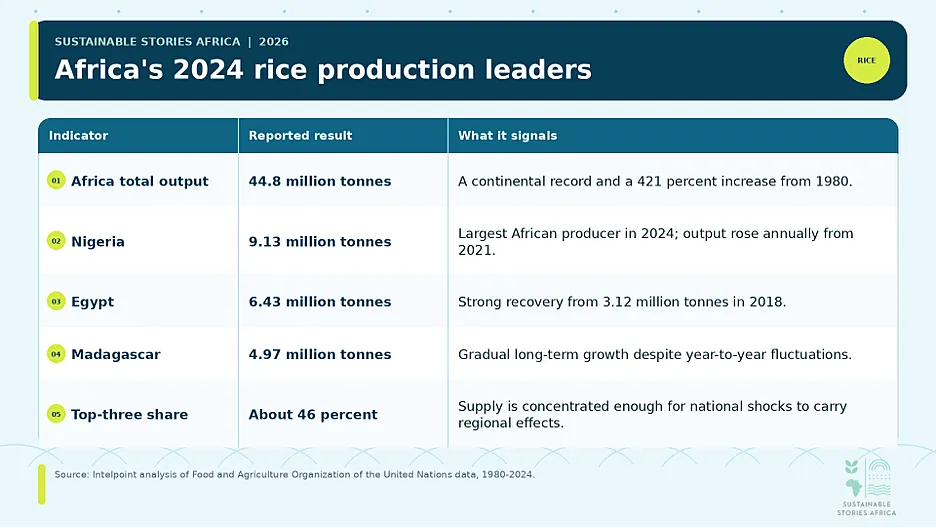
Africa's rice harvest reached 44.8 million tonnes in 2024, the highest level in the dataset reviewed by Intelpoint and 421% above the continent's 1980 output.
Nigeria led the three largest producers with 9.13 million tonnes, followed by Egypt at 6.43 million tonnes and Madagascar at 4.97 million tonnes.
- Together, those three countries supplied roughly 46% of Africa's total rice production.
- Nigeria's output has risen every year since 2021
- Egypt has rebuilt from a sharp 2018 low.
- Madagascar has recorded a steadier, more uneven long-term expansion.
For policymakers, the result is both an achievement and a warning.
- Production matters, but food security depends on what happens after harvest: storage, milling, transport, trade, household purchasing power and resilience to droughts, floods and conflict.
A record crop is therefore a starting point, not the final measure of success.
Three producers anchor the continental harvest
Nigeria's 2024 output was its strongest since 2021 and confirms the country's place at the centre of Africa's rice economy. However, scale alone should not obscure the regional pattern.
Egypt and Madagascar together produced 11.4 million tonnes, more than Nigeria's total, showing that continental supply rests on several production systems with different water, climate and market conditions.
The concentration is strategically important.
- When nearly half of output comes from three countries, policy or weather shocks in those markets can affect regional availability.
- It also means that successful improvements in seed quality, irrigation, mechanisation, farmer finance and post-harvest systems in a few leading producers can create benefits well beyond their borders.
That concentration should encourage coordination rather than competition built only around national rankings.
Leading producers can share research on resilient varieties, pest surveillance, water management and price information, while regional institutions monitor whether harvest gains are reaching deficit markets.
A production leader becomes more valuable when its growth strengthens the wider food system.
Growth paths reveal different production strengths
The headline record contains three different stories.
- Nigeria's recent pattern is a single consistent annual growth from 2021 to 2024.
- Egypt's output, historically much higher in the 2000s, fell to 3.12 million tonnes in 2018 before recovering to 6.43 million tonnes in 2024.
- Madagascar's production reached 4.97 million tonnes after a more gradual rise marked by fluctuations.
These trajectories matter because they point to different policy questions.
- Nigeria must protect recent momentum while improving productivity and market efficiency.
- Egypt's rebound highlights the value of restoring production systems after decline, but also the risks of water dependence in a climate-stressed region.
- Madagascar's experience underscores the importance of rural infrastructure and resilience for smallholder-led supply.
Across all three, output data should sit alongside yield, farm income, consumer prices and loss rates.
- Tonnes harvested can rise while farmers remain exposed to expensive inputs or weak routes to market.
- Consumers can also face high prices when transport, storage and milling costs prevent supply gains from moving efficiently through the food system.
The 421% increase since 1980 also reflects population growth, changing diets and the spread of rice into everyday consumption. That makes demand a moving target.
Africa can produce more each year and still experience supply pressure if productivity, processing and distribution do not keep pace with urbanisation and household preference for conveniently prepared staples.
Finally, rice strategy must be climate- and nutrition-conscious.
- Water efficiency, flood and drought planning, resilient seed systems and soil management should sit beside production targets.
- Regional trade should remain open enough to move supply from surplus to deficit markets, with transparent standards that protect quality without creating unnecessary barriers.
Public procurement can reinforce these reforms if it rewards verified quality and dependable delivery rather than political access.
- School feeding, emergency reserves and other institutional demand can give farmers and processors predictable markets, but contracts should be competitive, payments timely and stock management transparent.
Otherwise, procurement can create arrears, waste and incentives to inflate production claims.
Path Forward – Turn record harvests into lasting security
Africa's rice record should now be measured by affordability, resilience and farmer value, not tonnes alone.
Nigeria, Egypt and Madagascar can lead by publishing fuller value-chain data and investing beyond the farm gate.
The path forward is practical: protect yields, reduce losses, finance processing, modernise logistics and keep regional markets connected.
That is how a production milestone becomes durable food security and inclusive rural growth.