
FinPolNomics reframes the audit report as the start of action, not the end of a compliance cycle, demanding that evidence, root-cause analysis, risk scoring and executive communication connect into one continuous loop.
For African banks, energy firms, NGOs and public institutions, that shift matters now because weak follow-through, not absent audit activity, is what turns known control weaknesses into public failures.
When Reports Refuse To Sit Still
Most organisations do not fail because nobody audited them. They fail because someone knew about the weakness, wrote it down, filed the report and moved on.
FinPolNomics, through its Green Finance and Analytica divisions, is challenging that pattern with a workflow model that treats the audit report as a working document meant to drive decisions, not archive them.
The stakes are immediate for African institutions navigating scarce capital, investor scrutiny and rising governance expectations.
Banks managing depositor trust, energy companies under public pressure over service delivery, and NGOs accountable to donors all share a common vulnerability: control weaknesses that are known internally long before they surface externally as losses, sanctions or reputational damage.
This is a story about process design, but it is really about credibility. When audit findings translate into named owners, deadlines and evidence of closure, institutions build the kind of trust that attracts capital and public confidence.
When Filing Cabinets Fail Institutions
A striking pattern runs through governance failures across sectors: the audit findings existed, the risks were flagged, and nothing changed until the damage went public.
FinPolNomics is naming this gap directly, arguing that the difference between an audit that informs and one that transforms lies entirely in what happens after the report is signed off.
The workflow spans banks, energy companies, NGOs and growing private businesses across Africa, and its central claim is blunt: audit reports are most valuable when they assign owners, set deadlines and feed directly into management decisions.
Anything less, and the report becomes paperwork rather than protection.
Evidence Alone Changes Nothing
Every audit begins the same way, with fieldwork data, documents, interviews, system logs and working papers gathered across multiple channels.
However, raw evidence does not by itself change how an institution behaves. It has to be synthesised into findings that management can actually understand and act on.
FinPolNomics places these findings process at the centre of its model, insisting that each finding be clear, risk-ranked, linked to business consequence and backed by traceable evidence.
The goal, as the framework puts it, "is not to prove that auditors were busy; it is to show what must change".
Root cause analysis is where many audit processes quietly fail. Treating symptoms as findings, without asking why a control broke down, whether through process failure, poor accountability, system limitation, skill gaps or management override, produces remediation that looks busy but changes nothing.
The table below captures how the same audit stage can either reinforce weak practice or drive real accountability.
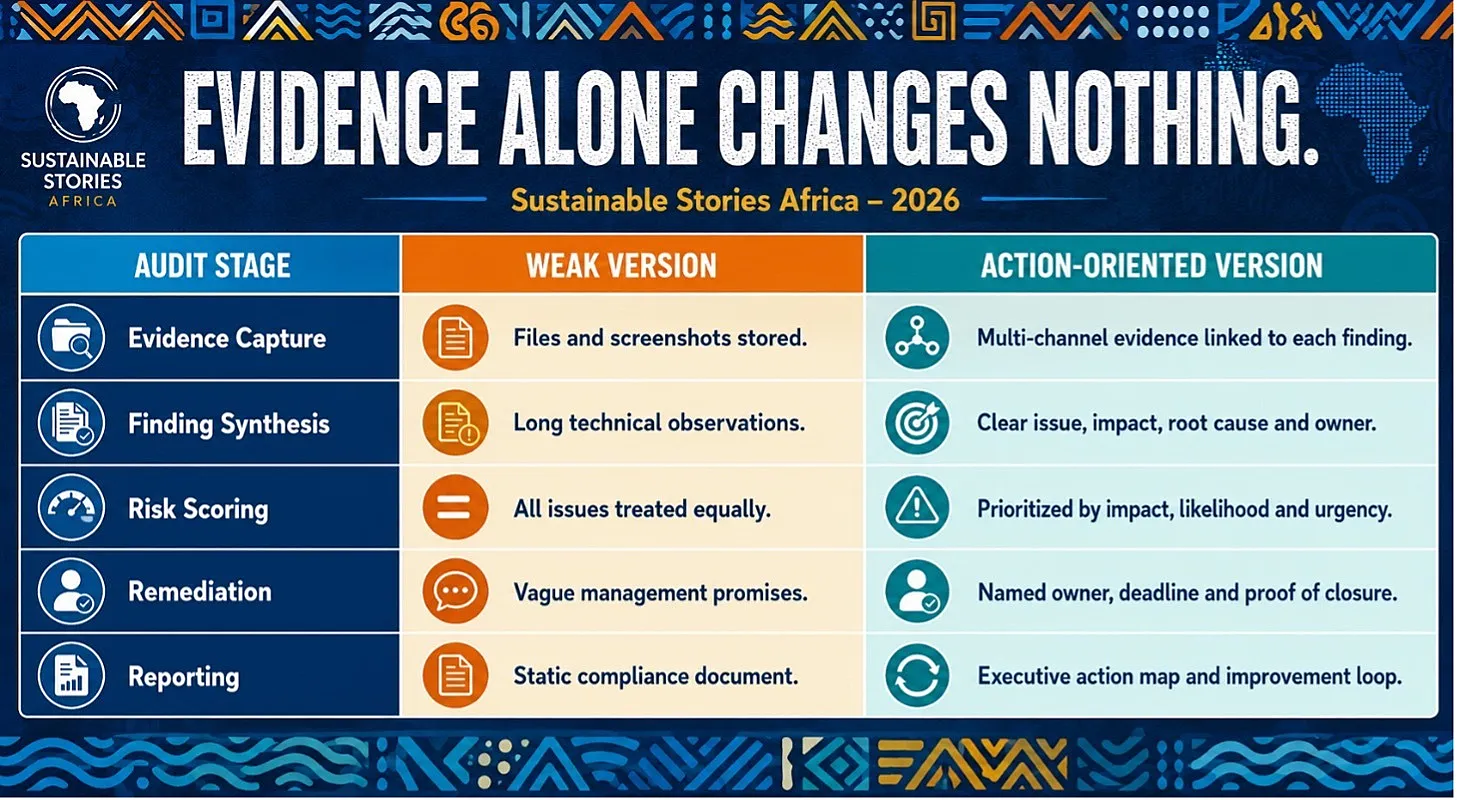
Not every finding deserves equal urgency. Risk rating and scoring filter issues by impact, probability and exposure, producing a prioritised list of issues that helps executives allocate scarce resources where failure would hurt most.
What Better Reporting Unlocks
When audit reports translate risk into plain-language action, the payoff is tangible: clearer board decisions, faster reduction of losses, stronger controls and more durable public trust.
FinPolNomics frames this as a virtuous cycle in which accountability drives performance rather than simply satisfying a compliance checklist.
For African institutions specifically, the upside is proportionally larger. Control weaknesses left unaddressed tend to surface publicly, whether through service failures at utilities, financial losses at banks, or funding scrutiny at NGOs, precisely because informal accountability structures often absorb problems until they become visible crises. Closing that gap early protects both institutional reputation and the communities and markets that depend on these organisations.
The reverse is equally instructive. Delay turns manageable control gaps into public failures, eroding investor and depositor confidence at a moment when African markets are competing hard for capital and credibility.
Action: Owners, Deadlines, and Proof
FinPolNomics is explicit about what leaders must demand. Audit committees should insist on clear owners, firm deadlines, defensible risk ratings and documented evidence of closure for every finding, not just a narrative summary.
This shifts the audit function from a periodic compliance exercise into a continuous management tool.
The framework's proposed structure closes the loop through ranked actionable insights, remediation deadlines, scheduling and executive summaries that feed directly back into governance systems. In practice, that means:
- Risk registers updated directly from audit findings, not as a separate exercise
- Board dashboards reflecting real-time remediation status rather than annual snapshots
- Process controls and training plans redesigned around identified root causes
- Prioritised issues list reviewed on a fixed schedule, not left to the next audit cycle
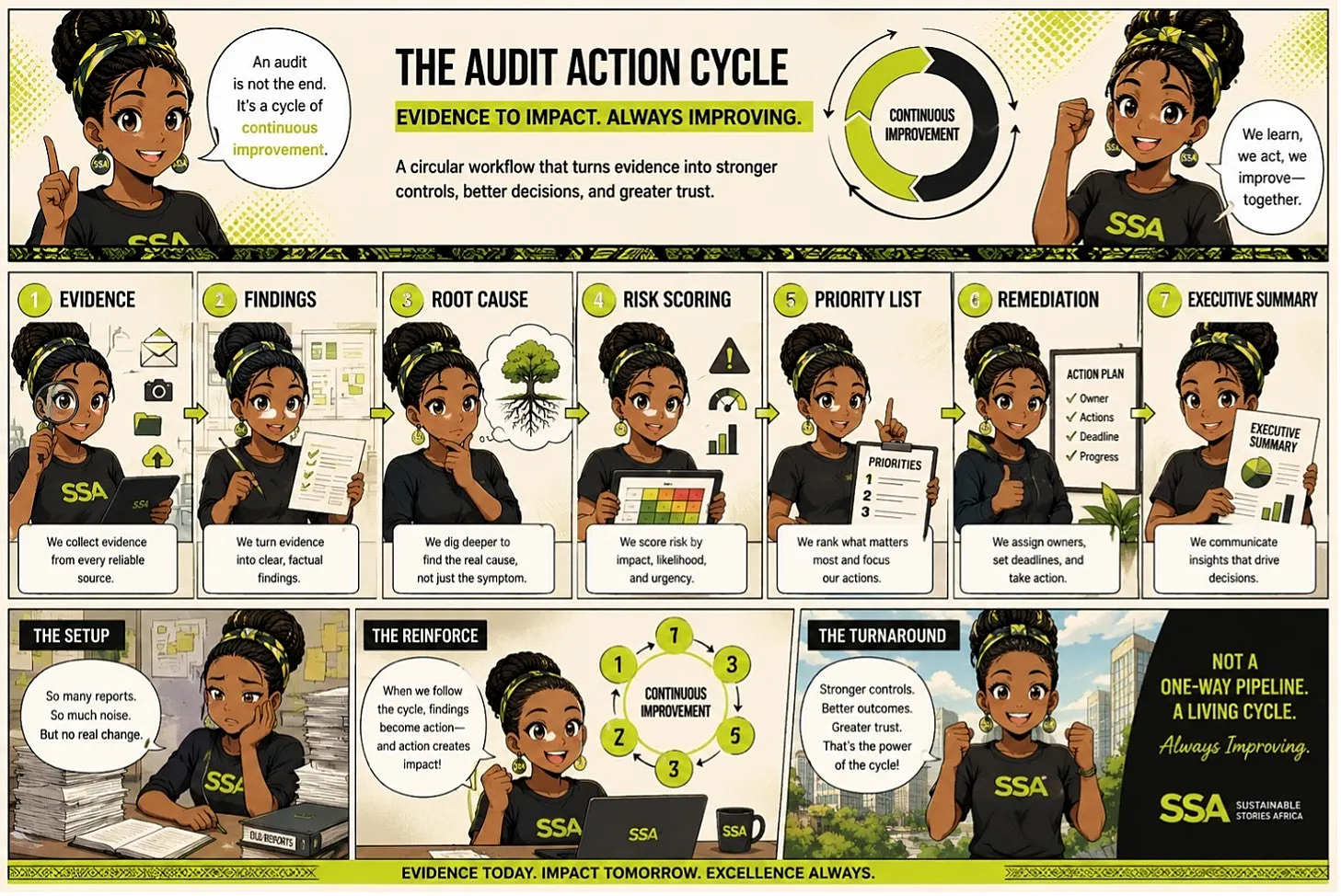
Path Forward – From Findings To Follow-Through
The next step is disciplined follow-through, not another audit cycle. FinPolNomics argues that great audit reports do not merely inform management; they transform controls, accountability and trust across an institution.
For African banks, energy firms, NGOs and expanding private businesses, that means audit committees treating every report as a live action map, with named owners and deadlines, rather than a filed document.
The measure of success shifts from "was the audit done" to "did the organisation actually change".