Forests regulate rainfall. Nitrogen shapes global food systems. Air pollution suppresses productivity.
From green water to green jobs, the World Bank’s latest analysis argues that environmental degradation is no longer an ecological issue alone — it is a macroeconomic risk embedded in growth models worldwide.
Nature’s Economics – Repricing Growth and Risk
Economic growth has long been measured by volume of capital, labour and productivity.
However, pages 35–124 of Reboot Development: The Economics of a Livable Planet argue that the missing variable is natural capital; the land, air and water systems that quietly determine prosperity.
From forests that generate rainfall to nitrogen that sustains yields and sometimes destroys them, the report reframes environmental degradation as a structural economic liability.
The message is direct: development policy must shift from managing environmental symptoms to redesigning economic systems within ecological limits.
Green Water, Hidden Growth Engine
Forests as Macroeconomic Infrastructure
Chapter 2 introduces the concept of “green water”, the moisture recycled by forests that fuels rainfall systems.
Key findings include:
- Forest loss dries soils and reduces crop yields.
- Global losses linked to forest-related water decline cost $379 billion annually, equivalent to about 8% of global agricultural GDP.
- Natural forests reduce GDP growth losses from droughts by more than half compared to plantation forests (Figure MM.3; Chapter 2).
- Deforestation-induced rainfall loss in the Amazon costs approximately $14 billion annually in lost economic growth.
Nearly half of global rainfall originates from vegetation-driven moisture recycling.
Forests are not passive carbon sinks. They are atmospheric regulators underpinning food systems and urban water security.
Biodiversity and Productivity
Chapter 3 extends the economic logic to biodiversity.
Species abundance is not ornamental; it affects:
- Agricultural productivity
- Ecosystem resilience
- Fisheries yields
- Household incomes
Biodiversity loss reduces ecological resilience, increasing vulnerability to shocks. Ocean plastic density and species mapping exercises illustrate the fragility of the ecosystem.
The economic implication: resilience is a productivity asset.
Nitrogen’s $3.4 Trillion Imbalance
Chapter 4 reframes nitrogen fertiliser, once hailed as the engine of agricultural abundance, as a case of diminishing returns.
Key findings:
- Nitrogen fertiliser has more than doubled global crop yields historically.
- However, half of global food production now occurs in regions where excessive nitrogen reduces yields.
- Nitrogen pollution costs up to $3.4 trillion annually, through water contamination, air pollution and biodiversity damage.
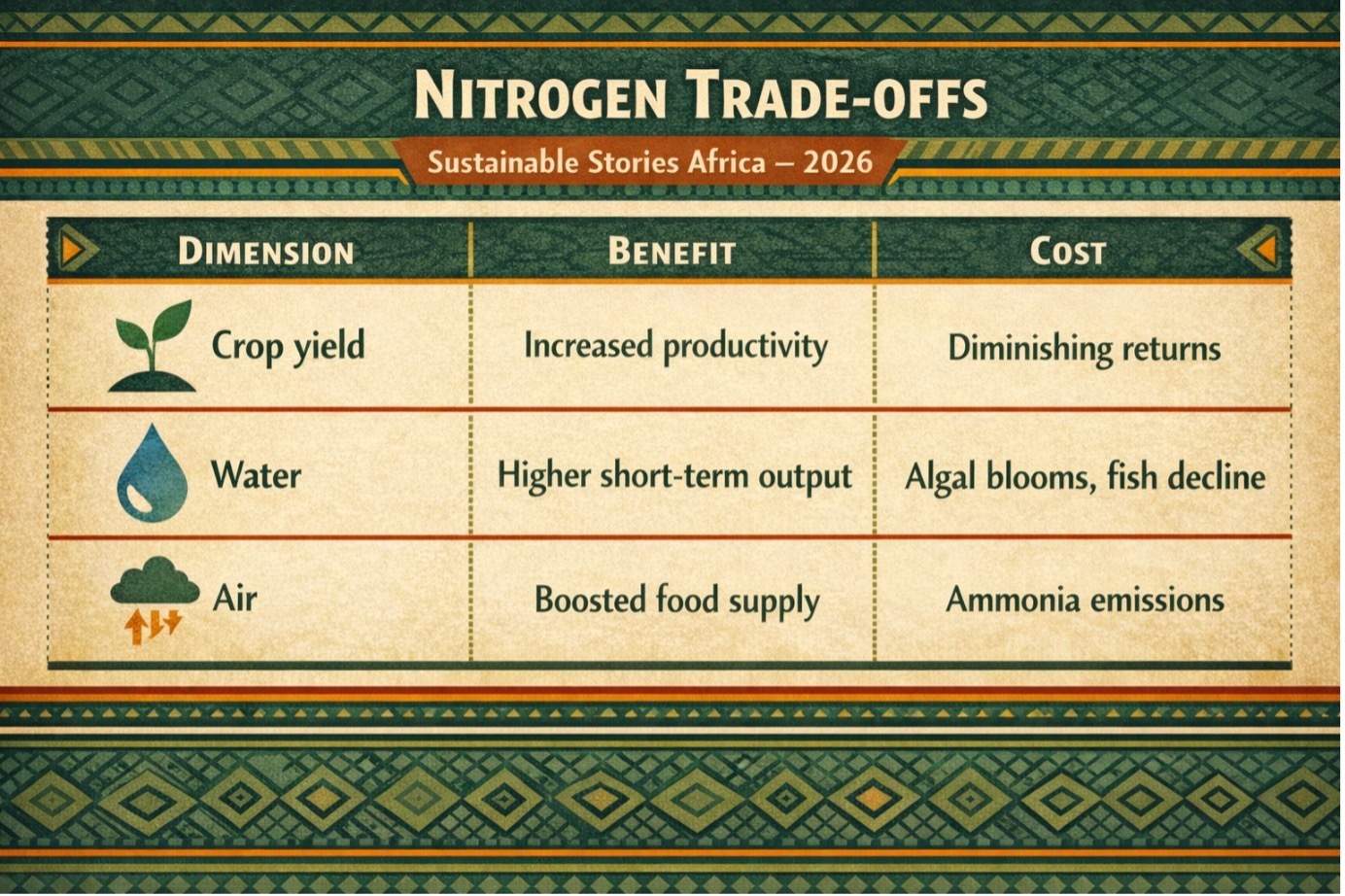
Nitrogen Trade-offs
Dimension | Benefit | Cost |
|---|---|---|
Crop yield | Increased productivity | Diminishing returns |
Water | Higher short-term output | Algal blooms, fish decline |
Air | Boosted food supply | Ammonia emissions |
Optimised fertiliser disbursement, such as site-specific fertiliser recommendations, increases profitability while reducing runoff.
Efficiency must be recalibrated, not abandoned.
Clearing the Air
Chapter 5 highlights air pollution as a systemic economic risk.
- Outdoor air pollution kills at least 5.7 million people annually.
- Pollution reduces cognitive function, productivity and GDP growth.
- PM2.5 trends show decoupling is possible, especially in China, where stringent enforcement and monitoring bent the pollution curve downward while growth continued.
Policy instruments matter:
- Command-and-control regulations
- Market-based instruments (e.g., Gujarat’s PM2.5 market pilot)
- Clean energy incentives
The lesson: environmental policy can drive efficiency without sacrificing growth.
PATH FORWARD – Design Systems, Not Siloed Fixes
Environmental reform must adopt a systems approach: inform with data, enable cross-sector alignment, and evaluate continuously.
Natural capital accounting, policy integration and institutional reform are prerequisites for durable progress.
Growth that ignores ecological feedback loops is self-defeating. Rebooting development requires embedding land, air and water stewardship at the core of macroeconomic design.