Solar and wind are expanding rapidly, but grids cannot rely only on the weather.
A new analysis from the Clean Air Task Force argues that clean firm electricity, technologies capable of delivering power on demand without carbon emissions, will determine whether net-zero targets are credible.
For Africa and other emerging markets, the debate is no longer renewable versus fossil. It is variable versus firm, and how to finance both.
Beyond Intermittency: The Firm Power Question
Global electricity systems are transforming. Variable renewable energy (VRE)—primarily solar and wind has achieved dramatic cost declines and record deployment levels.
However, as its penetration rises, system operators confront a structural constraint: intermittency.
When the sun sets or wind speeds drop, the supply fluctuates. Without firm capacity, power that can be dispatched reliably at any time, grids risk instability.
The Clean Air Task Force (CATF) report reframes the energy transition debate. The challenge is not only adding renewables; it is ensuring clean firm electricity that supports industrial demand, urban growth, and electrification of transport and heating.
For Africa, where electricity deficits remain severe, the question is particularly acute. How can expanding grids leapfrog carbon lock-in while guaranteeing reliability?
Reliability Underpins Economic Stability
Electricity reliability is foundational to economic growth. Manufacturing plants, hospitals, data centres, and transport systems require a continuous supply.
Across many African markets:
- Grid reliability remains uneven.
- Backup diesel generation raises costs.
- Peak demand often exceeds supply.
Variable renewables, though increasingly affordable, cannot alone guarantee stability without storage, transmission expansion, or firm clean capacity.
Firm clean electricity technologies aim to fill that gap.
What Qualifies as a Clean Firm
CATF categorises clean firm technologies as those capable of delivering low- or zero-carbon electricity on demand.
Technology Category | Characteristics | Deployment Challenges |
|---|---|---|
Advanced nuclear | High-capacity factor, low emissions | High capital costs, regulatory complexity |
Fossil with carbon capture | Dispatchable, lower emissions | CCS infrastructure scale-up |
Geothermal | Steady baseload supply | Resource-location constraints |
Long-duration storage | Grid balancing | Technology maturity, cost |
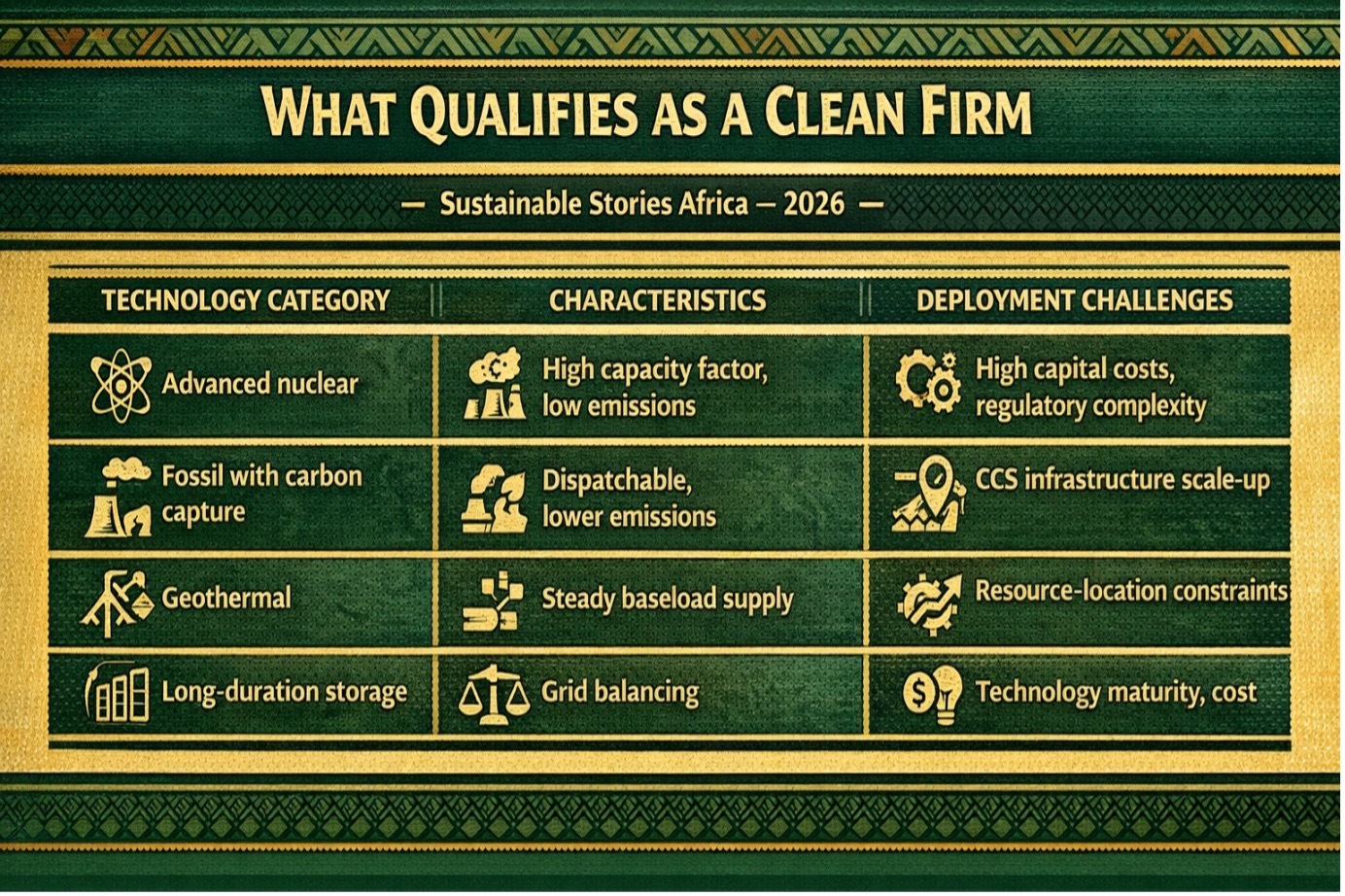
Each pathway presents trade-offs between cost, scalability, and regulatory readiness.
The report cautions against the assumption that renewables plus short-duration batteries will suffice for deep decarbonisation. Long-duration storage, carbon capture systems, and next-generation nuclear may be necessary complements.
For developing economies, the sequencing question emerges again: should governments prioritise immediate renewable deployment, invest early in firm clean technologies, or pursue hybrid strategies?
Cost Declines, Financing Gaps
Solar PV and wind costs have declined significantly over the past decade. However, long-duration storage and advanced nuclear remain capital-intensive.
System modelling suggests that as renewable penetration surpasses certain thresholds, marginal integration costs rise.
Curtailment increases. Storage needs expand. Grid reinforcement becomes necessary.
In high-growth regions such as Sub-Saharan Africa, electricity demand is projected to expand sharply over the coming decades.
Industrialisation, urbanisation, and digital infrastructure will intensify baseload requirements.
Without clean firm options, countries may revert to unabated fossil fuels to secure reliability.
Integrate Firm Capacity Into Planning
The CATF analysis proposes pragmatic integration:
- Diversify Technology Portfolios – Avoid overreliance on single solutions.
- Invest in Demonstration Projects – Accelerate cost reductions for emerging firm technologies.
- Align Policy Signals – Carbon pricing, tax incentives, and procurement standards can reduce investment risk.
- Strengthen Grid Infrastructure – Transmission interconnections reduce variability pressures.
For African policymakers, energy planning must synchronise electrification targets with reliability guarantees. Industrial policy and power system design cannot operate independently.
Development finance institutions also play a pivotal role.
Concessional capital and risk-sharing mechanisms can crowd in private investment into early-stage clean firm projects.
Path Forward – Balanced Portfolios Deliver Reliable Decarbonisation
Deep decarbonisation requires more than the deployment of rapid renewable energy. Clean firm electricity must anchor reliable, scalable power systems capable of sustaining industrial growth.
By integrating advanced technologies, grid modernisation, and strategic financing, governments can avoid carbon lock-in while ensuring economic competitiveness. Reliability and sustainability must advance together.